

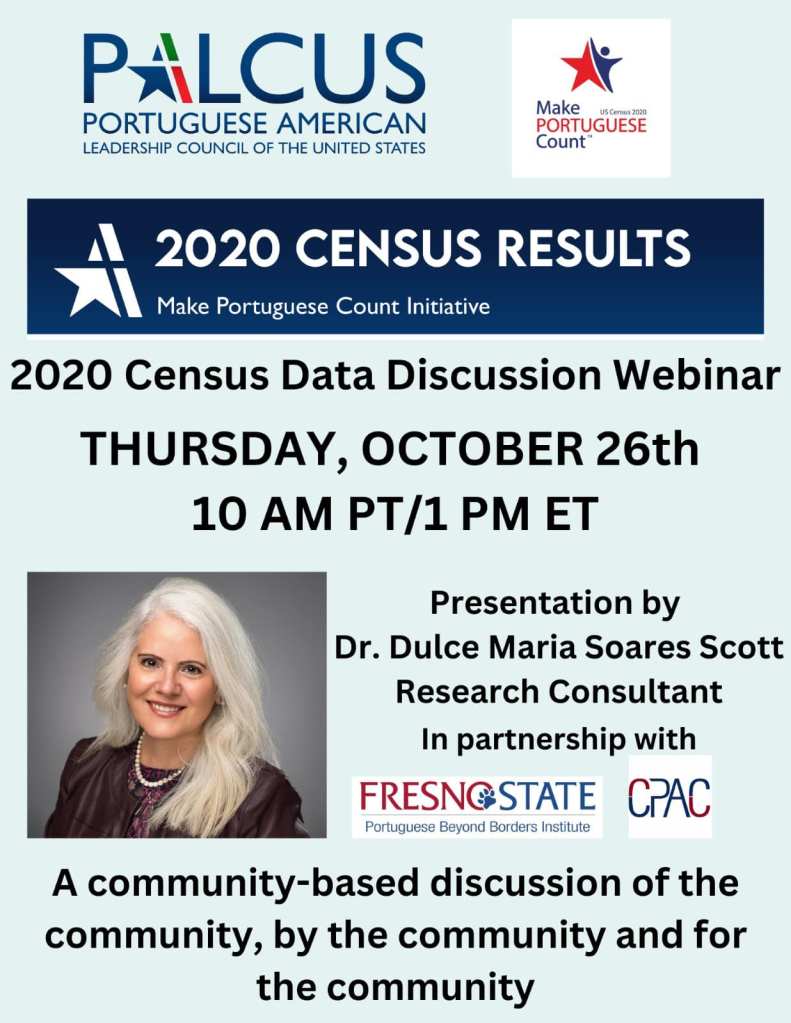
The Portuguese-American Leadership Council of the United States (PACLUS) is hosting an online session this coming Thursday, October 26th, to decipher the most recent official numbers the US Census Bureau put forth on the Portuguese-American presence in the United States. This Webinar is co-hosted by the Portuguese Beyond Borders Institute (PBBI) from Fresno State and the California Portuguese-American Colation (CPAC). The presentation (please see flyer below) will be done by Dr. Dulce Maria Soares Scott, a well-known and respected scholar from Anderson University in Indiana. The session is free of charge and everyone is invited to attend.
The following is from a Palcus Press Release from September 30th.
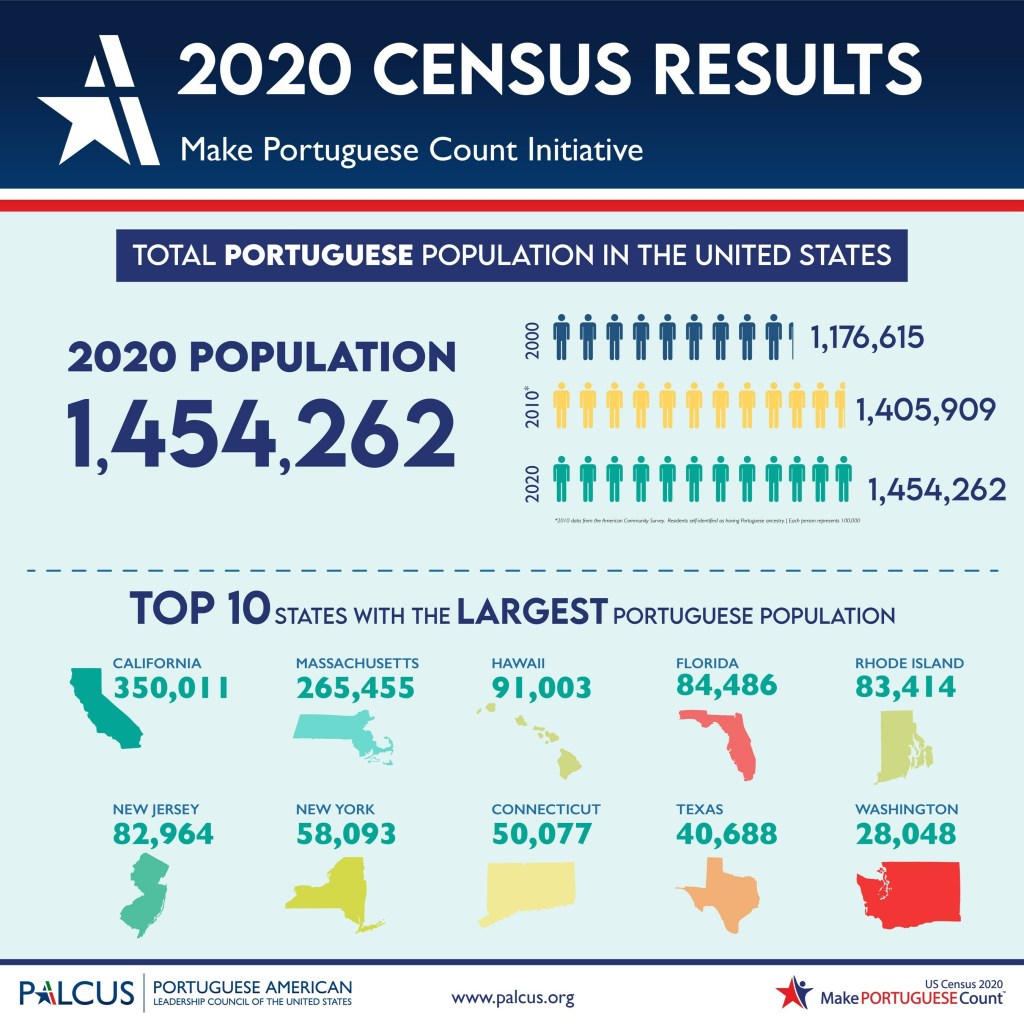
WASHINGTON, Sept. 21, 2023 /PRNewswire/ — PALCUS, the Portuguese-American Leadership Council of the United States, the singular national organization representing and serving the national Portuguese community, today announces that the data from the 2020 US Decennial Census shows an increase in the population of Americans who claim Portuguese ancestry with a total population of 1,454,262. Compared with the previous decennial census in 2000 and the American Community Survey in 2010, the total from the 2020 Census shows an increase of Portuguese-Americans over the past 30 years. (see figure 1).
The 2020 Census was the first time that Portuguese was assigned an identification code, along with two sub-identification codes for Azorean and Madeiran. PALCUS has been working with the Census Bureau for the past 15 years to ensure that the 2020 Census would be the first time the Portuguese community experienced a true count, and launched a national two-year campaign entitled Make Portuguese Count. All previous population data, including data from the American Community Survey, were estimates based on algorithms designed to project the population counts based on sampling and in all likelihood resulted in undercounts.
“During the 2020 Census, there was a unique opportunity for our community to finally prove that there is strength in numbers,” said PALCUS Chair, Katherine Soares. “We are thrilled that not only do these numbers show that our community is growing, but also that the Portuguese population in the United States is no longer just an estimate or approximation. We now have official numbers that tell us how many we are and where we are. The increase in the Portuguese population revealed in the 2020 Census Data demonstrates that our nation-wide campaign, Make Portuguese Count, led by former PALCUS Director Marie Fraley was effective in informing the Portuguese-American community about the importance of self-identifying as Portuguese. We thank Marie, and the dozens of MPC captains who worked across the country for over two years to really get the word out that we are Portuguese and we count.”
The Make Portuguese Count campaign aimed to ensure that as many Portuguese-Americans as possible knew why the Census is vital to our community, how to answer Question #7: Race/Origin on the 2020 questionnaire, and encourage Portuguese Americans to complete the Census. On the proposed question, respondents first check the race with which they identify and, under that selection, write in “Portuguese” in the space provided to be counted as Portuguese. Thirteen years ago, in the 2010 American Community Survey, 1,405,909 million residents self-identified as having Portuguese ancestry; however, PALCUS and other research experts speculate that number may have underestimated the Portuguese-American population. The data for 2010 was based on a survey rather than a total count of the people, and the Census Bureau (before Census 2020) used a different methodology to collect data on ancestral origin.

Why is it Important to Have an Accurate Count of Portuguese Americans?
When PALCUS can show educators, legislators, and the business community the strength of Portuguese-Americans in their areas, a stronger case can be made to ensure that the Portuguese-American voice is heard and their concerns and interests are addressed. In addition, the census numbers determine funding and resources such as:
- Funding for schools, public safety, roads, highways, and bridges in the communities where Portuguese live is determined by population.
- Based on U.S. Census data, businesses decide where to set up their headquarters and outlets.
- Congressional districts are determined by population.
- As Portuguese specifically, our strength is in our numbers in local, state, and federal elections. Elected officials respond to the fact that Portuguese-American citizens are numerous in their districts and vote at a higher level by approximately 20% more than the national average (Scott, PALCUS Index National Survey, 2017).
- By writing in “Portuguese” in the Race/Origin question, we can be counted by census tract, city/town, county, state, and national totals.
“The number of Portuguese Americans who indicated that they had Portuguese origins far exceeds the number provided by data collected by the Census Bureau using probability sampling techniques,” said Dr. Dulce Maria Soares Scott, PALCUS Research Fellow, Professor at Indiana University and the leading research expert on Portuguese-American data. “We are looking forward to analyzing the data at smaller geographical levels, including county, Congressional district, school district, and census tract levels. A more granular analysis of the data within these smaller geographies will provide our community with a much more concrete picture of exactly where Portuguese Americans reside as well as a better understanding of our socioeconomic and political power in different areas of the United States.”
The 2020 Census Detailed Demographic and Housing Characteristics File A (Detailed DHC-A) provides population counts and sex-by-age statistics for approximately 1,500 detailed race and ethnic groups and detailed American Indian and Alaska Native (AIAN) tribes and villages.
Some of the biggest changes in our Portuguese population include:
- California continues to be the state with the largest Portuguese population, with 350,011 Portuguese
- North Dakota is the state with the fewest number of Portuguese, with 703
- Hawaii went from being the 8th state with the most Portuguese to the 3rd
- Rhode Island, Massachusetts, Alaska, Arkansas, Kansas, Kentucky, Louisiana, Maine, Mississippi and Missouri all saw a decline in the number of Portuguese (when 2020 Census data is compared to ACS 2012-2016 5-year estimate data).
For Hawaii, this data may be a result of the different data collection methodology used in Census 2020, which permitted people to indicate a larger number of ancestral origins.
 Novidades - The Islands and the Diaspora