

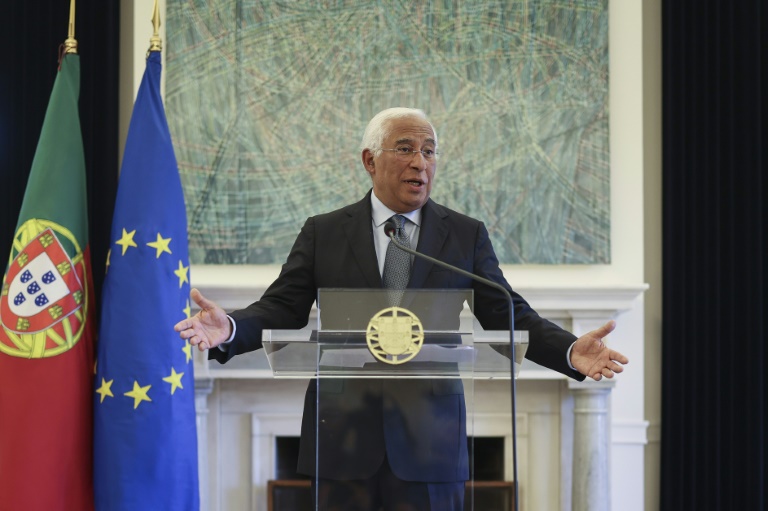
Although not a story from the islands, the resignation of Portugal’s prime minister affects the entire country.
After accepting Prime Minister António Costa’s resignation yesterday, the President of the Republic, Marcelo Rebelo de Sousa, called the parliamentary parties together today and scheduled a meeting of the Council of State for tomorrow, Thursday. Only then will he speak to the nation and announce his decision. All political analysts in Portugal say there will be a special election, more than likely in February or March of 2024, and an interim government of the currently ruling party, the PS will govern the country.
A note from the Presidency of the Republic states that Marcelo Rebelo de Sousa acted “under article 145, paragraph a) and paragraph e), second part” of the Constitution. These rules state that the Council of State is responsible for “pronouncing on the dissolution of the Assembly of the Republic” and “advising the President of the Republic in the exercise of his functions.” The President of the Republic had already announced that António Costa’s departure would lead to the dissolution of parliament, ruling out the formation of another executive with the same majority.
The Prime Minister’s resignation follows the announcement by the Public Prosecutor’s Office that the Supreme Court of Justice is investigating his lithium and hydrogen projects autonomously. Speaking to the country, António Costa said he was leaving with his “head held high” and his “conscience clear.”
He justified his resignation by claiming that “the dignity of the functions of Prime Minister is not compatible with any suspicion about his integrity, his good conduct and, even less, with the suspicion of the commission of any criminal act.”
SEARCHES
Yesterday morning, searches were carried out in government offices, including the official residence of São Bento, targeting the Prime Minister’s chief of staff, Vítor Escária, who was detained for questioning.
António Costa resigned after almost eight years in office as prime minister. He was sworn in on November 26, 2015, by the then President of the Republic, Cavaco Silva.
In recent times, António Costa’s government has been plagued by cases – the Prime Minister called them “cases and little cases” – with possible judicial implications.
Despite many opinions to the contrary, the Prime Minister has always rejected resignations in such cases. He didn’t use the same yardstick for himself, citing the Prime Minister’s special status.
This is an adaptation of a story in Diário Insular newspaper-José Lourenço, director.
Translated to English as a community outreach program from the Portuguese Beyond Borders Institute (PBBI) and the Modern and Classical Languages and Cultures Department (MCLL) as part of Bruma Publication and ADMA (Azores-Diaspora Media Alliance) at California State University, Fresno.
Here is António Costa’s statement….
 Novidades - The Islands and the Diaspora