

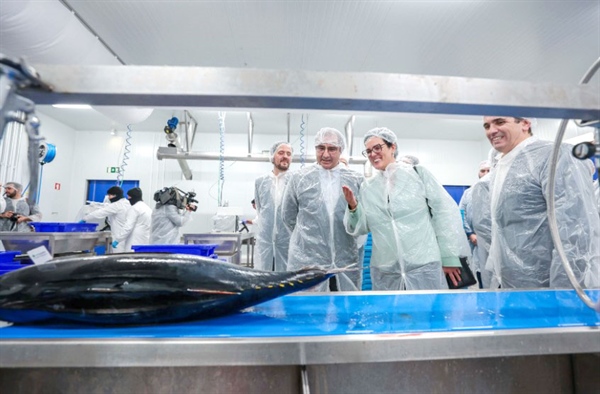
The President of the Government of the Azores, José Manuel Bolieiro, has said that the region’s economy will depend on a “continuous commitment” to the ability to produce food, warning of the risks of external dependence.
“We and the whole world experienced the risk of total dependence on externalities during the pandemic. I believe that our economy and the development of the Azores also depends on our continued commitment to the production capacity of goods that can be traded for human food, both in the agri-food and maritime-food sectors,” he said.
Bolieiro was speaking at the inauguration of the Azores Manufacturing Center (CFA), an investment by the Bensaude Group, in Ponta Delgada.
The regional government leader defended the need to promote the region’s food autonomy.
“In the balance of trade, it’s important to have this shipping capacity that helps create wealth in the Azores,” he stressed.
He added: “I strongly believe in the value of our economy and our production, packaging and distribution capacity. I also believe in sophistication, in verifying food safety and organic quality.”
Bolieiro defended the need for a “fair price at each stage” of the value chain to ensure the “redistribution of income”.
“I would like to point out another observation that I want to be the essence of the message: the added value that I want to introduce into our strategic public policies for developing the value chain, from production to distribution,” he said.
According to the Bensaude Group’s website, CFA – Centros de Fabrico dos Açores “defines itself as a meat, bakery, pastry and fish processing industry present” in the Azores.
4 million to renovate the Ponta Delgada Conservatory
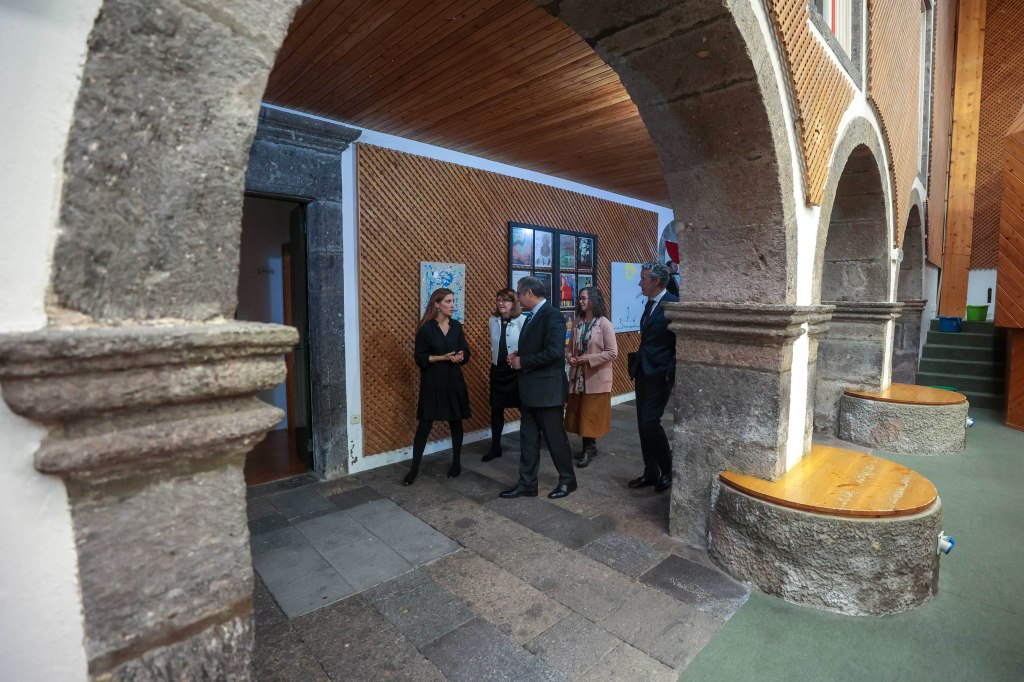
The Government of the Azores will invest more than four million euros in refurbishing the Ponta Delgada Conservatory, making it possible to rehabilitate the old Graça Church and expand the current facilities, announced the leader of the regional executive.
“We are carrying out a project that qualifies the installed capacity: the conservatory building, the old Igreja da Graça, guaranteeing an investment that, in the end, will certainly be more than four million euros and that will be carried out within a year,” declared José Manuel Bolieiro.
The Regional Government President spoke to journalists after the project presentation to restore the Ponta Delgada Regional Conservatory building.
José Manuel Bolieiro guaranteed that the work “will give the conservatory the capacities it deserves”, but warned about the state of the current buildings.
“We have problems with leaks. We don’t have the best acoustic potential, nor even a good demonstration space. All of this will now be part of a project of enormous quality that will have to count on the critical participation of the Conservatoire itself if we are to have something of excellence,” he stressed.
The regional leader also argued that refurbishing the Ponta Delgada Regional Conservatory goes against the “myth that there is no investment in São Miguel.”
With an execution time of 360 days, the intervention will promote the conservation and expansion of the Conservatory’s current facilities” and requalify the old Graça Church, according to the Regional Government.
The old Graça Church has been owned by the Ponta Delgada Conservatory since 2021 (it was previously given to the Academy of Arts). With the renovation, it will have four more teaching rooms, dressing rooms, and sanitary facilities. The ceiling will be given an “anti-xylophage” treatment.
The Luís de Camões auditorium, located in the Conservatory building, will also be modernized with the “introduction of air conditioning and the upgrading of the electrical network,” as well as changes to the stage, lectern, and audience. The Ponta Delgada Conservatory currently has around 602 students who receive specialized training in different musical instruments at various levels of education.
in Diário dos Açores, Osvaldo Cabral-director
Translated to English as a community outreach program from the Portuguese Beyond Borders Institute (PBBI) and the Modern and Classical Languages and Cultures Department (MCLL) as part of Bruma Publication and ADMA (Azores-Diaspora Media Alliance) at California State University, Fresno.
 Novidades - The Islands and the Diaspora