

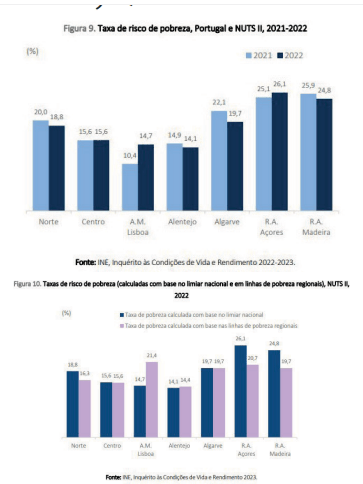
The Azores is the poorest region in Portugal. In 2022, considering the national
threshold, the risk of poverty increased in Área Metropolitana de Lisboa (up 4.3 p.p.) and in Região Autónoma dos Açores (up 1.0 ) to 26.1% and continues to be the poorest region in the country.
The at-risk-of-poverty rate remained at 15.6% in the Centro region and fell in the other regions. Despite the reduction in the Autonomous Region of Madeira, the two Autonomous Regions still have the highest at-risk-of-poverty rates in the country.
In each NUTS II region, the regional corresponds to the proportion of inhabitants who live on equivalent disposable monetary incomes of less than 60% of the median of the distribution of equivalent disposable monetary incomes in that same region.
The use of regional poverty lines results in an increase in the risk of poverty for regions with higher than the national median income (21.4% in the Lisbon Metropolitan Area and 14.4% in the Alentejo) and a reduction in the risk of poverty for others (very significant, for example, in the Autonomous Region of Madeira of Autonomous Region of Madeira, from 24.8%, based on the national line, to 19.7%, and in the Autonomous Region of the Azores, from 26.2%.

The at-risk-of-poverty rate increased in Portugal to 17% in 2022. This is the percentage of the population
living below the poverty line last, i.e., on less than 591 euros per month, according to data released yesterday by the National Statistics Institute (INE). That’s 1.78 million people, 81 thousand more than the previous year.
In 2021, there were 1.69 million people in poverty, when the rate was 16.4%. At that time, the data reflected
a recovery from the increase seen during the pandemic.
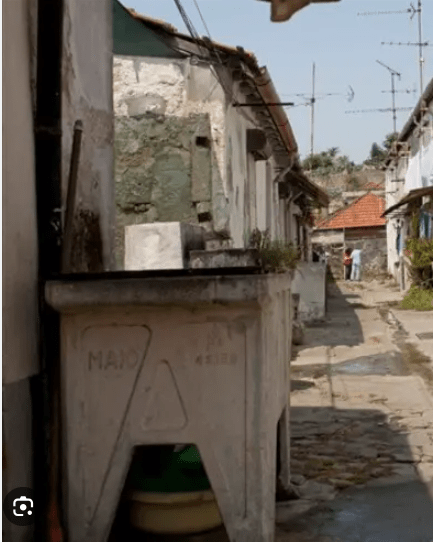
However, in 2022, a year marked by rising prices and the housing crisis, the reality worsened. The INE indicators now released also show that this increase in poverty in 2022 covered all age groups, “although more children and young people under 18.
It increased more among women(from 16.8% in 2021 to 17.7% in 2022) than among men (from 15.9% in 2021 to 16.2% in 2022). As for the characterization of the poor population by level of education, it can be concluded that more than a fifth (22.7%) of the Portuguese population with only elementary education live in poverty. This percentage is much higher than those with secondary education (13.5%) and higher education (5.8%). There are no significant differences regarding workers: 10% of people working in 2022 were poor (10.3% in 2021). Also noteworthy is an increase in income distribution inequality last year, “mainly comparing the 10% of the population with resources and the 10% of the population with fewer resources”.
in Correio dos Açores, Osvaldo Cabral-director (second picture from Diário Insular)
Translated to English as a community outreach program from the Portuguese Beyond Borders Institute (PBBI) and the Modern and Classical Languages and Cultures Department (MCLL) as part of Bruma Publication and ADMA (Azores-Diaspora Media Alliance) at California State University, Fresno.

 Novidades - The Islands and the Diaspora