

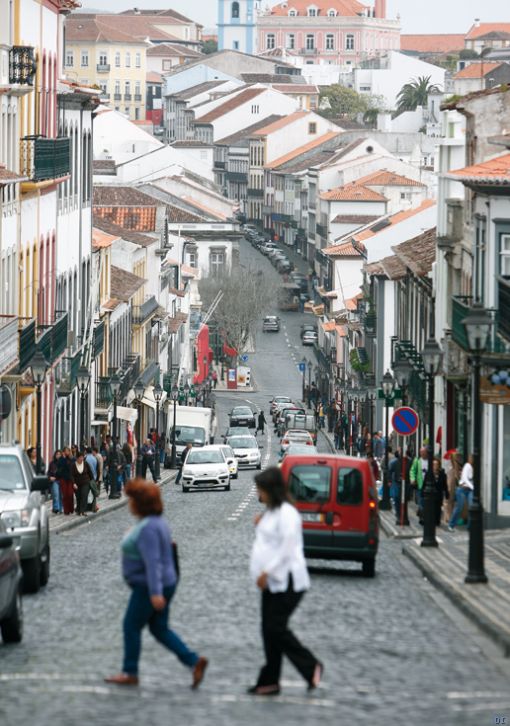
UMAR (Union of Alternative and Responsive Women) monitors an average of 40 to 45 new cases of domestic violence on Terceira every year. Raquel Costa, a psychologist at the Terceira branch of the Association for Equality and Women’s Rights, says that considering the island’s population, the number is exceptionally high.
“We get a lot of new people, not to mention repeat offenders,” says the psychologist, who points out that UMAR monitors around 100 people yearly in Terceira. The psychologist stresses that it is difficult to draw a general picture of domestic violence on the island. “There are a lot of black numbers, which are those people who don’t complain,” she says.
The psychologist stresses that domestic violence is a transversal problem in society. “We work with all types of people, from children to the elderly, and we do some awareness-raising activities for specific audiences, through some partnerships. Often, the idea is that domestic violence is a problem of a lower socio-economic stratum, or of households that have problems with drugs or alcohol. That’s not true,” she says.
However, the difference in the visibility of cases often lies in financial capacity. “Someone who can’t afford to hire a lawyer or to get a home on their own has to turn to the system. You end up knowing more because you work in a network. You go to the police, social security… Another person with economic power can hire a lawyer, move into a house independently, and only reach our institutions when they are more or less organized. Because they’ve left home or the situation continues, the other person can’t accept the breakup,” she explains.
“The subtlety of violence is increasing,” says the psychologist
It’s a cross-cutting problem that is becoming increasingly subtle. Enhanced by digital channels, violence can be less physical and more psychological. “The subtlety of violence is increasing. Then there’s the issue of technologies and digital channels, which are increasingly active. This is linked, for example, to dating violence,” he says.
“We’re noticing that there are more and more cases that aren’t physical violence and never involved physical violence, but which are quite complicated in terms of psychological, verbal, economic, sexual and stalking violence,” adds Raquel Costa.
Victims and associations are still faced with the “difficulty of proving this type of violence to the Public Prosecutor’s Office.”
Then, the psychologist points out, “We are still in a somewhat patriarchal society, which excuses certain behaviors.”
Women do it, too. “Many women come to our office and don’t identify themselves as victims because ‘he never hit me.’ He takes her money every month, demands that she have sex, makes her feel isolated, but there’s that detail that he never hit her,” she says.
UMAR’s work, therefore, involves raising awareness of the different types of violence. “It’s not because a person hasn’t been physically assaulted that they’re not being assaulted in some other way,” the psychologist reminds us.
The International Day for the Elimination of Violence Against Women was marked on November 25. Domestic violence is a public crime. In the Azores, reports increased by 3.5% between 2021 and 2022.
in Diário Insular – José Lourenço, director
Translated to English as a community outreach program from the Portuguese Beyond Borders Institute (PBBI) and the Modern and Classical Languages and Cultures Department (MCLL) as part of Bruma Publication and ADMA (Azores-Diaspora Media Alliance) at California State University, Fresno
 Novidades - The Islands and the Diaspora