

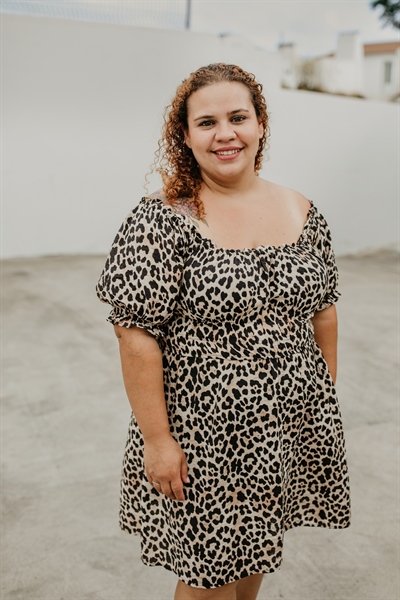
The daughter of emigrants to Canada decides to return to her roots in search of a different quality of life and to develop her handicraft project.
“In the past, our parents left here to improve their lives in Canada. Now it’s different. Many people are leaving to come here,” says Jéssica Gonçalo, 34, born in Canada to parents from Ribeira Quente. Like the people she mentions, she decided to leave Canada last year to come and live with her husband and children in São Miguel, specifically in her family’s parish..
“I’ve always come here, every year or every two years. I had my grandparents here. When I brought my husband, who is from the mainland, he fell in love with São Miguel. He said that one day we were going to move to São Miguel. At the time I said it would be something we would do when we were older, when we were retired. He always talked about us moving here,” says Jessica Gonçalo, who brought the handicraft project she started in Canada to the Azores.
The move came sooner than they thought, and in August last year, they moved to São Miguel because the situation wasn’t easy on the other side of the Atlantic either: “A lot of things changed for a lot of people during Covid. At this time, we were thinking about what we wanted for our lives. Our children weren’t very happy at school, and things were getting expensive. We had to sell our house because it only had two bedrooms and we needed a bigger house. We decided to give it a try, and if we didn’t like it, we’d come back.”

The family discovered this was what they sought, and the children’s adaptation was surprisingly positive. Going back is only in the plans to miss those who stayed in Canada, says Jessica: “Since we arrived, my children have started school, and they’ve really enjoyed it. They’re very happy. So far, it’s gone well for us. Everything is moving in the direction we wanted. We bought a house here. My children don’t want to return to Canada, just to visit family. We left everyone behind: my parents, sisters, sisters-in-law, nephews. Our children miss the people, but they don’t miss not living there. We had to think about the quality of life we wanted to have. To be happy or to be rich? I know the standard of living is very different here, but life is much better.
In the Azores, the family can live slower and spend more time with each other, explains Jessica: “It’s quieter here. People aren’t in such a hurry. I got stressed out last year when I returned to Canada for two weeks. We drove so long. Not everyone is nice there, but everyone greets each other here. Here, there’s a community, and there wasn’t that. We needed that quiet. And we needed more time with our children. We work long hours there, and when we get home, there’s only time to eat and go to bed. Here we’re more like a family, together, and even my children have noticed the difference, that they spend more time with their parents.” On the other hand, the Canadian says the economic situation is no more favorable than here: “Things are expensive here, but they’re much more expensive there. People think life is much better there. Some ask why we left, but they don’t think things aren’t like that.”
In São Miguel, people value handicrafts more than in Canada.

Jessica worked as a receptionist in a pediatrician’s office in Canada for 16 years. During the pandemic, she learned and developed a taste for handicrafts as a hobby and to relax; she says: “I started doing it because it was something to distract me and relax. I started slowly, learning independently, watching YouTube videos of how it was done, and trying new things and techniques. During Covid, we were at home, and I thought about what I could do to occupy myself. I started slowly. I wanted to keep doing it.” This is how the “Jessica Verde” brand came about, which made its first appearance in the Azores at the Handicraft Fair held in Ponta Delgada from December 7 to 12.
Most of the items Jessica makes are earrings in various shapes and colors. “Most of them are earrings. Sometimes I like to make other things, like paintings, Christmas tree pieces, and kitchen utensils. It all depends. All the earrings are different. I never make the same pair and don’t repeat styles.” The material of choice is polymer clay.
According to her experience, “in São Miguel people value handicrafts more. In Canada they don’t want to spend money on it because they think they can do it at home. But they don’t think about the time it takes to make it and they don’t value the work it takes. You have to spend time choosing the color, getting the material, gluing, painting. Sometimes people don’t think about this process.”

Her first participation in the Craft Fair was very good: “I really enjoyed it. I didn’t have high expectations, but the people were very pleasant. It seemed like everyone was a family. I really liked the atmosphere. I want to continue taking part.” The event also allowed other local artisans to meet Jessica and exchange contacts. The Canadian says that although there were some quiet days at the fair, on Sunday, when a cruise ship was docked at the marina, “many people were visiting the fair. That day was very good for everyone. A lot of people stopped and asked questions about how I did my job.”
For now, “Jessica Verde’s” products can be ordered via her Facebook and Instagram pages, but the artisan is considering opening her own website to make ordering easier, she reveals. For now, the aim is to continue with the project and enjoy the family time life in Canada didn’t allow.
Mariana Rovoredo, journalist for Correio dos Açores newspaper-Natalino Viveiros, director
Translated to English as a community outreach program from the Portuguese Beyond Borders Institute (PBBI) and the Modern and Classical Languages and Cultures Department (MCLL) as part of Bruma Publication and ADMA (Azores-Diaspora Media Alliance) at California State University, Fresno
 Novidades - The Islands and the Diaspora