

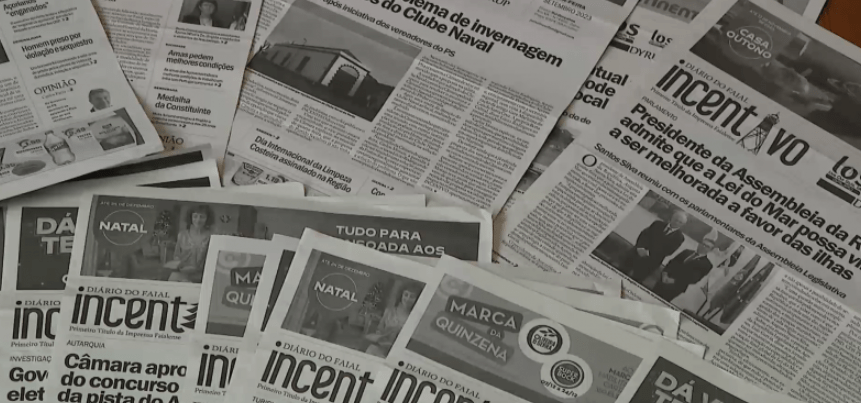
Due to economic difficulties, Incentivo, the only daily newspaper on the island of Faial, is no longer being published on paper. Its director, Rui Gonçalves, who has been in charge of the paper for 20 years, believes that this is a suspension of the print edition but hopes to reissue it. In the meantime, Incentivo is being published online, with a reduction in costs that has led to the dismissal of one journalist, and now there are only two journalists on staff.
How did Incentivo arrive at this situation?
Rui Gonçalves (Director of Incentivo newspaper) – This trend has continued for some time. There are fewer and fewer subscribers. And why are they fewer and fewer? Young people don’t sign the paper or the link. So older people are disappearing or becoming unable to read, and the number of subscribers is falling. On the other hand, there’s practically no advertising. Our market is very small, and finding advertisers here is difficult. All this combined led us to make this painful decision. We couldn’t maintain the newspaper’s cost since we had no printing house. It was printed by an outside printer, and the newspaper’s cost was impossible to maintain without income. So this was the solution we found. We already had a website, but it was static, just the news from the newspaper, and now the model we’re going to use is a dynamic website with updated news that we’ll post throughout the day. We hope this update will motivate some interest and that people will join in because they have to subscribe to the newspaper online to access information.
The other problem that I think is important to mention is that of state support. The Regional Government was in office for three years and did not decide on any new support. Everything remained as it was, and, on the other hand, we only have one municipality. We tried to make the town council aware of the problem because the government wouldn’t do anything, and we needed some immediate help. In fact, as with previous councils, we had a service exchange agreement whereby the municipality advertised, we invoiced, and they paid. This council was not sensitive to that. And we were practically left, as they say, without water at the helm. We decided to stop now so that the problem wouldn’t grow so as not to create problems with commitments we couldn’t meet. The summary is more or less this.
Did the region’s daily newspapers ever take a group position with the government?
Yes, the newspapers did so some time ago, even with the previous government. We proposed to the government to find a support solution, but this never materialized. Salary support was announced, but it didn’t have time to materialize. We never received any encouragement from the government. There was no contact from the government, no openness or interest in finding out what we needed. This is the situation.

How many journalists did the Incentive have?
It had three. Now we’ve cut one and kept two. We used to do everything. So we no longer need three because paying three journalists was already unaffordable. And, unfortunately, that’s the way it had to be.
How much did it cost to print the newspaper every month?
Printing the newspaper was over 2,000 euros a month for a print run of 500 copies. We had a problem of scale. The smaller the print run, the higher the unit price. This weighed heavily on us; we couldn’t maintain the paper edition without revenue.
Do you fear for the Azorean press?
Yes, I certainly do. The problem, as we know, is widespread. Of course, there may be newspapers that have a better chance because they are in a larger market. Ours here is very small, and I don’t see how this can be resolved for now or even the foreseeable future. A lot has been lost with the internet. The identification that people had with each place. This is a small place. People used to identify very strongly with their newspapers.
With the internet, people have moved on to their cell phones, leaving the paper behind, and they’ve lost a bit of that connection, that sense of belonging they had with the newspaper, with their newspaper, the newspaper of their island. This has also been lost a lot, making it difficult for everyone. A paper newspaper has its own identity; I think it’s unique and singular. The website, then, is the same as all the others. Everything is much more generalized, much less individualized.
Do you believe that the Incentive will return to paper?
I think it’s very difficult in the current circumstances. Unless, to go back to the beginning of the conversation, if the state, the political authorities, both regional and municipal, were concerned about somehow compensating for the lack of advertising and subscribers, in which case it might be possible to consider it again.
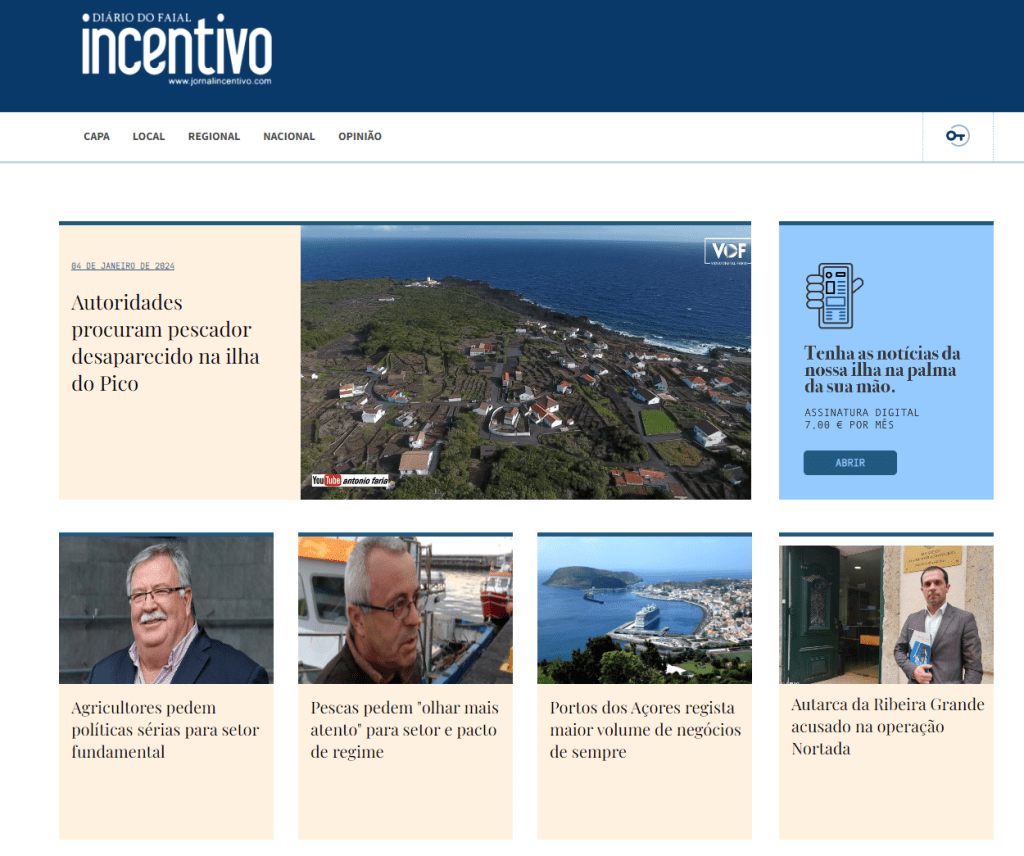
Incentivo has a history…
Incentivo was born in 2004. It was born after the closure of the Telégrafo and later the Correio da Horta, which were the two dailies we had here. Incentivo lasted about 20 years.
Who founded Incentivo?
There were four journalists. It was me (Rui Gonçalves), Fernando Lemos, Ricardo Freitas and Souto Gonçalves, who is my brother. The company was ‘Escrever e Editar, Lda.
Did you change directors over 20 years?
No, it was always the same. It was always me (chuckles). There was an evolution here when Incentivo appeared, and in the early days, and Telegrafo and Correio da Horta had ceased to exist, Incentivo had some strength. We had a color cover and several journalists, and we did a job that was quite satisfactory for the community at the time. Over time, the difficulties got worse, for the reasons I’ve already explained, we lost journalists, we had to reduce the number of pages, we even took the color off the cover, always to reduce costs. But now, it was no longer possible. It was down to the last drop…
It really was (chuckles). You can no longer wait for news if it comes along very well; if not…Hope is the last to die.
That’s true, and I’ve experienced it.
João Paz, Journalist–Correio dos Açores-Natalino Viveiros, director
Translated to English as a community outreach program from the Portuguese Beyond Borders Institute (PBBI) and the Modern and Classical Languages and Cultures Department (MCLL) as part of Bruma Publication and ADMA (Azores-Diaspora Media Alliance) at California State University, Fresno–PBBI thanks the sponsorship of the Luso-American Development Foundation from Lisbon, Portugal (FLAD).

 Novidades - The Islands and the Diaspora