

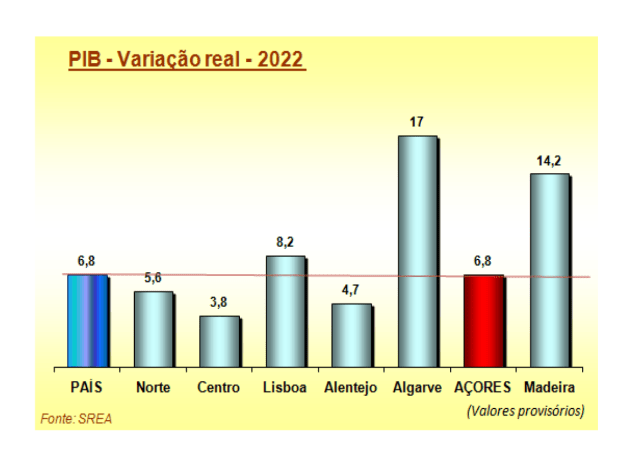
Figures recently released by the INE show that GDP in 2022 grew by 6.8% in the Azores, the same as the national figures in Portugal.
The Algarve is the region with the highest growth (17.0%), followed by the Autonomous Region of Madeira (14.2%) and the Lisbon Metropolitan Area (8.2%), all of which performed above the country’s average.
The North (5.6%), the Alentejo (4.7%), and the Center (3.8%) showed more moderate growth. It should be noted that, to a large extent, the regions that performed more modestly in 2022 had been less affected by the pandemic in the previous two years. Conversely, the regions with the strongest growth in 2022 had experienced the strongest contractions in the years of the pandemic.
The Gross Value-Added figures for all sectors are not yet known. Still, there are indications that tourism will have made a significant contribution in 2022, given that the regions with the most traffic were those with the best GDP performance, namely the Algarve, Madeira, and Lisbon.
The Azores have a lower figure, probably affected by other sectors of activity. From the figures, financial activities, insurance, and construction have grown in the region, while agriculture and real estate have fallen slightly.
Closer to the EU
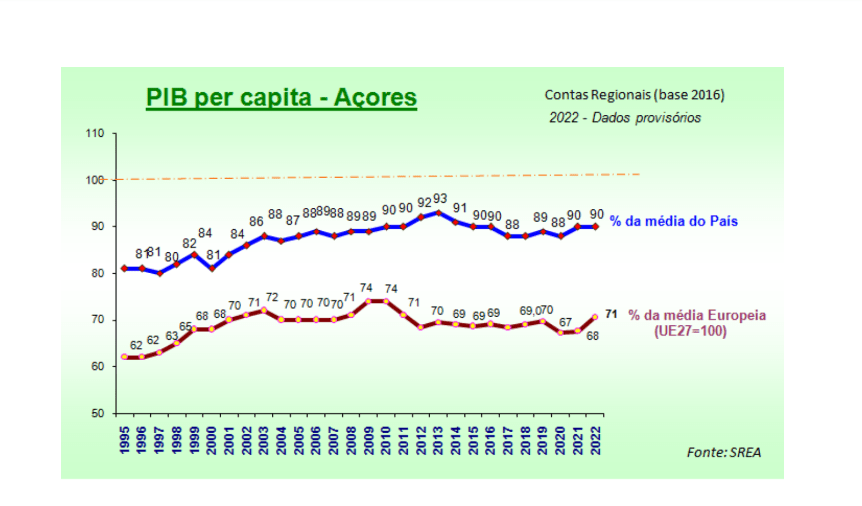
In the figures released by INE, it is worth noting the percentage of GDP per capita about the national average, which since 2021 has stood at 90%, and in particular, the comparison with the European average (EU27), which has risen significantly by 3 percentage points and now stands at 71%, although in previous years it had already reached 74% (see graph).
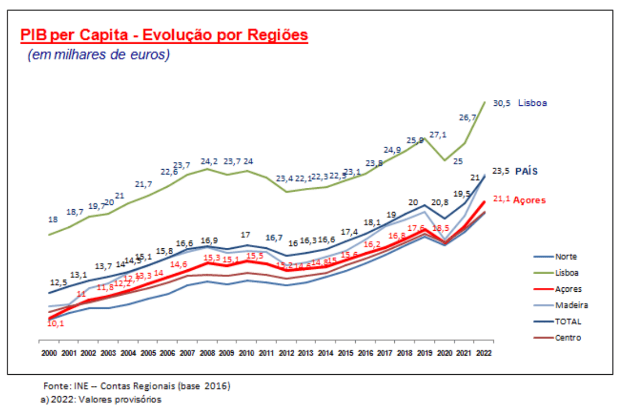
In terms of GDP per capita, the Lisbon region is much higher than the other regions and the national average, followed by the Algarve and Madeira. The Azores are ahead of the North and the Center.
What produces the most wealth in the Azores
As mentioned, the Gross Value Added figures for all sectors for 2022 are not yet known. But if we consider last year’s figures, it’s quite possible that the tourism sector, which had already grown from 4% to 6% from 2020 to 2021, will reach a figure similar to pre-Covid times, close to 8%. Unofficial figures suggest that tourism could reach 10%.
Looking at the figures, one comes to the conclusion that the civil service is still the sector that contributes most to economic growth, with figures of around 13%, followed by health at 11% and education at 8%.
If we consider civil servants as a whole, the Gross Value Added is close to 32%, i.e., around a third of the region’s wealth comes from the public sector.

Rafael Cota is a journalist who lives on Terceira Island in the Azores.
This piece was published in Portuguese by Diário Insular and Diário dos Açores.
Translated to English as a community outreach program from the Portuguese Beyond Borders Institute (PBBI) and the Modern and Classical Languages and Cultures Department (MCLL) as part of Bruma Publication and ADMA (Azores-Diaspora Media Alliance) at California State University, Fresno–PBBI thanks the sponsorship of the Luso-American Development Foundation from Lisbon, Portugal (FLAD)
 Novidades - The Islands and the Diaspora