

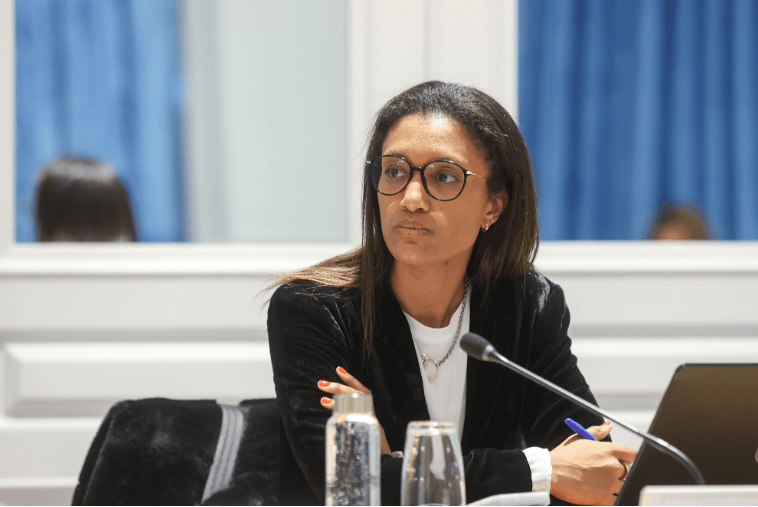
The regional secretary for Health and Sports, Mónica Seidi, said on Tuesday, in a personal statement sent to newsrooms across the Azores, that she had been the target of racist insults that prompted a complaint to the Public Prosecutor’s Office against unknown people.
The issue is, above all, a Facebook post in which the regional secretary is identified, in which comments are made that refer, for example, to “monhés” children.
Mónica Seidi, who has two daughters, defends herself: “These racist insults don’t just affect me, my family, my friends and my collaborators. They affect our entire society and offend all good people because those who write, under the cowardly cloak of anonymity, believe that they will have the support of others on the other side.” She stressed that those who “decide to serve their country through a service in which visibility is inevitable, must prepare themselves for fair public scrutiny,” but that they cannot, “as no good person can, accept that both the public and private aspects are subject to racist attacks.”
“I understand that these attacks are the result of the profound ignorance of their perpetrators and that, as a society, we still have a long way to go in accepting the other,” writes Mónica Seidi.
“Despite this, I cannot consider this to be an issue that can be said to be expected in campaigns or pre-election periods. I can’t consider it natural for these anonymous authors of such degrading publications to appear,” she continues.
The regional secretary stresses that “for every individual who rejoices in such discriminating pleasures, there are a hundred or even a thousand who revolt.”
“It is because of this abuse, imposed on me but also on the community, that I have decided to file a complaint with the Public Prosecutor’s Office against unknown people, so that I can, in some way, be one of the people who, with their heads held high, believe that freedom is a precious asset that should be cherished and respected, and not a means of trying to justify the unjustifiable,” she stresses.
The regional secretary stresses that her work as a government official remains “subject to the opinion of others who, with greater or lesser objectivity, analyze and judge it as they see fit.”
“This is something I accept without fear, because my conscience allows it,” she says.
in Diário Insular
Translated to English as a community outreach program from the Portuguese Beyond Borders Institute (PBBI) and the Modern and Classical Languages and Cultures Department (MCLL) as part of Bruma Publication and ADMA (Azores-Diaspora Media Alliance) at California State University, Fresno–PBBI thanks the sponsorship of the Luso-American Development Foundation from Lisbon, Portugal (FLAD)
 Novidades - The Islands and the Diaspora