

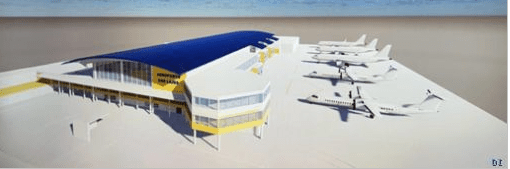
With a capacity for five planes with their noses against the landing doors and another five in the parking lot, the future Lajes terminal in Terceira island, planned in pre-project form, is expected to cost between 35 and 40 million euros – according to documents to which DI (Diário Insular) newspaper has had access.
The project is budgeted at half a million euros, according to DI. However, when questioned by our reporter, the vice-presidency of the Regional Government, which directs the project, refused to give details about the exact cost and dates, citing doubts about the information that can be provided to the media during the current election period.
According to DI, the investment has been flagged up as part of the Cohesion Fund and can be subsidized to 85 percent. The Cohesion Fund is national, although it has an allocation for the Azores, which includes a slice of more than 160 million euros for accessibility on the islands. However, works or other investments in airports managed by ANA cannot be included, which is not the case with Lajes, as it is a military infrastructure.
According to our sources, what is planned complies with the rules for construction in the area in question, particularly concerning volume and non-involvement with the military servitude (aeronautical operation), objectives that are considered essential if there are no obstacles to the work.
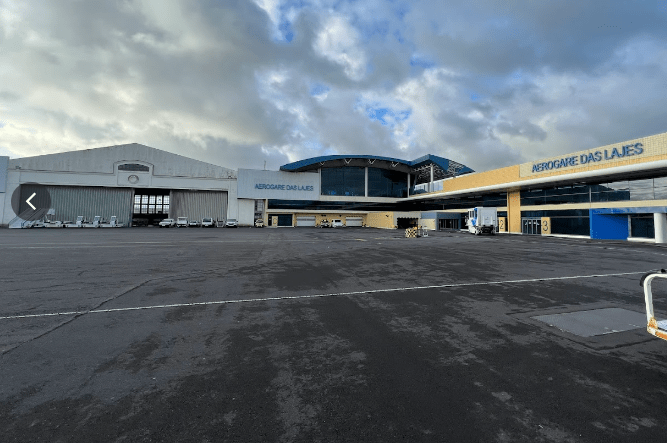
The infrastructure, with three floors, will cover an area of 28,000 square meters, and structures such as the navy hangar that currently serves SATA maintenance will disappear.
Nine boarding gates are planned, and two disembarkation gates will have a direct exit to parking lots.
According to the documents, at least three baggage reclaim belts are planned.
It is also planned to build refueling stations for the planes, which means that the tanker trucks currently used will no longer be necessary.
The growth of the Lajes terminal and the surrounding area, namely the aircraft parking area, is a long-standing demand and has been voiced especially by entities involved in the tourism business.
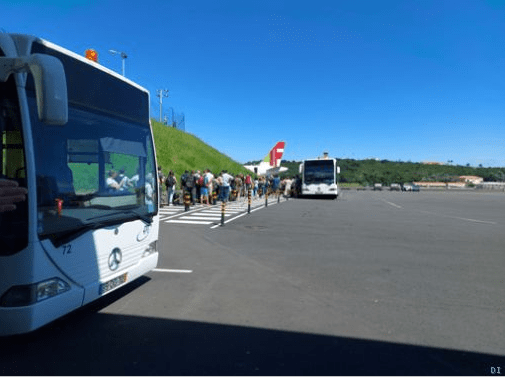
The current terminal is limited, and the aircraft parking area is tiny and doesn’t allow people to park with their noses in the boarding area.
On busy days – when there may be two medium-sized planes simultaneously, for example – the terminal does not provide a fluid response to the embarkation-disembarkation movement, causing significant congestion, which has already been the subject of complaints to various governmental bodies and the media.
in Diário Insular, José Lourenço-director
Translated to English as a community outreach program from the Portuguese Beyond Borders Institute (PBBI) and the Modern and Classical Languages and Cultures Department (MCLL) as part of Bruma Publication and ADMA (Azores-Diaspora Media Alliance) at California State University, Fresno–PBBI thanks the sponsorship of the Luso-American Development Foundation from Lisbon, Portugal (FLAD)
 Novidades - The Islands and the Diaspora