

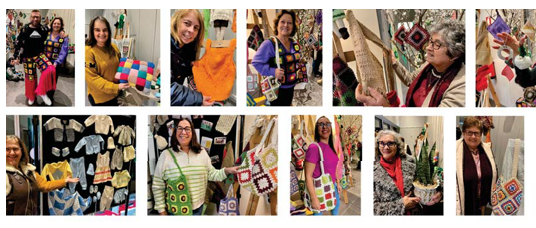
For the Miratec Arts Association, January is the “most bare” month ever: “For the first time, the festival program will be without artists present. MiratecArts is celebrating 10 years of the Montanha Pico Festival with 10 film screenings in the three municipalities of Pico Island, but without any accompaniment, lectures, conferences, or other parallel events on the seventh art, because, for the first time, there will be no invitations for artists to participate live. All because of financial difficulties.
In the 2023 balance sheet, the Association “reflected on one of the most difficult years since its foundation in terms of financial management. Not because the Association had a smaller budget, but because of the 55% cut in investment by the Regional Government of the Azores in Mi- ratecArts’ projects, as well as the delay in regional payments, as had never happened before. This brings us to the first most talked about issue of the year,” Terry Costa said.
Moreover, he says this is “the worst regional government administration ever, which has affected more than 80 MiratecArts collaborating families, who have seen their participation for the year canceled.” In his opinion, this is “the regional government’s abandonment of the cultural sector, which will affect programming and production during 2024, while the Association is forced to pay interest on funds advanced by the financial banking system and by volunteers so that 2023 is not canceled in its entirety.”
This January, all the programming has been and will be on the big screens of the Lajes do Pico Municipal Auditorium, the Madalena Auditorium, and the São Roque do Pico School Auditorium. The association “refuses to stop, even when it finds it difficult to continue. That’s why the “Knitting Project – MiratecArts Knitting Project” is a community program promoted by the MiratecArts association on the island of Pico.
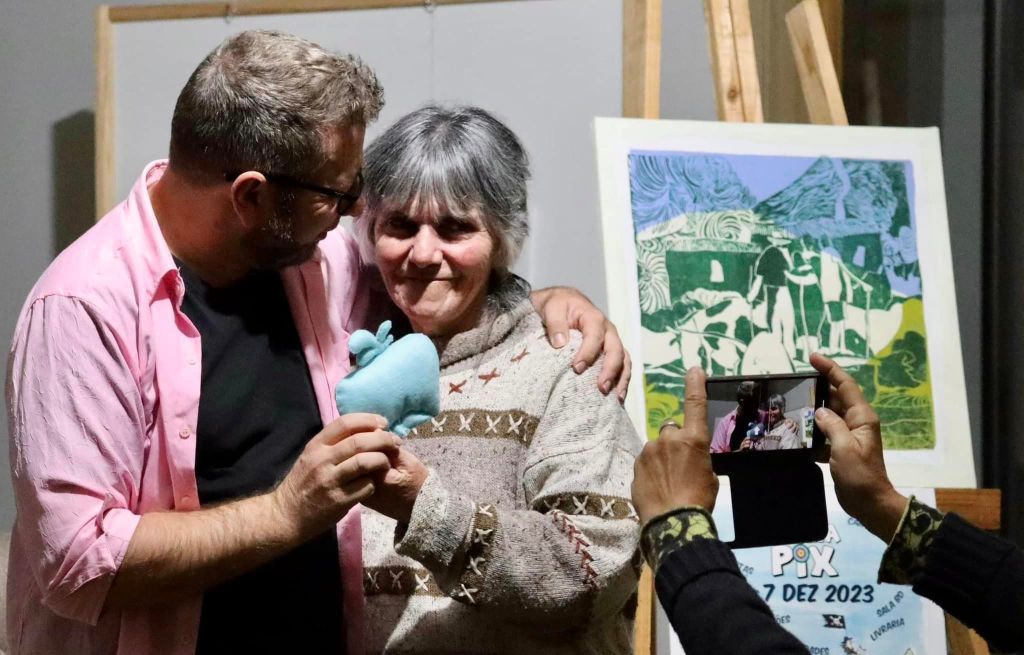
The year 2024 kicked off with the opening of the exhibition of works at the Madalena Auditorium Library, marking the tenth year of these meetings. “Encouraging people to get out of the house, get together to share their knowledge, learn new stitches and ideas, or just spend a few hours socializing with others who have the same interests around the art of knitting is the main aim of this project,” says Terry Costa. “It all started with some ladies from the island talking to me who wanted to participate but didn’t consider themselves artists. MiratecArts is for everyone,” admits the cultural association’s artistic director. “Everyone has art in them; sometimes they just need help to develop it. And that’s when the Knitting Project was born with women, some of whom have strengthened the cause since day one.” In the exhibition marking 10 years of the Knitting Project, as well as community work involving more than 50 participants, you can see individual works by Gina Neves, Maria Ildeberta, Conceição Vargas, Edite Cunha, Evalina Serpa, Fátima Patrício, Leonilda Vargas, Lola Dinis, Marisa Santos, Teresa Silveira, Angela Valeroso, Sandra and Fátima Medeiros. A new work by Andreia Sousa is also on display in Madalena do Pico. It’s an installation. It’s a sculpture made from various materials. It can be used for literary presentations. There are two giant books representing the mountain island’s past, through the most international title by a writer from Pico, Dias de Melo, “Pedras Negras,” and the representation of the new generation of large illustrated books, also from the island of Pico, with Néveda.
Andreia Sousa has already had a history on the mountain island since she began working with the MiratecArts association in 2018. The new work will be on display at the Madalena Auditory Library until January 26 as part of an exhibition that includes Néveda Ent’s books and works from the MiratecArts Knitting Project. MiratecArts has more than 700 members and collaborators on the nine islands of the Azores. The cultural association, run by a board of volunteers, has already welcomed more than 2,600 artists to its headquarters, MiratecArts Galeria Costa, says the association.
Neliz Câmara, Journalist–in Atlântico Expresso, Natalino Viveiros, director
Translated to English as a community outreach program from the Portuguese Beyond Borders Institute (PBBI) and the Modern and Classical Languages and Cultures Department (MCLL) as part of Bruma Publication and ADMA (Azores-Diaspora Media Alliance) at California State University, Fresno–PBBI thanks the sponsorship of the Luso-American Development Foundation from Lisbon, Portugal (FLAD)
 Novidades - The Islands and the Diaspora