


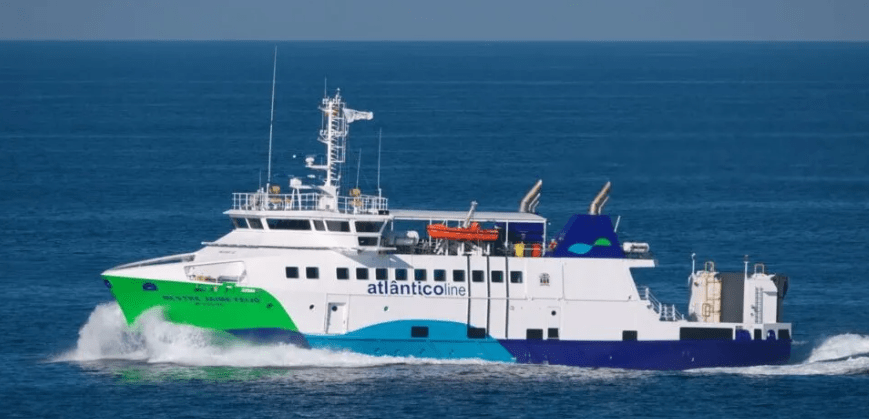
Atlânticoline (Azorean company for naval transportation) clarified yesterday, “All the questions that have come to light following the announcement of the launch of the public contract for the construction of two electric ships for Atlânticoline’s operation in the Islands of the Triangle (S. Jorge, Pico and Faial. “
As such, the company believes it is appropriate to clarify the following about the tender’s deadlines and procedures:
“Atlânticoline submitted all the necessary documents on the electronic public procurement platform acinGov on January 15th. However, the public availability of the tender requires its introduction in the Diário da República (Official Gazette) and the Jornal Oficial da Região Autónoma dos Açores (Official Gazette of the Autonomous Region of the Azores). This process was only completed yesterday. The base price is 25 million euros for the two ships, and bids can be submitted until February 21, 2024. The winner should be announced by April 25th”.
Ships for 250 passengers and 9 vehicles
Regarding the capacity of the ships, Atlânticoline says: “The transport capacity of the ships is not a closed issue at this point. It will depend on the bids submitted, and there are certainly minimum limits for them to be eligible.
Each ship must have a capacity of at least 250 passengers and 9 vehicles. Both ships will be equipped with infirmaries”.
Regarding the choice of electric ships, Atlânticloline explains: “It is the conviction of Atlânticoline’s Board of Directors that the company has a responsibility in the environmental area that cannot be limited to compliance with existing legislation in this area. Decarbonization is an inevitable and necessary step.
PRR (European Funds) supports 100% of the investment
Added to this need is the opportunity brought by the PRR, which will support 100% of the investment through the Repower EU program, aimed only at non-polluting energies. This is a unique and unavoidable opportunity. This does not mean, however, that Atlânticoline has not prepared for this tender in the best possible way. The choice of monohull vessels guarantees the same levels of operability as the current ferries. In fact, the tender specifications were drawn up based on the current vessels, so the new vessels will be very similar to the current ones, which have already proved their suitability for the operation.
A speed of 16 knots instead of the current 14
The ships will be 36.5 meters long and have a service speed of 16 knots, whereas the current ferries have a speed of 14 knots. These ships are designed to serve the Horta/Madalena Canal and the Velas/São Roque Canal, and their autonomy guarantees that this will happen with the necessary efficiency.
3 charging stations in the Triangle
There will be three charging stations in the Triangle, in the ports of Horta, São Roque, and Velas. In the case of the Velas/São Roque route, a round trip is guaranteed, with the ship still having enough energy to return to Pico, which will allow it to remain operational in case of a problem with the São Jorge charging station. In the case of the Horta/Madalena route, the ship can make 2 round trips before charging.
Also, concerning the Velas/São Roque Canal, the planned autonomy guarantees the option, when necessary, of the alternative port of Madalena. The possibility of trips to Horta/Velas or Velas/Horta is also guaranteed if repositioning is necessary. It should be noted that the autonomy referred to includes not only the energy consumed during voyages but also the energy needed for operation in port during stopovers. It is based on sailing at a service speed of 16 knots.

Renewable and clean
Since the beginning of this project, Atlânticoline has worked closely with Portos dos Açores and EDA to guarantee all the conditions for loading. The Azores have always sought to be pioneers in renewable energies and were, for example, the first European region to have a hydroelectric power station. An investment plan is currently underway to ensure that 30 to 40% of the energy produced in Faial comes from renewable sources.”
One of the current ships will be directed to other routes.
Regarding the allocation of Atlânticoline’s fleet to other routes, the statement from the company concludes: “With the arrival of these ships, scheduled for 2026, Atlânticoline’s fleet will be reinforced, which could allow one of the current ferries to be directed to other routes. However, it is important to stress that Atlânticoline prioritizes the routes with regular operations (Corvo/Flores and Triângulo). For Atlânticoline, public service is more than a contractual relationship with the region.
It is a philosophy that guides the company’s day-to-day activity. With this in mind, Atlânticoline works constantly to guarantee a regular connection on routes without alternatives, and mobility is essential for providing health care and a dynamic economic fabric. With this in mind, no changes to the operation will compromise the offer made available on existing regular routes.
Atlânticoline considers the public discussion on this issue to be healthy and important. Introducing electric ships in the region represents a major evolutionary leap, comparable to those experienced with the arrival of the “cruise ships” in the 1980s, which are now at the end of their useful life, or the current ferries, around 10 years ago. The use of clean energy in maritime transport is still somewhat uncharted territory, meaning this leap must be made with particular sensitivity and care. Atlânticoline’s Board of Directors knows its enormous responsibility in this process. It guarantees that it works correctly to ensure this unavoidable opportunity is realized with sure steps”.
in Diário dos Açores – Osvaldo Cabral, director
Translated to English as a community outreach program from the Portuguese Beyond Borders Institute (PBBI) and the Modern and Classical Languages and Cultures Department (MCLL) as part of Bruma Publication and ADMA (Azores-Diaspora Media Alliance) at California State University, Fresno–PBBI thanks the sponsorship of the Luso-American Development Foundation from Lisbon, Portugal (FLAD)

 Novidades - The Islands and the Diaspora