


Third Segment: As our readers know, the Autonomous Region of the Azores will have an early parliamentary election on Sunday, February 4th. Through NOVIDADES (the islands and the diaspora), we continue, twice weekly, with the feature, Navigating the Political Tides: Election Updates from the Azores. This is done in collaboration with the Diário Insular newspaper from Terceira Island. So twice a week, until Friday, Feb 2nd, NOVIDADES will feature a synopsis of their excellent political coverage, with the intent of bringing awareness to the diaspora of all that is happening in the Azores and how the various political forces look at the future of the archipelago. This project is put forth by Bruma Publications, with the Azorean Diaspora Fourm from PBBI-Fresno State in partnership with Diário Insular, José Lourenço-director, and Armando Mendes, PhD, editor-in-chief.
PS wants to fight depopulation in the Azores.
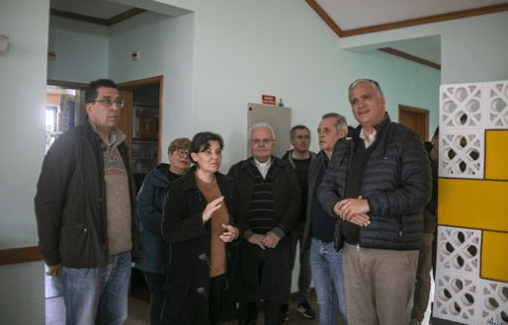
The PS/Azores candidate for President of the Regional Government in the February 4 regional elections, Vasco Cordeiro, stressed this week in Flores that the party’s electoral program presents “concrete measures and responses to combat population loss”.
Speaking after a visit to the “O Girassol” nursery school, Vasco Cordeiro said that the 2021 Census, the most recent study by the National Statistics Institute, “shows that the entire region is facing the demographic challenge,” recalling that “between 2011 and 2021, there was a very serious financial crisis, a series of disturbances, which certainly had an influence on this”.
The PS/Azores president recalled that the “Demographic Challenge as a Condition for Sustainability” is one of the strategic lines of the PS government program, presented last Sunday.
In the document, he recalled, “the PS makes a commitment for the next legislature to invest in the creation of new nurseries”.
Vasco Cordeiro also pointed out that “the PS will make a clear commitment to social policies, above all to providing conditions for young couples, young families, so that they have a support network, be it in the field of childhood, education, health and even support for the elderly so that it becomes more attractive for them to settle on our islands.”
Vasco Cordeiro also guaranteed that a government led by him “will focus on economic policies, to help create job opportunities that allow people to settle, but also on accessibility policies, including digital accessibility.”
Valuing Rorkers and Modernizing Health Care

The BE advocates valuing workers and more investment in modernizing healthcare to meet people’s needs.
At a meeting with the Portuguese Nurses’ Union (SEP), António Lima, coordinator of BE/Açores and candidate for the São Miguel and Compensation constituencies in the regional elections on February 4, pointed out “problems that go back to the time of the PS governments, which the coalition government hasn’t solved and which are accumulating.”
Firstly, he referred to “the process of unfreezing careers, which has generated a debt for nurses in the Azores that is already around 10 million euros and which increases with each passing year”.
“This has to stop. We need a payment plan that is adhered to,” said António Lima.
According to the candidate, “Another problem, which the BE has been warning about, is the need to apply incentives for nurses to stay and work in the Azores.”
“We’ve heard the previous Secretary of Health and the current Regional Secretary of Health talk about incentives for nurses so many times, but they’ve never been implemented,” he said.
António Lima also pointed to job insecurity in the Regional Health Service as another problem that needs to be resolved.
“It’s incomprehensible that a region that has a shortage of nurses, that can’t keep those who graduate and go abroad, has around 100 nurses in hospitals on precarious contracts,” he said.
The Bloc member recalled that “these nurses are under the so-called ‘covid contracts’, which the Bloc has talked about so many times and which even brought a proposal to parliament to integrate these workers into the Regional Health Service (SRS), but which was ultimately rejected by the coalition government parties”.
“The SRS is worse off with this government, because it’s a government that doesn’t want to improve the SRS, that doesn’t want to value its professionals, because it doesn’t give them a future, and this leads to a weaker SRS, which responds less to people’s needs and whose future is increasingly uncertain,” he said.
António Lima warned that “voting for the PS is no guarantee of no longer having right-wing politics in government”, referring to the fact that Vasco Cordeiro has stated that he is available for agreements with parties to his right.
The candidate pointed out that “IL, which has a clear project to privatize the SRS and which supported the current coalition government, may end up siding with the PS.”
According to António Lima, “The vote that is safe for the modernization of the SRS and its ability to respond to people’s needs is a vote for the BE.”
European funds for companies reinforced

The PSD/CDS/PPM Coalition candidate for President of the Regional Government in the February 4 elections, José Manuel Bolieiro, pointed out that “it was the coalition government that reinforced European funds for the private business sector in the Azores.”
José Manuel Bolieiro, who was speaking to journalists at the end of the “Future of the Azorean Economy” meeting, which took place in Ponta Delgada and was attended by businesspeople from São Miguel, pointed to the reprogramming of the Recovery and Resilience Plan (PRR) carried out by his government to support the private economy.
As well as “securing more European funds for entrepreneurs in the Azores,” the leader of the PSD/CDS/PPM Coalition said that “an agreement has been reached with Banco Português de Fomento and the retail banking sector, to provide more advantageous and competitive access to credit for companies, cutting costs in the operation.”
“Entrepreneurs can have confidence in this path, which is a good one, and in the course that has been set, which will be further strengthened with the entry into ‘cruising speed’ of the implementation of Agenda 2030, as well as the PRR and our option to capitalize our business fabric,” assured the candidate.
José Manuel Bolieiro, leader of the center-right coalition, that includes the monarchists, said he felt “great satisfaction and support for the continuity of these public policies on the part of businesspeople, who want stability that continues the strong economic growth seen over the last three years, recognized by the Public Finance Council, as well as the robustness of the business fabric.”
Courses must respond to market demands.

PAN/Açores argued that vocational schools should adapt their training offer to the job market’s needs.
“Vocational schools must respond to the demands of the market, promoting vocational courses that are not only attractive to young people, but also essential for the regular functioning of the Azorean economy, making it possible to fill the labor shortage in various sectors, such as health and construction, without forgetting the potential of green jobs that aim to protect the environment and reduce the environmental footprint,” said Pedro Neves, PAN/Açores spokesman and candidate for the regional elections on February 4th.
Pedro Neves spoke after a meeting last Monday with the Angra do Heroísmo Professional School management, which was also attended by Terceira’s list leader, Frederico Ferreira.
“We have to try to adapt the training offered by vocational schools to the needs of the market. We can see the impact of the lack of qualified construction workers, which has made it difficult to implement the PRR funds earmarked for housing, without prejudice to the enormous potential of vocational courses in the health sector,” Pedro Neves said at the time.
The PAN candidates stressed that “it’s important to make the courses attractive to young people”, highlighting “their practical side and the employability rates that achieve high success rates among young people, making it possible, in many cases, to end the cyclical poverty of many Azorean families”.
The port in Angra do Heroísmo must be redeveloped.

The head of the Liberal Initiative (IL) list for the Terceira constituency, Pedro Ferreira, argued that Porto das Pipas, in Angra do Heroísmo, should be redeveloped.
“The Port of Pipas should be reorganized and clearly placed at the service of water sports, the embarkation and disembarkation of maritime passengers and contain a space that tells the story of the importance of the bay that gave its name to the age, as well as the valuable spoils submerged in the largest and most important underwater archaeological park in the Azores,” considers the IL.
“This infrastructure, now geared towards small cruises and passenger transportation on inter-island connections, should also serve the clubs and sports associations linked to water sports that are here, creating conditions for athletes to access the sea,” said Pedro Ferreira during a visit to the site.
For the candidate, “we need to reorganize the ship repair area”, which “is disorganized, in disarray and without conditions”.
Pedro Ferreira said, “This infrastructure also needs to be used to create a kind of interpretive center for Angra do Heroísmo’s underwater archaeological park.”
This is “a valuable heritage that is submerged and identified and that can be enhanced from a tourist and economic point of view,” he said.
“It’s essential that in Porto das Pipas, there is a small space that tells the story of the historical importance of the bay of Angra, which gave its name to the city and was a point of passage for caravels at the time of the discoveries and all their shipwrecks,” concluded the candidate.

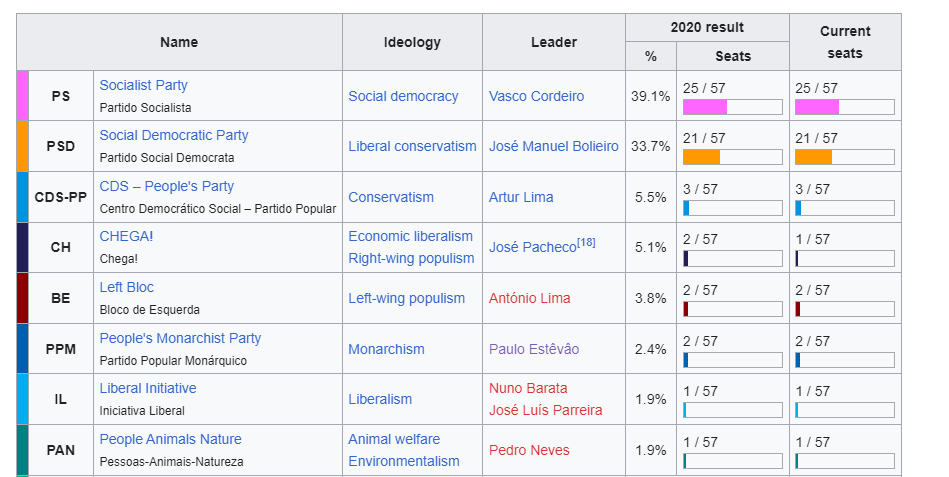
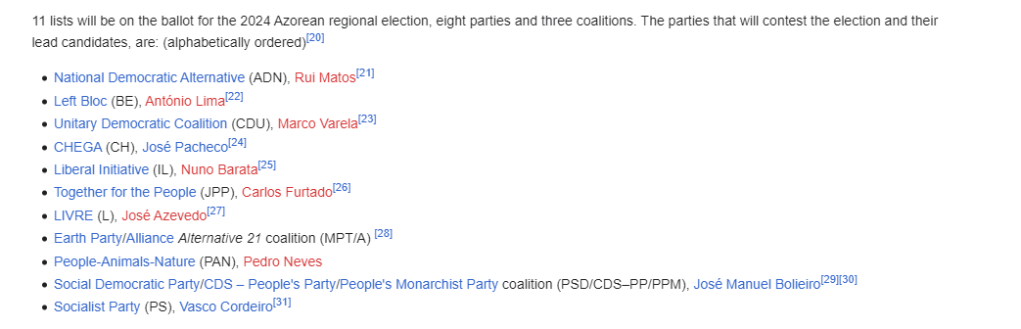
Below are some infographics from Wikipedia that provide additional information…

 Novidades - The Islands and the Diaspora