

Over the centuries, the island of Santa Maria has been a silent witness to important historical events. One such episode is the passage of Christopher Columbus through these parts during his return voyage after the discovery of the West Indies in 1492.
With regard to the report on the need to create the Vila Franca Islet Underwater Archaeological Park, defended by researcher Diogo Teixeira Dias, Rui Andrade, who has a degree in History, sent Correio dos Açores an article of his published last January in the Santa Maria newspaper O Baluarte, which also mentions “the need to extend underwater archaeological studies to other islands. In this case, the anchors that Christopher Columbus left on the island of Santa Maria in 1493 on his return from his first voyage to the New World.
According to Rui Andrade, a researcher and history graduate, this first expedition began in the port of Palos de La Frontera on August 3, 1492. On October 12, the fleet in the service of the kings of Spain reached the island of Guanahani1 after passing through the Canary Islands. On October 28, it reached Cuba and on December 6 it reached the island of Santo Domingo.
The first part of the voyage was uneventful, but the same could not be said for the return to Europe, which was immediately jeopardized by the “Santa Maria” ship running aground on a reef in Caracol Bay, near what is now Cape Haitian, on Christmas Eve.
According to researcher Rui Andrade, Columbus reformulated his return plan and on January 16 set sail with his company, now distributed among the two caravels that supported the ship “Santa Maria”. The “Pinta” commanded by Martim Alonzo and the “Nina” commanded by Columbus himself.
The stopover of the ‘Nina’
“They had been sailing in the Atlantic for more than three weeks when they were forced to face a great storm. Both ships lost sight of each other, so each followed its own route. A few days later, the “Pinta” arrived in Baiona, in northern Spain, while the “Nina” reached the island of Santa Maria in the Azores. It was a stopover that would prove troubled for the Admiral and his crew,” he recounts.
According to a description in the Baluarte newspaper, Rui Andrade states that Columbus’ logbook has not survived to the present day, however, there are two chronicles that relate this stopover on the island of Santa Maria. The first was written by Friar Bartolomeu de Las Casas, a friar who was part of the entourage on Columbus’ second voyage to the Americas, and the other by Don Fernando Colombo, the navigator’s son. According to these accounts, during the storm and before finding land, the navigator promised to go and pray with his crew at the first temple he came across in honor of Our Lady. When he was informed that he was on the island of Santa Maria and that there was a chapel in honor of Our Lady of the Angels, he decided to pay his promise there.
According to the chroniclers, “on February 16, the day after arriving in Santa Maria, Columbus determined that half the crew would go ashore to fulfill his promise, barefoot and in shirts, while the other half, which included Columbus himself, would remain on board the caravel. When the first returned, the rest would go ashore to do the same.”
Detained in Santa Maria
According to Rui Andrade’s text, what happened next is still unknown to this day. From Columbus’ accounts, it appears that “the crew that was on land was arrested by João da Castanheira, acting Donatory Captain, claiming that he had orders from King João II to arrest Castilians who were roaming the coasts of Guinea in constant raids and in breach of the Treaty of Alcáçovas”.
“Suspecting that Columbus had come from an illicit cruise along the coasts of Africa, Castanheira followed these orders from the King of Portugal”.
According to the researcher, this fact is contradicted by some historians, including José Hermano Saraiva, who has been to the island of Santa Maria several times and studied this passage. According to this historian, Columbus may have been lying, not least because, after having been to Santa Maria, he went to Lisbon to pay his respects to King João II himself.
“What historians all agree on is that Christopher Columbus, when half of his crew was on land, had to quickly move away from the coast and leave his men behind. This was most likely due to the worsening sea conditions, forcing the captain of the “Nina” to sail for two days lost between the islands of Santa Maria and São Miguel. When the weather calmed down, he again looked for a bay on the island to anchor and rest his men, before returning to Baía dos Anjos and rescuing the rest of the men who had stayed there,” he reveals.
From Columbus’ accounts, it is known that “it was at this anchorage, on February 20th, that the ‘Nina’ lost her moorings and anchors due to the bad bottoms they found there. It is precisely this moment that we are interested in highlighting here in this text, since Columbus never mentioned that the anchors had been rescued, unlike what happened to his men,” says Rui Andrade.
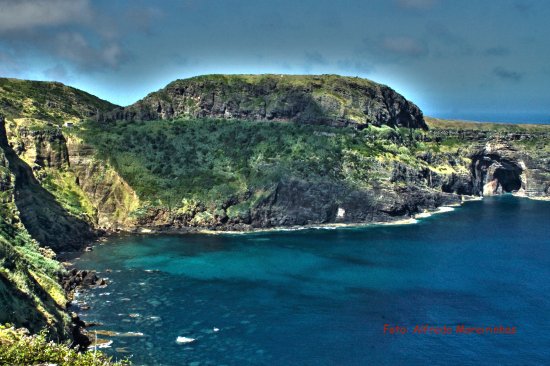
“Where did Christopher Columbus leave his anchors when he passed the island of Santa Maria?” asks Rui Andrade, who then replies that “there are already two answers to this question. The first was given to us by Dr. Jacinto Monteiro, who defended the thesis that Columbus’ anchors were those that were removed, on his own initiative, in 1960 from the bottom of Cura Bay, on the east coast of the island. The second answer is given to us by Professor José Hermano Saraiva, who believes that these anchors are still there today at the bottom of Cré Bay, on the north coast.”

Jacinto Monteiro was one of the researchers who most studied this passage, which he called the “Colombine Episode on the Island of Santa Maria”. His thesis was based on the facts described by Bartolomeu de Las Casas and also on the technical opinions of some nautical experts such as Commander Sousa Mendes, at the time Captain of the Port of Vila do Porto and also a researcher into Columbus’ passage around the island. According to him, it was common practice for sailors to seek out the bays of Cura or São Lourenço, temporarily, when the winds and sea turbulence didn’t allow them to continue on to their destination, particularly with the westerly winds, which were very common at the time of year when Columbus passed the island. “The navigator’s search for Cura Bay proved to be a wise and prudent decision, however, not knowing its very uneven and rocky bottom became a real storm when it came to collecting the irons,” he says.
José Hermano Saraiva’s thesis appeared 28 years later, on April 16, 1988, in an article published in the newspaper Diário Popular. As Rui Andrade explains, this researcher argues that Columbus’ anchors could only be at the bottom of Cré Bay. To defend his suspicion, he mentions that the navigator said at one point in his account that he couldn’t see the chapel of Nossa Senhora dos Anjos, where the other half of his crew were, because he was behind a point of land, referring, according to Saraiva, to Ponta dos Frades, which separates the Bay of Cré from the Bay of Anjos.
Rui Andrade defends archaeological in Cré Bay
For Rui Andrade, “in view of these two answers and given the importance of the island of Santa Maria for Christopher Columbus’ feat, it is incomprehensible that more than thirty years later, no underwater archaeological surveys have yet been carried out in Cré Bay in order to find the aforementioned irons and thus dispel the doubts that still exist. It was the authors themselves, who are now deceased, who on several occasions asked for the bottoms of Cré Bay and even Cura Bay to be ‘brushed’ so that we could arrive at a single answer to this particular question for the history of the island of Santa Maria.”
With regard to the anchors found and removed from Cura Bay, “even if they are not Columbus’ anchors, it has been proven that they are from the same period, which gives them significant historical value. There are three in total, all of the admiralty type, the longest with a shaft length of 3.10m and a weight of 700 kg,” we read. The initiative to remove these anchors came from Jacinto Monteiro, “a true Mariense and a great fan of his island. Certain of his convictions and supported by Jaime Cortesão and Damião Peres, his professors at Coimbra, he paid for an initial survey of the bay out of his own pocket, which proved to be a success. From then on, the then captain of the island’s port, Commander Sousa Mendes, took the lead and, with the collaboration of some of the island’s authorities, drew up the entire plan for removing the anchors,” he explains.
On May 18, 1960, the procedures began in the morning. “A large barge was used with a crane mounted on a tracked tractor, two motorboats and a few men, including two amateur divers who led the underwater operations,” he says. According to the Port Commander’s report, the first two anchors were picked up without difficulty, with only the third offering some resistance as it was more stuck in the rocks. They also tried to retrieve a fourth anchor, but it was no longer possible because it was too stuck.
in Correio dos Açores – Natalino Viveiros, director
ranslated to English as a community outreach program from the Portuguese Beyond Borders Institute (PBBI) and the Modern and Classical Languages and Cultures Department (MCLL) as part of Bruma Publication and ADMA (Azores-Diaspora Media Alliance) at California State University, Fresno–PBBI thanks the sponsorship of the Luso-American Development Foundation from Lisbon, Portugal (FLAD)
 Novidades - The Islands and the Diaspora