

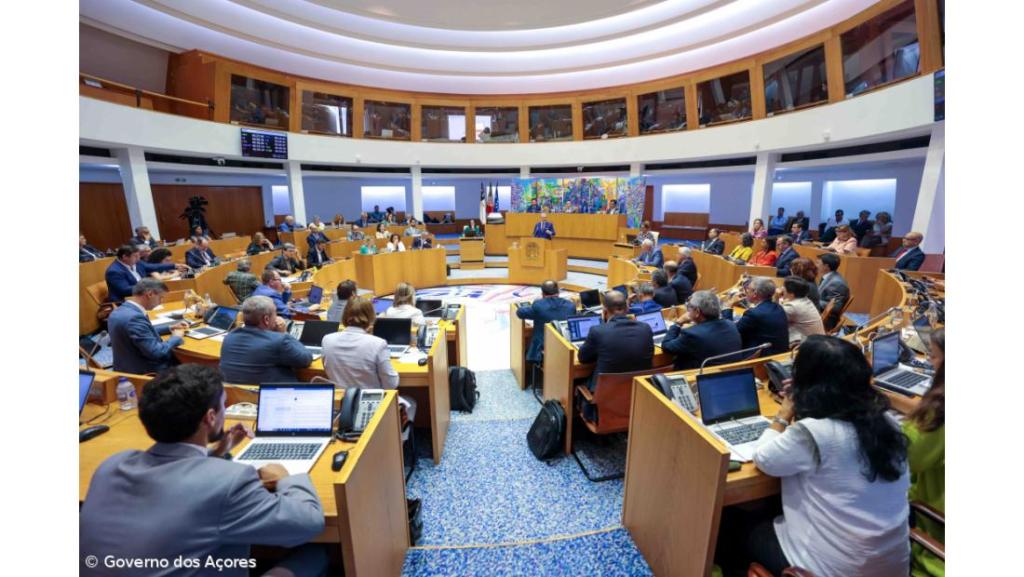
The PSD/CDS-PP/PPM Regional Government Program was approved yesterday in the Legislative Assembly of the Azores, with the votes in favor of the benches that support the executive, the abstention of CHEGA, IL, and PAN, and the votes against PS and BE.
In his final speech, the President of the Regional Government, José Manuel Bolieiro, promised to materialize a “path of dialogue”.
The document, he stressed, includes a “set of actions from other parties’ electoral proposals”, which signals “a good understanding of the election results” and “openness to democratic dialogue”.
Bolieiro criticized the Socialist position. “With no connection to the electoral reality, the PS says that the Government Program that was debated here does not respond to the problems of the Azores. Nothing could be more wrong,” he said, rejecting the idea that the PS is the “master of the truth.”
“The people have unequivocally decided that the PS does not have the role of governing, of being the master of everything and everyone, but rather of leading the opposition, but if it knows how,” he quipped.
For the leader of the Regional Government, “the people want responsibility and stability”, and the executive is committed to a “paradigm shift”.
He stressed that the priority in the budget negotiations will go to the parties that made the document possible.
On another level, José Manuel Bolieiro’s speech focused on Youth. “Young people constantly challenge society to change and progress,” he said.
One concrete measure is based on the “Mais Jovem” program.
“We will ensure the payment of two free plane tickets a year for young Azoreans who are studying outside their island of residence. We will create the ‘Mais Jovem’ package, designing a system in which students enrolled in higher education abroad will only pay the stipulated amount for the round trip, without the need to request subsequent reimbursements,” he said.
The approval of the Government Program did not come as a surprise, given that José Manuel Bolieiro had admitted, on Thursday, to negotiating “case by case” with CHEGA (the ultra-right wing party) in an interview with CNN Portugal.
Before the final vote, CHEGA, IL, and PAN stated that they would abstain.
CHEGA’s parliamentary leader pointed to the high number of votes for the party in the regional and national legislative elections, considering that “the voice of the people must be respected.”
José Pacheco stressed that “there will be no government of the Republic without an agreement with CHEGA” and recalled the more than one million votes for the party. “However, some party leaders have decided to establish a health fence in democracy and insist on shouting from the top of their arrogance that no is no,” he said, in a criticism directed at the PSD president at the national level, Luís Montenegro.
“It’s sad and painful to have a country held hostage by someone’s stubbornness and personal vanity,” he lamented.
For Pacheco, Montenegro will go down in history “as Nero,” who prefers to “destroy Portugal.”
“For us, the Azores are more important than any personal or party vanity. If we have to make any concessions that don’t jeopardize our principles and the commitments we’ve made to our voters, we’re ready to take this step forward, in favour of our land,” he said.
Pedro Neves, from PAN, presented his abstention as a defense of April’s values. “We abstained in the expectation that it would be an incentive to open up to implementing reforms. In the year that marks the 50th anniversary of April, I am disgusted that the future could be a path to the past. I vote for democracy to be free of instability and autocracy,” he said.
The PAN’s priorities remain “caring for people, fighting for animals and combating the climate emergency”.
“At this particular moment, we welcome the inclusion of PAN measures presented and approved during the last legislature. I’m talking about ending quotas in the evaluation of civil service workers, valuing doctors’ overtime work, creating incentives to attract and retain teachers, lung cancer screening, incentives to attract and retain health professionals and incentives to collect and recover marine waste,” he said.
Nuno Barata, the IL’s parliamentary leader, once again pointed out that the Azorean Parliament remains “plural” and “without an absolute majority.”
“A more plural Parliament, more representative and without an absolute majority, is certainly a regime that improves, that supervises the regime itself,” he said.
He added that there should be no illusions: “We will only fight populism and the growth of totalitarianism if we solve people’s problems. Otherwise, we’ll only be contributing to the growing number of discontented people expressing their discouragement at the ballot box.”
From the Socialist benches, the new parliamentary leader, João Castro, argued that it is the party’s role to lead the opposition and that it was Bolieiro who closed “the doors to any understanding” when he did not admit any solution other than a minority government, which would be “an alternative path to non-Socialist governance.” João Castro criticized various aspects of governance over the last three years, including the “degradation of regional public finances.”
The regional public administration’s debt climbed to 3159 million euros at the end of the third quarter of 2023, “an increase of 31% (754 million euros) in just 33 months”, he pointed out.
“The Socialist Party is and will be the largest opposition party. In the Azores, that is the place we occupy and will occupy until the next regional legislative elections. In politics, as in life, it’s up to everyone to take responsibility for their actions and choices,” he stressed.
A “commitment to building an alternative for the Azores” was left by Left Bloc MP António Lima, who criticized the coalition and CHEGA.
“For this program to be politically viable, it needs to be made viable by those who call themselves anti-system. Those who demanded seats in the government, who demanded that the CDS and PPM leave the government and wanted a government agreement. In the end, all it took was one conversation and CHEGA embraced the system. And we note that the PSD’s ‘no is no’, in the end, means understanding on a case-by-case basis and buying by the piece,” he argued.
For João Bruto da Costa, the PSD’s parliamentary leader, the Socialist Party prefers to “fall into the arms of radicalism and extremism instead of accepting electoral defeat with democratic humility and working to be an alternative”.
He said the PS shows an “irresistible desire to prevent this government from fulfilling the mandate given by the Azoreans, trying to wash its hands of the high responsibility of having 23 regional deputies.”
“This document once again expresses the plural commitment of different parties to walk together to affirm a change for the benefit of the Azoreans, starting in 2020, as an alternative to a 24-year Socialist government,” defended Catarina Cabeceiras, who leads another caucus that supports the Regional Government, the CDS/PP.
“The watchwords must be stability, responsibility and governability. Stability is what the Azoreans demand of us,” she said.
João Mendonça, a member of the PPM, acknowledged in a speech that he wasn’t “the best of speakers.” He cited various famous sayings to consider that the PS brought to the debate “a lot of grapes.”
“The majority of people voted for the coalition’s project. Because the economy is growing, employment is the highest it’s ever been and taxes are the lowest they’ve ever been. After the storm comes the bonanza, after the PS, the coalition,” he said.
By journalist Helena Fagundes, Diário Insular-José Lourenço, director
Translated to English as a community outreach program from the Portuguese Beyond Borders Institute (PBBI) and the Modern and Classical Languages and Cultures Department (MCLL) as part of Bruma Publication and ADMA (Azores-Diaspora Media Alliance) at California State University, Fresno–PBBI thanks the sponsorship of the Luso-American Development Foundation from Lisbon, Portugal (FLAD)
 Novidades - The Islands and the Diaspora