

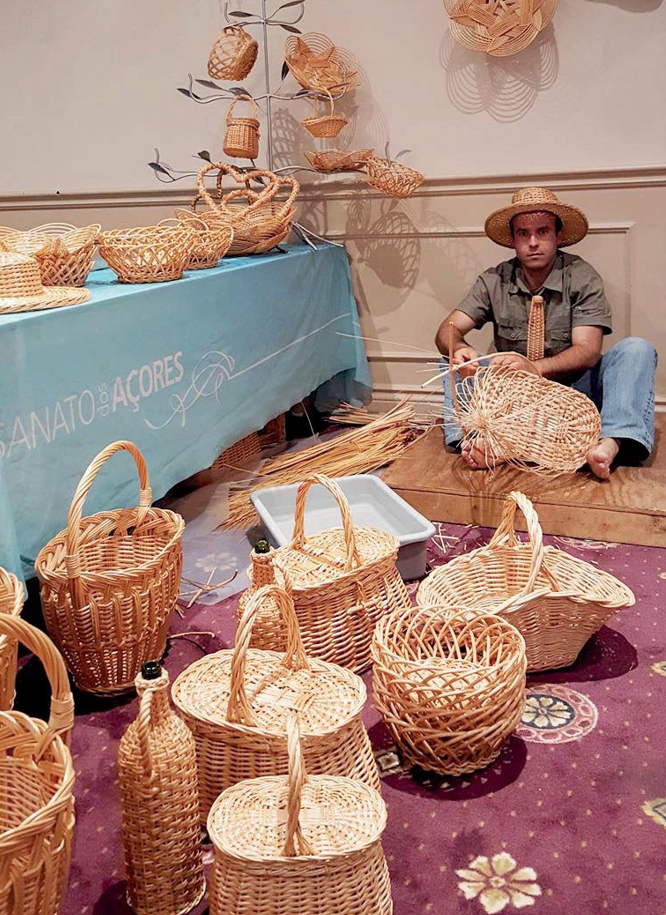
Alcídio Andrade, 43, from Água de Pau, in the municipality of Lagoa, a wickerwork craftsman certified by Marca Açores, learned his craft from his father, the craftsman João Andrade, who is well known abroad. He has had contact with wickerwork since he was a child. Over the years, his work, which combines the traditional and the contemporary, has been recognized not only in the Azores but also in mainland Portugal and abroad, mainly in diaspora countries, where he has exhibited several times, namely in Canada and the USA, where he has also taken part in craft fairs. She has also given training courses in the Azores and participated in various craft fairs in the archipelago, at home and abroad. Last year, he took part in a biennale in Luxembourg at the invitation of the Directorate-General for the Arts, and he says that he has been widely promoted both in Portugal and Europe. “It was interesting that government members congratulated me only after I had published some photos on social media because they were unaware of my participation abroad. I think the government should invest more in what is ours. I don’t have to report it if they don’t support it. People work in Santa Maria, Terceira, Madeira, and mainland Portugal, but they chose me. I was very pleased to be able to give training in art workshops in Luxembourg.”
However, while he used to work on his own projects, for some years now, he has been working mainly with designers and architects, mostly decorating restaurant chains and hotels.
I make between 4,000 and 5,000 pieces a year, depending on the size”. In São Miguel, for example, his work can be seen at the Tu Ka Tu La restaurant in Santa Bárbara, in the municipality of Ribeira Grande. He recalls that the pieces were placed in the space “through Clara Vasconcelos, the interior decorator. “But there are many other restaurants in Ponta Delgada where I made the lampshades.” However, even with so much work on the island, which is left to his father, Alcídio Andrade does more work for mainland Portugal. “Last year alone, I made 400 pieces for a hotel, the Sublime Comporta, from furniture to decorative items, like the lampshades.”
From planting to harvesting and cooking, the craftsman does it all
This art takes a lot of work, from planting the wicker to the final product; we’re talking about one year. “We have to plant the wicker, cut it, cook it, peel it. I colored the wicker in January and pruned it in March to make it grow again. It’s like a vineyard. There’s a whole process for picking the grapes. It’s the same with the vimes“
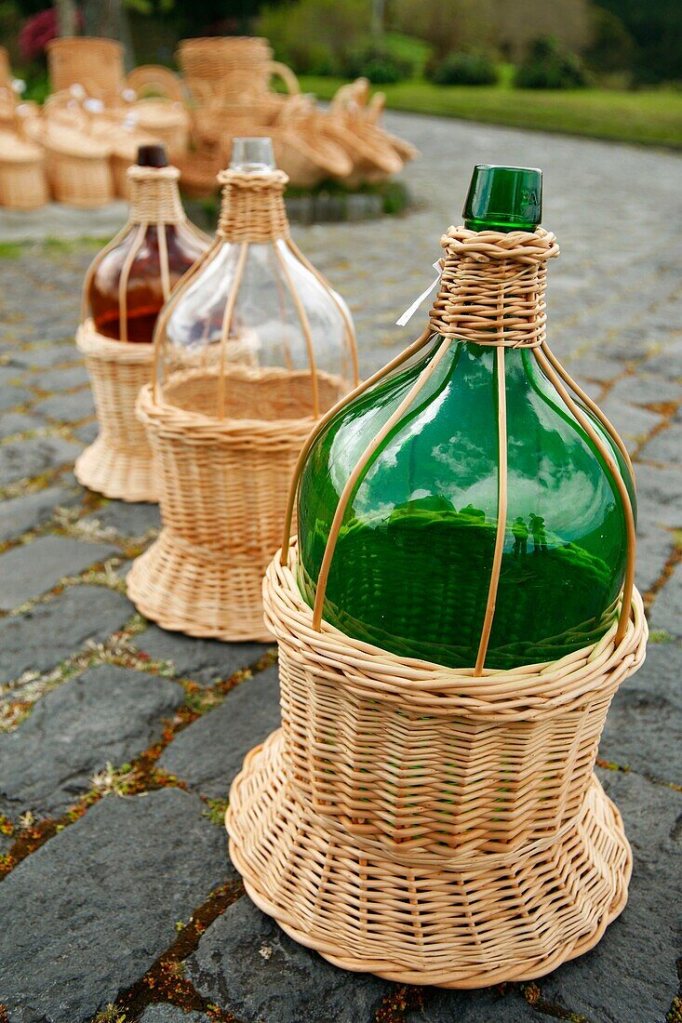
Alcídio and João Andrade do all the work, from preparing the land (four bushels) to harvesting the vines. “I do everything with my hands, from planting to the final product. It’s only after all this work that the baskets, furniture, and lampshades are made,” he says, but he also creates other pieces, such as wicker ties and glasses.
From Monday, 18th until April 5th, the craftsman will hold a wicker basketry workshop in the mornings at the community center in the village of Água de Pau as part of an initiative by the Lagoa Municipal Council. Participation is free. According to the municipality, it “is to give the trainees knowledge of the interlacing techniques used in wickerwork and of the vegetative and characteristic cycle of this plant fiber. This art draws on ancient knowledge and techniques passed down from generation to generation”.
Bearing in mind that the number of artisans working with plant fibers in the municipality of La Goa is minimal, the local authority wants to “invest in training new artisans, in order to guarantee the perpetuation of wickerwork, espadana, and corn leaf, which are so characteristic of the craftsmanship of this municipality.”
Incentives for raw materials are essential.
Alcídio Andrade thinks this type of initiative is essential “to see if anyone continues. My father is already 72, I’m the youngest, so I hope someone can be trained to continue this art”. However, he warns that anyone starting out in this art “has to learn that the government doesn’t give subsidies. The government doesn’t support the raw materials. Anyone who starts has to have their own wicker, because if you buy it abroad it’s going to be very expensive”. The craftsman believes that there should be a way of giving support to those who cultivate wicker because it’s a huge expense and in order not to let the art die. “For this year 2024 alone, around 7,000 euros have been invested in the raw material.” However, he’s not complaining about the lack of work, he’d even like “to have more wicker so that I can put people to work to meet the great demand I’ve had. I have a lot of customers from continental Portugal who ask me for pieces, but I have to say no because I don’t grant all their requests.”
Nélia Câmara is a journalist for Atlantico Expresso Newspaper in Ponta Delgada, Natalino Viceiros-director
Translated to English as a community outreach program from the Portuguese Beyond Borders Institute (PBBI) and the Modern and Classical Languages and Cultures Department (MCLL) as part of Bruma Publication and ADMA (Azores-Diaspora Media Alliance) at California State University, Fresno–PBBI thanks the sponsorship of the Luso-American Development Foundation from Lisbon, Portugal (FLAD)
For more information, look at this story:
 Novidades - The Islands and the Diaspora