


Natalie Sousa is a first-generation Portuguese American born in Tulare, California. Her two parents, Germano Sousa and Rosa Sousa, and two of her older brothers, António Alberto Sousa and Carl Sousa, lived on the island of São Jorge before moving to the United States of America. Seeking the land of opportunity and the chance to obtain a better financial situation, in October of 1968, her family flew from the Azores to San Francisco, California. Once landed in San Francisco, Germano and Rosa headed to Tipton, California, where they could find work on a dairy and the first step towards a better financial future for the family.
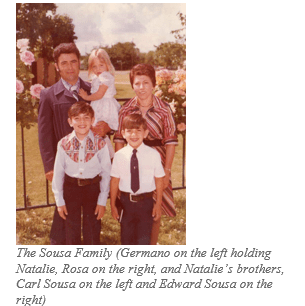
Just as things started to seem promising in the States for the Sousa family, they were deprived of their first glimpses of hope as their eldest son, António Alberto, passed away from health complications at the age of four. With this devastation brought upon the family, there was a newfound bitterness towards the country they had just moved to, and a negative mindset for the Land of Opportunity was born. After living in Tipton for a couple of years with the hardship heavy on their minds, the Sousa family made the executive decision to move to Tulare, California; being so similar to Tipton, they found work on another diary with an even better opportunity for the family to capitalize on.

Shortly after moving to Tulare, Germano and Rosa had another son named Edward and their last child, Natalie. As a young Portuguese American, Natalie has fond memories of playing on the dairy, going to Mass on Sundays with her family, and attending all the Festas she and her family possibly could. Natalie had the opportunity to even become queen of the Festa one year, and seizing this opportunity, she absolutely adored every moment of it. She precisely remembers that the year she was queen, her family did not have the money to purchase a lovely cape, but her mother, Rosa Sousa, was a great seamstress, and she decided to make Natalie her own cape for her to be queen of the Festa that year. Being queen is a huge deal in the Portuguese American community, and this is something she is exceptionally proud to have achieved. Growing up in the Central Valley, Natalie remembers being deeply in tune with her Portuguese heritage. She must keep a solid Portuguese identity, even being born here in the States. Despite having a completely different lifestyle here in the States, her family reinforced the importance of being Azorean and never forgot that fact. My mother’s first language was Portuguese, and she eventually learned English during her early years of elementary school. She is fluent in both languages, which has dramatically impacted her professional career today, as she is now a Portuguese interpreter for medical appointments here in the valley.

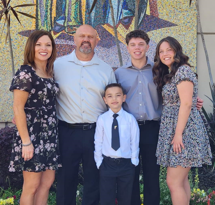
Living with her parents in Tulare, when she was in her early twenties and attending community college, she met Dino Giannandrea, an Italian man with a strong identity and cultural background like herself, who would later become her future husband. A few years later, Natalie and Dino got married in Saint Aloysius Catholic Church and, soon after, started their new family with one another. Natalie now has three kids and a wonderful family of five, which is one of her proudest achievements that she boasts today. She tries to pass on critical Portuguese traditions to all of her children today to preserve the Azorean identity in the family.
One of Natalie’s favorite traditions growing up, and currently, is the Portuguese Festa. She loves every part of the ceremony and enjoys the sense of community that the Festa brings to the Portuguese people in the valley. She has always been involved in them since her family moved here, and she never plans on leaving that tradition behind. She continues to attend festivals as much as she can to this day, and being born and raised Catholic, she is still heavily involved in Saint Aloysius Church in Tulare. More Portuguese traditions that Natalie appreciates are the Portuguese bullfights, the religious candlelight processions, the card games, Portuguese dancing, music, and excellent Portuguese food. She has fond memories of playing cards, dancing, and eating Portuguese food with her family and cousins and will always hold on to these moments.

Natalie has not yet been to the Azores but is actively seeking to make a trip to her roots as soon as possible. It has always been a massive dream of hers to return to the home her parents grew up in and to experience the Azorean island life for herself. Unfortunately, both of her parents passed away in recent years, but she still has her brothers left and holds on to the valuable family connection she has with them. She believes her parents would have loved for her to vacation in the Azores and experience it for herself since she had never lived there. The memory of her beloved parents lives through her today, and she is highly grateful for the sacrifices they have made for her to live the extraordinary life she has today.
As a proud Portuguese American today, Natalie feels strongly compelled to have an impact on the community. Natalie is deeply connected today with the Portuguese community in the Central Valley and is passionate about continuing the traditions into the next generation. She is thankful for where she has come from and believes that for the Portuguese American community to stay connected, we must continue passing on the beautiful stories, traditions, food, and overall culture.
By Dino Giannandrea – Azores Culture Class (Central California Portuguese-American Oral History project at Fresno State has recorded over 90 oral history interviews–our goal is to reach 200)
 Novidades - The Islands and the Diaspora