

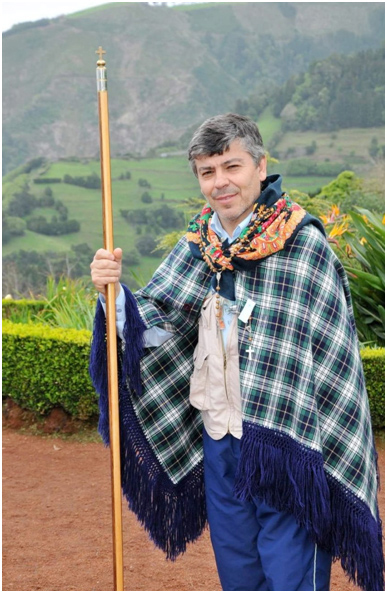
Correio dos Açores – Another pilgrimage is over. How did it go?
José Maria Sousa (Mestre do rancho de romeiros dos Milagres, Arrifes) – Thank God it was another excellent pilgrimage. The magnificent weather partly contributed. It was always very mild, shady, and rain-free. I was fortunate enough to complete my forty-sixth pilgrimage.
What motivated you to “run the island” as a pilgrim for the first time?
I was 16 when I first joined the ranch. I was motivated by curiosity and by the presence of family members in the group.
What is the primary function of the brother Mestre?
The main mission of the brother mestre, as the person in charge is known, is to coordinate everything related to the walk so that it runs smoothly.
What are the biggest difficulties in leading a large group of brothers?
Although the group was large (62 brothers), we didn’t experience any difficulties. First of all, the master, assisted by his collaborators (counter-master and helpers), tries, when necessary, to draw attention to the need to comply with and put into practice what has been agreed upon in the preparation meetings.
Good preparation is fundamental, and this is done in the meetings that precede the week of the pilgrimage. In these meetings, we also rehearse the prayers and have the precious collaboration of the brother priest, who talks about the doctrinal and spiritual aspects. We deal with the practical aspects of our lives, focusing on the attitudes and corrections we should have.
What drives a person from Canada or the United States to join a ranch of pilgrims in São Miguel?
The motivation is the same as for those who are here. In fact, we have been fortunate to have brothers from Canada and the United States (some of whom were born there) come to experience unique moments of faith, prayer, penance, and sacrifice with us.
Is this break from everyday life like a spiritual retreat?
It’s no coincidence that all those who take part or have taken part say that joining a pilgrimage is an authentic and genuine spiritual retreat.
Many people say that many pilgrims don’t practice their faith regularly. Why is that?
Sometimes, it happens because some brothers and sisters don’t practice their faith regularly. They are part of the non-practicing Catholics. However, the pilgrimage is a natural way for them to experience their religiosity in depth.
But one thing is sure: even those who have only taken part in the pilgrimage once are forever marked. They become much more aware of human beings and attentive to what’s happening around them. It’s very common for them to take part in solidarity actions.
How do pilgrims find the courage to continue their walk despite tiredness, rain or sun, or even a few sores on their feet?
The strength acquired through prayer and the positive energy that emanates from one another creates an atmosphere of enormous fraternity, which allows us to have the strength and courage to withstand the heat, the bad weather, and the ailments that appear on our bodies.
The pilgrims treat each other like brothers and sisters even outside the pilgrimage, and their friendship and complicity persist throughout the year, forming a bond between everyone. Why is this so?
The fraternity experience during the walk is so solid and consistent that it motivates everyone to call each other brother and sister throughout the year. On the pilgrimage, everyone is united in the same feelings, and the permanent mutual help strengthens the group spirit, and this spirit lasts throughout the year.
Is it essential to meet up with families again?
Reuniting with families in the middle of the week isn’t valued as much as it used to be because, given their easier mobility, relatives or friends visit the ranches almost every day (unfortunately, to a certain extent).
In the past, pilgrimages were only for simple people from the countryside or the sea. Nowadays, they include people of all ages, professions, and social conditions, whether from cities, towns, or parishes. Why is that?
Contrary to what used to happen in the past, people from all walks of life increasingly take part in the pilgrimages. I believe this is due to the need everyone has to take a break from their day-to-day lives and their usual routines, given the daily hustle and bustle to which we are all subject (some more than others), and in particular the physical and psychological strain.
Does contact with the brothers of the ranch and with nature lead the pilgrims to greater intimacy with God?
Knowing that during the pilgrimage, long walks are made in silence (more and more), some take advantage of the (unique) opportunity to reflect, meditate, and introspect.
This golden silence is ideal for assessing our lives and what we can and should do to become more conscious human beings who fulfill our duties and obligations towards our fellow human beings.
Does this popular religiosity lead to a deepening of authentic faith?
The pilgrimage is a journey of faith, prayer, penance, and sacrifice. It is aimed at a firm resolve to change one’s life. Only by participating can you get an accurate idea of what it is and what it represents for each of the many people who are fortunate enough to be part of it.
It’s open to everyone, so everyone is welcome. Resilience combined with faith and willpower make anything possible in a pilgrimage.
António Pedro Costa for Correio dos Açores-Natalino Viveiros, director
Translated to English as a community outreach program from the Portuguese Beyond Borders Institute (PBBI) and the Modern and Classical Languages and Cultures Department (MCLL) as part of Bruma Publication and ADMA (Azores-Diaspora Media Alliance) at California State University, Fresno–PBBI thanks the sponsorship of the Luso-American Development Foundation from Lisbon, Portugal (FLAD)
 Novidades - The Islands and the Diaspora