

Almost all nine respondents said that Easter is a Christian festival. For José, 75, “Easter is an exceptional event” but one that has “lost its meaning” because “people want Christmas pudding and almonds.” He believes that this season is very “commercialized” everywhere.
His response is very similar to that of Francisco, 60, and Pedro, 23, who says that “it represents the end of Lent, a time of penance, sacrifice, and prayer, culminating in the death of Jesus Christ”, despite their different ages.
Hugo, 22, believes that this day represents “a prosperous new beginning and a sign of growth and change in the lives of all” people.
Easter has lost “some meaning” but continues to be celebrated as a family
The response was almost unanimous: almost all those interviewed felt Easter had lost some spirit over the years, and many only celebrated it when they were children.
Maria, 58, says that the religious part of Easter was only celebrated when she was a child and in a different way. As she lived in a village in the north of mainland Portugal for several years, Maria says that she “celebrated the Compasso”, a moment felt by the Catholic community in the north of mainland Portugal.
Margarida, 21, used to spend Easter hunting for eggs as a child, something she no longer does nowadays. However, she does spend the season with her family: “I spend Easter Sunday lunch with my maternal side, while I spend the afternoon with my paternal side.”
Dário, 31, says that Easter is “just another day” since “this season lost its meaning after I stopped being a child.” However, what gives him joy is seeing his daughters happy at this time of year and buying Easter eggs. Like Dário, Pedro agrees that “Easter is just another day” on the calendar.
José feels that, in general, the little spirit of Easter has disappeared: “Easter used to be the only festival that existed in Christian communities. As time goes by, people see Easter as just another feast. It’s very commercialized. I think that nowadays the little meaning Easter had has gone,” he explains.
Hugo contradicts this and believes that “it hasn’t lost its value.” He says that “it’s even gained more value, because as we get older, we value taking a break from work or university to spend time with our families” at Easter.
Few go to church
Not all of the interviewees go to church on Easter Sunday. José says that he usually goes to church every Easter Sunday. However, he notices and feels that there is a big difference in people’s attendance at Mass on that day over the years and generations: “I remember very well that in the past, at the Mass of the Resurrection, the parish church would fill up and there would be no seats available. Now, it’s exactly the opposite, there are seats and the pews don’t fill up,” she says.
Alexandrina, who is at least 80 years old, says that in the past, even the shutters would close and then open on Alleluia Day: “it was a tremendous joy”, explaining the feeling when the shutters opened.
No traditional food
Unlike Christmas, where many families already have one or more dishes designated for the season, almost all those interviewed don’t have a typical Easter dish.
The most common answer was “a roast made in the oven.” For 59-year-old Miguel, Dário, and Francisco, the most common dish is roast lamb or kid. Hugo says he usually eats roast loin with roast potatoes, and Margarida says she usually eats roast beef, but it could also be chicken or pork.
Fried chicharros (mackerel fish) are usually on the Easter menu for José, but he doesn’t have a designated dish for this time of year either.
Unlike the other interviewees, Alexandrina will have her meal in a restaurant, and she will be accompanied by her family.
There’s no shortage of desserts at Easter.
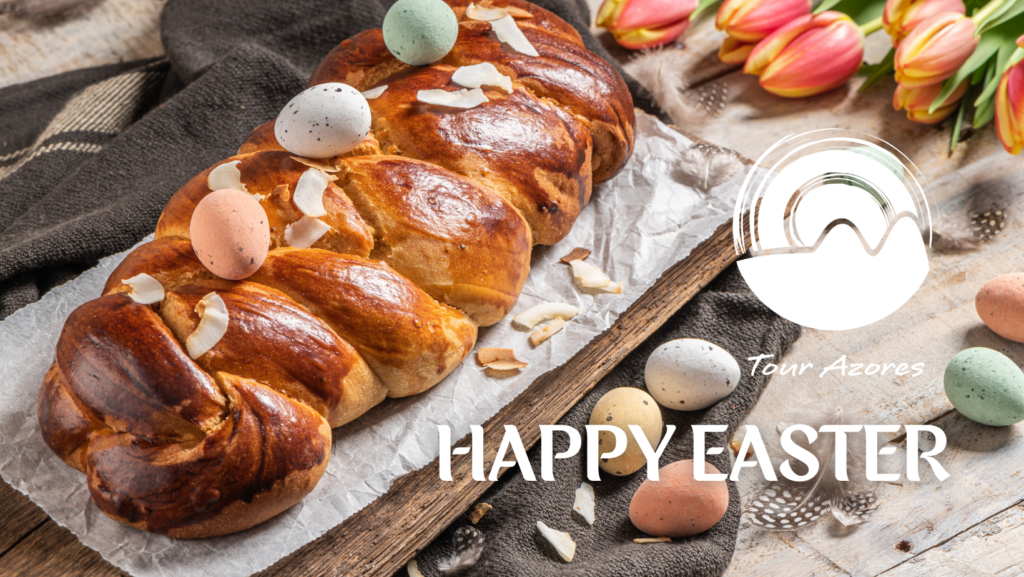
There are lots of sweets at Easter. Almost everyone, from the youngest to the oldest, eats desserts and sweets during Easter. Folar, Easter eggs, almonds, and chocolates were the most common answers from those interviewed by the newspaper.
For José, folar is “the food of Easter, and it’s sacred,” while Margarida says folar (traditional sweet bread with an egg on top) is a “tradition for the last Saturday before Easter,” when the family gets together to eat folar, which in her family usually contains two eggs.
Francisco and Hugo’s menu includes almonds and Easter eggs. Margarida doesn’t give up sponge cake at Easter, while Alexandrina says she usually eats “one chocolate a day” and will give her grandchildren some chocolate eggs this Easter.
In Maria’s house, sweets and chocolates are not usually a habit at this time of year.
Filipe Torres, a journalist for Correio dos Açores – Natalino Viveiros, director.
Translated to English as a community outreach program from the Portuguese Beyond Borders Institute (PBBI) and the Modern and Classical Languages and Cultures Department (MCLL) as part of Bruma Publication and ADMA (Azores-Diaspora Media Alliance) at California State University, Fresno–PBBI thanks the sponsorship of the Luso-American Development Foundation from Lisbon, Portugal (FLAD)
 Novidades - The Islands and the Diaspora