

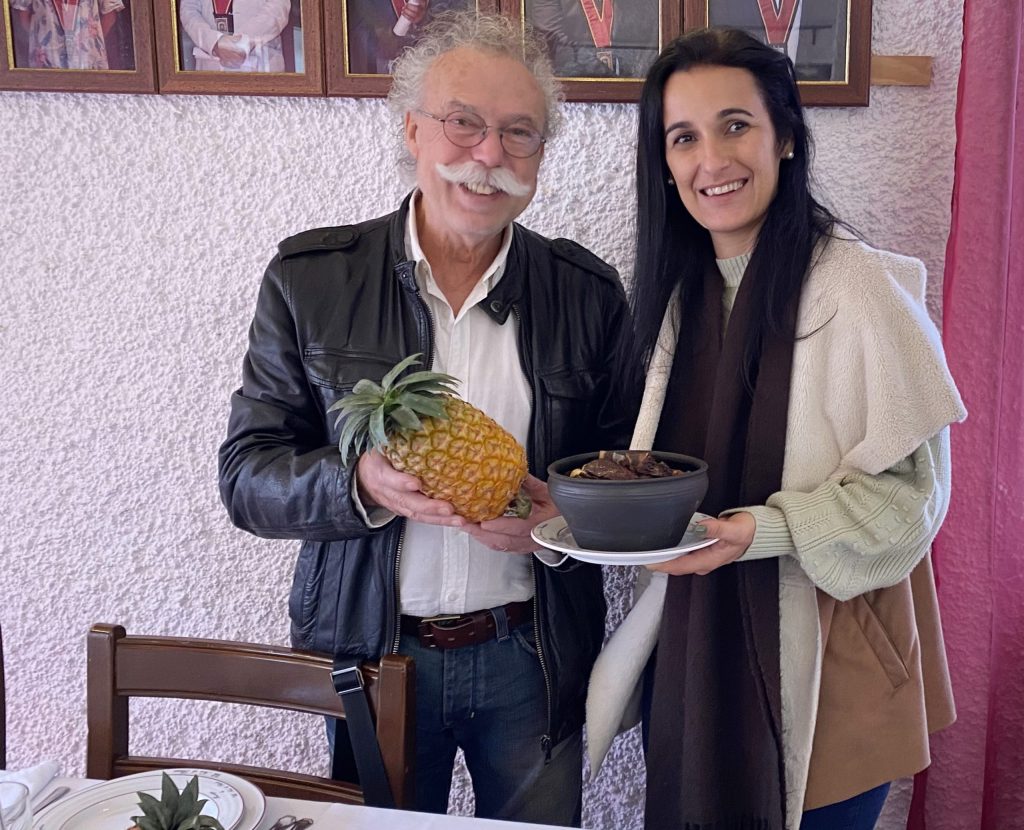
He could have been a history teacher, a tour guide, or worked in the social sector, but he opted for gastronomy and is now head of the Confraria Gastronómica dos Açores. Why this choice?
“Well! A history teacher is always a teacher, a tour guide is always a tour guide. And a gastronome is always a gastronome. Because it is umbilically linked to all human transversality. Whether we like it or not, gastronomy is in everything, in one way or another. Without being an advocate of lost causes, I want to free gastronomy and the brotherhoods from the social stigma to which they are consigned,” replied António Cavaco, who argues that Azorean tourism is starting from the ground up and that, first, all Azoreans need to “gain a tourist culture.”
Correio dos Açores – Tell the readers about yourself!
António Cavaco, 72, a gastronome, I left the rolling plains where I was born for the rolling Azorean Atlantic. I’ve lived in Ponta Delgada for forty-four years. I consider myself Azorean by choice!
I’m a practicing Christian Catholic, and I believe that coincidences are God’s way of maintaining anonymity.
Tell us about your academic, professional, and social life?
In my academic life, I can’t count the number of courses I’ve taken. I did my basic regular school studies. I went on to technical school in electro-mechanics and attended the first year. I completed the first experimental courses run by the French AFPA, vocational training in welding at the CNFM (now the IEFP), and parallel academic training. I went on to high school as a student worker and finished seventh grade in the field of literature. I made a foray into biology to study medicine. In the meantime, I was invited to attend an expert course in metal connections (welding) in England at Babcock & Wilcoks in high-temperature chrome molybdenum.
I worked at OGMA (Oficinas Gerais de Material Aeronáutico) welding light alloys (I became World Champion in the old “Valor no Trabalho” (Value at Work) competitions promoted by Mocidade Portuguesa, now known as “Worldskills”).
At Lisnave, in all types of welding in the shipbuilding sector. And in the Quality Control and Training Office. At the ISQ (Welding and Quality Institute), training and ND and D (non-destructive and destructive) testing technician.
At the CFPA (Centro de Formação Profissional dos Açores) as a trainer, professional training technician, and later deputy director and director of the center until the 90s.
I took a break from academia and graduated in History and Social Sciences (via teaching). I taught at Antero de Quental, went private, and taught for 24 years at the Vila Franca do Campo Vocational School and other institutions.
I completed a post-graduate Strategic Management and Tourism Development course with a Master’s degree. I am a certified interpreter guide. I work in tourism, specifically in gastronomy, linked to the Confraria dos Gastrónomos dos Açores, which I founded with good friends in the same field.
What influence did your parents have on your academic training and life choices?
I come from a humble family that has lived with difficulties and its own limitations in terms of knowledge. They have always supported my decisions, which, through the influence of good friends, I have been able to make in life.
How do you define yourself professionally?
I consider myself a capable professional with intellectual honesty in the areas I’ve worked in.
What are your responsibilities?
In the context of the confraternity, the aim is to protect and defend gastronomic traditions and the cultural identity of the territory, enhance the genuine products of the Azores, and provide the local population and visitors, internally and externally, with knowledge of gastronomic culture as a tourist product.
How do you describe the meaning of family at the time of your parents? What is its meaning today, and what space does it have?
The value of the family was based on the complicity of its members. Respect and truth. Everyone shared an emotional vein of love and communion.
That’s not to say that the principles I mentioned have been lost. Rather, they have changed. Social transformations have had a decisive influence on the functioning of the small social cell.
In my analysis, I would venture to say that the path of history, of the whole in aggregation, is being countered by philosophy, in a whole in disintegration.
How important are friends in your life?
Tremendous! Without forgetting God’s principle of anonymity, I’ll say that there are people we’ve known all our lives, and they’re just acquaintances. But there are others you’ve only just met, and you feel like you’ve known them forever. These are friends! And they are supportive. They are the pillar, sometimes more than family, of social support.
Apart from your profession, what activities do you enjoy doing in your day-to-day life?
I love cooking and going on gastronomic, cultural, and historical tours. I spend my life researching and experimenting in the kitchen.
What dreams did you have as a child?
So many! Medicine still looms on the horizon as a philanthropic activity. A doctor for the poor.
What bothers you most about other people?
Dishonesty, arrogance, and lies.
What characteristics do you admire most in the opposite sex?
Femininity and the emotional capacity to manage a relationship in complicity.
Do you like reading? Name your favorite book?
I do! Not as much as I’d like. “Society at Risk” by Ulrich Beck
How do you deal with the wealth of information, particularly fake news, that floods social media?
I try to sift through it with some rationality and cross-checking of sources.
How do you deal with new technologies, and which sectors should use them to improve performance?
Reasonably, from the user’s point of view, I invariably resort to Cartesian science.
Artificial intelligence is at the center of the debate and could put human beings at risk. How far should this innovation go?
Everything has a limit. History has shown us that in the midst of confusion and uncertainty, sensible brains have emerged to guide us on the right path.
Do you read newspapers?
Yes, especially the local and national ones.
Do you like to travel? What was your favorite trip?
A lot! I’ve traveled to four continents, with only Oceania to go. Among many, the best travel record I have was visiting the cradle of Greek civilization.
What news item would you like to find in the paper tomorrow?
That concord and peace reigned among the peoples.
What maxim inspires you?
Coincidence is God’s way of remaining anonymous. The hard part is done; the miracle takes a little longer.
What historical era would you like to have lived in?
Although I have the feeling of having lived in another time, I feel good in the one I’ve been living in. After all, crossed by a series of abstractions…
What are your gastronomic tastes? And what’s your favorite dish?
I eat everything! It’s hard to name one dish… but my favorite is fish. Not to mention meat.
You could have been a history teacher, a tour guide, or worked in the social sector, but you opted for gastronomy and are now a member of the Confraria Gastronómica dos Açores. Why this choice?
Well! A history teacher is always a teacher, a tour guide is always a tour guide. And a gastronome is always a gastronome. Because it’s umbilically linked to all human transversality. Whether we like it or not, gastronomy is in everything, in one way or another.
Without being an advocate of lost causes, I want to free gastronomy and the brotherhoods from the social stigma to which they are consigned.
You are also trained to carry out functions in Tourism Strategy and Development. What is your opinion on the way tourism is growing in the Azores? What profile of tourists should investment in promotion target?
Azorean tourism has incredible potential. But we can’t start building the house from the roof down. To gain tourism, we have to gain a tourist culture.
The growth of Azorean tourism is the result of the genuine and natural offer we have, which visitors are increasingly seeking out.
Defining profiles can be a mistake when we have the right service for the profile.
We have to see tourism as a person-to-person activity. And what often happens is that we forget the person.
Regional tourism must be segmented according to the profiles of those who visit us. Not the profiles we define.
Do restaurants still need more training to satisfy the tourist profile that the Azores should focus on?
We’re back to the “fallacious” question of the profile, which we dealt with earlier. The profile comes; it’s not dealt with or shaped internally. That’s utopian! We accept visitors. We don’t shape them. And it’s on these visitors that we must develop products… and, above all, affection.
Catering must not continue to be a raw, basic, and material business opportunity, forgetting affectivity and gastronomic culture. Where are the “Bacalhau com Minhotes,” the “Galinha na Panela,” and other notes? If we don’t pass them on to our children and continue to take the easy way out, fast food, and the like, we will lose our cultural/gastronomic identity—in other words, tourist/gastronomic culture.
The catering industry and the agents must know how to talk about instead of talking about. They don’t even talk about that.
Should hotels and restaurants focus more on regional meals? Would you like to explain?
Of course, they should! This would crown the efforts that the Azorean gastronomes and other agents have been making to place traditional Azorean gastronomy, a tourist product, on the altar it deserves.
We have good examples of how to promote and make the most of a tourist product, gastronomy, both nationally and internationally.
It doesn’t hurt to copy. Copying well is a sign of intelligence. Copying and altering is copying badly and a sign of “stupidity”.
Traditional Azorean gastronomy doesn’t need to be “tweaked.” What it needs is a presentation—another “outfit” without taking away its identity.
How is homemade Azorean food an asset for tourism?
Let’s define once and for all that gastronomy is a tourist product, no matter how much it pains many people. Homemade food, which has been out of doors for a long time, is the element that best identifies us and is preferred by visitors. It’s a genuine product that needs to be better valued.
If you were in government, would you describe one of the measures you would take?
That’s not an option!
But if I could collaborate, I would advise a paradigm shift in investment in people and self-sufficiency in agricultural production.
What is your analysis of the regional political situation?
Democracy has these things. If people knew their limits, we wouldn’t have our situation.
Those involved lack a backbone, truth, honesty, respect for those who elected them, and political exercise. Unfortunately, we are witnessing tavern politics. Regrettable!
Is there anything else you’d like to add in the context of this interview?
We’re going to prioritize the consumption of regional products. Treat our gastronomy with care, with love, defend it against invasions…
João Paz, journalist for Correios dos Açores–Natalino Viveiros, director
Translated to English as a community outreach program from the Portuguese Beyond Borders Institute (PBBI) and the Modern and Classical Languages and Cultures Department (MCLL) as part of Bruma Publication and ADMA (Azores-Diaspora Media Alliance) at California State University, Fresno, PBBI thanks Luso Financial for sponsoring this story.

 Novidades - The Islands and the Diaspora