

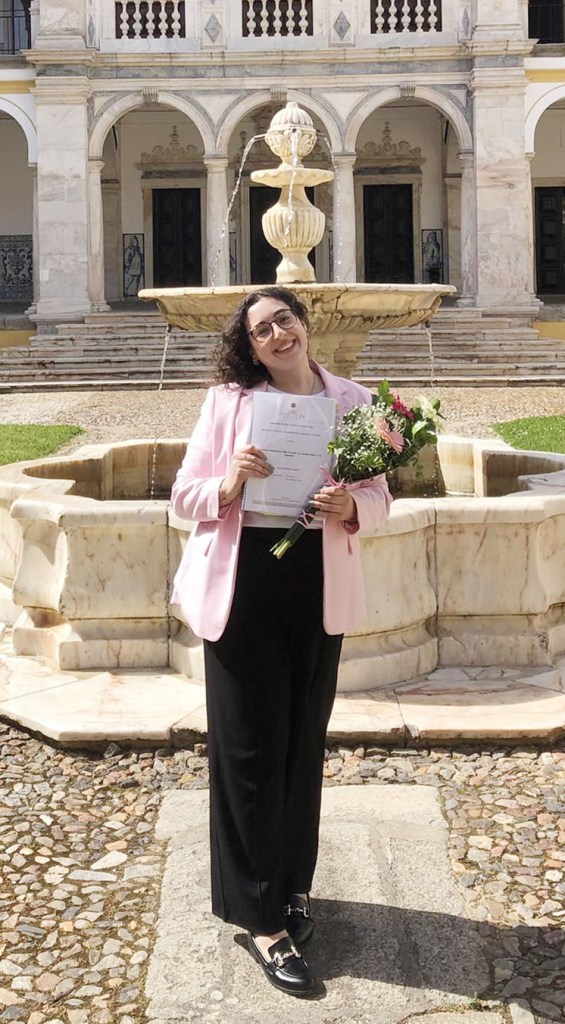
A 25-year-old Azorean woman completed her master’s dissertation at the University of Évora on spiritual tourism on the island of Terceira.
A young Azorean woman from Angra do Heroísmo, Natacha Soares, completed her master’s degree in Tourism and Destination and Product Development at the University of Évora with her dissertation entitled: “Spiritual Tourism in Terceira: A Study of its Potential” under the guidance of Professor Joana Lima (the primary supervisor) and Professor Maria do Rosário Borges (the co-supervisor).
The objectives of the dissertation were to analyze the potential for the development of the spiritual tourism product on the island of Terceira, to find out about the spiritual tourism offered in the Azores, to identify the profile of the spiritual tourist who seeks out these activities and to analyze the possible interest of spiritual tourists in consuming this product on Terceira.
In her dissertation, the new master in Tourism and Destination and Product Development addressed the concepts of spirituality and spiritual tourism, the profile of tourists and their motivations as identified in various studies, the characteristics of spiritual destinations, transformative tourist experiences, tourism sustainability in island destinations; and the positive and negative effects of tourism on the islands.
To strengthen the study, Natacha Soares interviewed public agents, private supply agents in the Azores—to find out about the supply of this type of product in the archipelago—and spiritual tourists to identify their profiles and potential interest in practicing this type of tourism in Terceira.
Tourists want to find or get closer to the “inner self.”
Natacha Soares concluded that there is no “clear definition of spiritual tourism”, which was acknowledged by all the authors considered, but that one aspect recognized by existing research is the fact that tourists who practice it “seek personal improvement, consciously”.
According to the research, the most studied motivations that lead tourists to undertake a spiritual journey are linked to escaping routine, reducing stress levels and finding or getting closer to the “inner self”.
With the data collected, the profile of the potential spiritual tourists on Terceira Island was identified, and interviews were carried out with 16 tourists who had already traveled with the primary motivation of mental and spiritual well-being. In this sample, the most significant age group was 31-55-year-olds (10 interviewees), mostly female and with a monthly income of between 1,001 and 2,000 euros net.
Concerning spiritual tourism destinations, it was observed that there are some essential attributes to make experiences more successful and meaningful, namely those related to nature and the landscape, as well as service providers.
According to the author of the dissertation, it was also possible to see that the transformation of tourists can be one of the consequences of a spiritual journey, as they end up bringing about a change, however small, which can be significant.
The effects that tourists felt due to their spiritual journey were also studied. The positive effects reported are mainly the fact that they feel a sense of cleanliness, lightness, calm, and peace after the experience, which remains beyond the trip and the connection and relationship established between the interviewees and the other people who were also taking part in the same activities.
According to the document, although studies on tourism sustainability in island destinations are not recent, one conclusion that can be drawn is that islands are territories with very vulnerable ecosystems, and achieving sustainable development is not an easy process but essential. Although there are positive effects when tourism is well managed, there are also some adverse effects of tourism on islands.
There is potential for development and interest in this type of tourism.
According to the author, the tourist survey results show potential development and interest in carrying out this type of activity on the island. The likely most valued by the interviewees is based on natural elements (flowers, greenery, forest, fog, water, among others), the landscape, and contact with nature in the whole environment surrounding the spiritual tourism experience.
It was also found that the environment surrounding spiritual tourism experiences can be decisive for tourist satisfaction and the success of these experiences, in addition to aspects such as purity, tranquillity, mysticism, hospitality, welcoming people, and the beauty of the Azores, which were mentioned as important factors.
According to the research, despite potential in the Azores, especially on the island of Terceira, “it is clear that the product is not properly structured and exploited in terms of tourism business.” On Terceira, only two known agents based on the island carry out this type of activity, while the other agents are located on other Azorean islands.
The agents interviewed said that they are aware of others, and even some hotels, that offer similar products related to this theme but don’t publicize their offers. The destination’s tourism planning agents said that the low level of promotion is more geared towards making the destination known for its more active and sporting side—nature tourism, sports tourism, and nautical tourism.
They believe that there should be more research…
According to Natacha Soares’ master’s thesis conclusion, it makes sense to create more regular activities and specific products, such as retreats in the island’s interior, meditation classes, and outdoor yoga on the island of Terceira.
It was also concluded that a complementary area of research, which could be a key to the success of spiritual tourism as a potentially sustainable tourism product, is to research the adverse effects on tourists and what can be done now to help minimize them.
It is also suggested that more research be carried out into the relationship between spiritual tourism and different elements of the destination’s nature since the results presented point to and recognize that there are significant benefits when these two dimensions are enhanced together.
The master’s thesis by Natacha Soares, the new master in Tourism and Destination and Product Development from the University of Évora, is 152 pages long.
Filipe Torres-journalist for Correio dos Açores-Natalino Viveiros, director


Translated to English as a community outreach program from the Portuguese Beyond Borders Institute (PBBI) and the Modern and Classical Languages and Cultures Department (MCLL) as part of Bruma Publication and ADMA (Azores-Diaspora Media Alliance)  at California State University, Fresno–PBBI thanks the sponsorship of the Luso-American Development Foundation from Lisbon, Portugal (FLAD)
 Novidades - The Islands and the Diaspora