

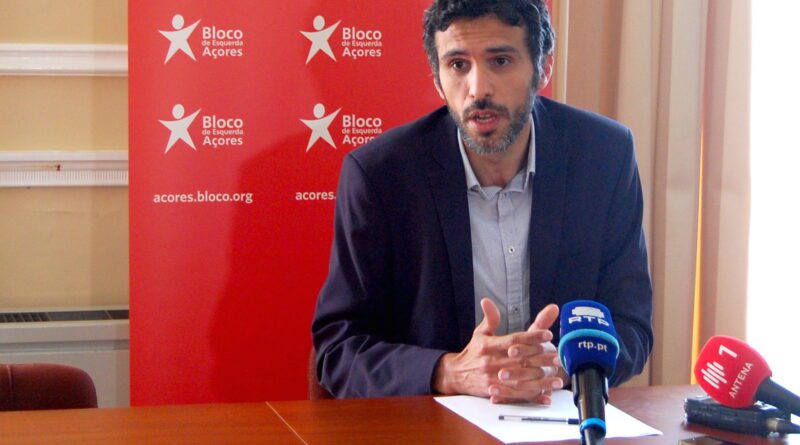
The Left Bloc presented a proposal to make higher education free and accessible for all students living in the Azores, including tuition fees, accommodation, and travel. The aim is to promote a fundamental change that will increase qualifications and improve the economy in the Azores.
The proposal’s timing is also symbolic: “In the year and month in which the 50th anniversary of April 25 is celebrated, fulfill the April constitution in the Azores: Progressively establish free tuition for all levels of education.”
With this initiative, the Bloc wants to guarantee effective equality in access to higher education so that “financial issues are not an insurmountable obstacle for the majority of young people.”
Statistics show that the Azores are lagging far behind the rest of the country.
Only 44.2% of the population finishes secondary school, contrasting with the 62% national average.
The situation is even more worrying regarding higher education: only 17.2% of the population aged between 25 and 64 has higher education, while the national average is 30%, and in the Autonomous Region of Madeira, it is 23.7%.
“We don’t have too many graduates, we have too few graduates. And that’s a problem for our development,” said António Lima.
The Bloc MP points out that “most families and young people simply cannot afford to go to university, especially when we talk about displaced students.”
Between tuition fees, accommodation, travel, and transportation, the costs of attending higher education are exorbitant: “There are many hundreds of euros per month, when the average basic salary is 1,278 euros in the Azores.”

For this reason, the Bloc is proposing the creation of universal support for higher education students, which includes the full payment of tuition fees for degree courses, the payment of three round trips for displaced students, support for accommodation costs according to the cost of housing in each municipality and the cost of public transport in conjunction with local authorities.
This support applies to higher education students at the University of the Azores and, when there is no course or the student does not get a place at the University of the Azores, to students attending other universities in the country.
This criterion aims to reduce the costs of the measure whenever the student is likely to stay in the Azores. It also benefits the University of the Azores itself, helping to attract more students, which is fundamental for its funding.
António Lima estimates that the cost of the measure could reach 14 million euros per year but stresses that it is a significant investment for the future of the Azores because this is a structural change that needs to be made.
He concluded, “We know that the economy will work better and be more productive if it has well-qualified people.”
In Tribuna das Ilhas newspaper from Horta, Faial.
Translated to English as a community outreach program from the Portuguese Beyond Borders Institute (PBBI) and the Modern and Classical Languages and Cultures Department (MCLL) as part of Bruma Publication and ADMA (Azores-Diaspora Media Alliance) at California State University, Fresno–PBBI thanks the sponsorship of the Luso-American Development Foundation from Lisbon, Portugal (FLAD)

 Novidades - The Islands and the Diaspora