

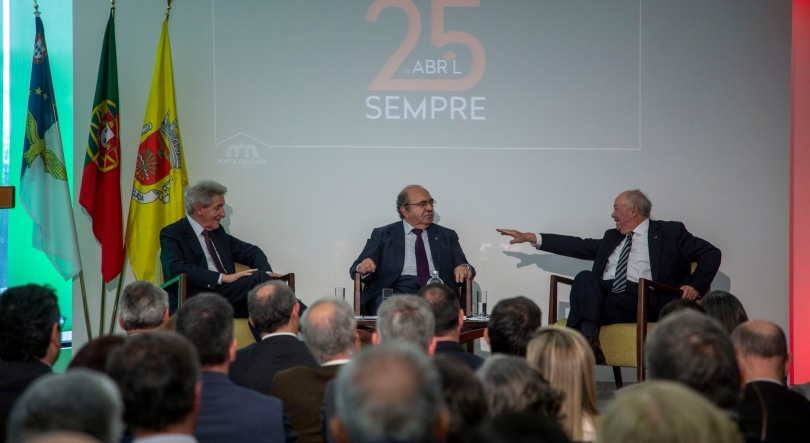
The first President of the Government of the Azores, João Bosco Mota Amaral, said yesterday at the meeting’ 25 de Abril Sempre’ at the Natália Correia Center that the Autonomy he has always defended has been “progressive” and that, over time, there has always been “a struggle that continues to expand this same autonomy.”
Mota Amaral was at the meeting with the former President of the Government of Madeira, Alberto João Jardim, who made it clear that the Autonomy initially ceded to the Azores and Madeira “was not the Autonomy we wanted, “understanding that “people have to be able to realize their happiness.” He argued that “with greater knowledge, the path to follow” for Autonomy is the one that is underway, and that states that “try to prevent” this evolution “are doomed.”
Alberto João Jardim said that in the Republic, “to annoy Madeira, they talked about debts,” but the fact is, he added, that the central government “still owes Madeira.”
João Jardim recalled that when the state “makes regionalizations, it hands over the competences but not the money” and asked for “the accounts to be done since the time of the discoveries.”
The former president of Madeira’s government believes that “Madeira’s debt is below the European Union average,” making it clear that “the weight of debt is not felt in Madeira’s life.” He stressed, “Without investment, there is no development.”
He emphasized that “those who don’t have raw materials have to live off services” and stressed that “at the moment, there is a national suicide.”
João Jardim said, “With the new Regional Finance Law, I’ve been treated like a prince,” and questioned a common Azores and Madeira Regional Finance Law. “I don’t know if a common law won’t harm one and the other (Mainland and Madeira),” said Jardim.
On the other hand, he stressed that Europe “is in a disastrous situation in terms of defense” and, in this regard, believes that “the consequences for those who depend on the outside world will be very bad if there is a world conflict.”

The discussion was moderated by journalist Lopes de Araújo, who closely followed the early days of the Autonomy led by Mota Amaral and João Jardim. Lopes de Araújo took his stance as a journalist, pointing out that “the Azores are different and we live better” before questioning the former President of the Government of the Azores, João Bosco Mota Amaral. Throughout the speeches, Mota Amaral admitted that the then Prime Minister Cavaco Silva “had a problem with the Azores and Madeira because of money”, i.e. state transfers to the two Autonomous Regions.
After recalling that the Government of the Republic had tried, over the years, to centralize the Atlantic Air Control Centre on the mainland, Mota Amaral stressed that “we have held firm to our position all this time” that the Air Control Centre should remain in Santa Maria.
For Mota Amaral, the Azores “made a qualitative leap with Autonomy,” and today we are 90% of the national average and 70% of the European average, “but there is still a lot to do.”
Responding to those who thought the Azores should move towards independence, he said, “What followed independence in small countries were civil wars.” He also revealed that 95 nationalities live in the region.
Mota Amaral quoted the current President of the Government of the Azores, José Manuel Bolieiro, when he said, “We have enlarged Portugal.”
In Mota Amaral’s opinion, “This projection towards the sea and marine resources is our contribution. We represent a very important part of our country,” he stressed.
In an implicit reference to the new Law of the Sea, Mota Amaral said, “We are here demanding what is ours and which has been taken away from us.

He also stressed that the Regions are autonomous from the national territory and autonomous from each other. And it is desirable to maintain solidarity between the two,” he said, referring to the revision of the Regional Finance Law.
Regarding immigration, he said, “We always have our doors open to everyone” and asked: “Why is it that everyone comes here and accepts any job, and then there are people here who don’t want to work? That wasn’t the case in my day. There was, in particular, paid work when no work was at sea.
Mota Amaral defends tourism as a solution for the Azorean economy “if it is balanced with agriculture and fishing. He also maintained one of his ‘golden keys’ of governance: “There has to be harmonious development” in the Azores.
In Correio dos Açores–Natalino Viveira, director

Translated to English as a community outreach program from the Portuguese Beyond Borders Institute (PBBI) and the Modern and Classical Languages and Cultures Department (MCLL) as part of Bruma Publication and ADMA (Azores-Diaspora Media Alliance) at California State University, Fresno, PBBI thanks Luso Financial for sponsoring NOVIDADES.


 Novidades - The Islands and the Diaspora