

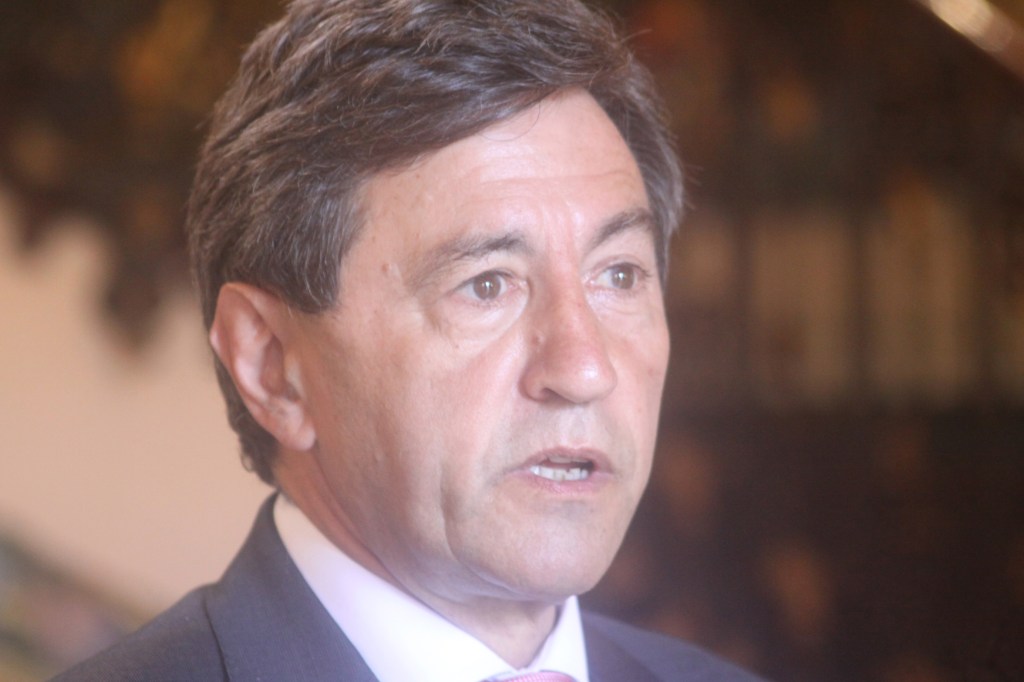
Correio dos Açores – What is your analysis of the economic situation in the Azores?
Mário Fortuna (President of the Ponta Delgada Chamber of Commerce and Industry) – The economic situation in the Azores can be characterized as reasonably good, given that we are coming out of a pandemic. Perhaps precisely because of this, we have had exciting growth rates, although these rates also go after a sharper drop than the national drop during the pandemic’s peak. The drop in GDP in the Azores reached 9%, slightly higher than the national average. So, we are in a period of recovery from an extraordinary episode, the pandemic. Now, we need to look at the underlying trend of the Azorean economy. This will determine whether or not we are on the right track. Looking at this trend, the significant determinants of the Azores’ economic trend are transfers from abroad, the agro-industrial sector, and now, the tourism sector. These are three fundamental vectors that determine the state of the Azorean economy.
Looking at these three determinants, in the field of transfers, we are naturally in a phase that will be, at least temporarily, positive in that we are in the most intense phase of implementation of the RRP (development plan), which is an extraordinary reinforcement of support from the European Union to pull the European economy and regional economies out of the pit they would find themselves in following a pandemic. The RRP has reasonably strengthened this pillar. But let’s remember that the PRR is a transitional program. It is, let’s say, a push to get the economy back on track and able to self-sustain in the future.
Looking at the other pillars, we have the agro-industrial and tourism sectors. How can we look at these two sectors? First of all, the problems of the agro-industrial sector are well known. It is a sector that is naturally also exposed to international competition, particularly in the milk sector. This is a characteristic of the industry. It has always been so. It should continue to be so. Therefore, judging by what has been the reaction of both farmers and industries, the situation is not very comfortable because there are significant tensions, particularly at the primary production stage, which have to be managed and managed very well if the sector is to continue – and it must continue – to be a pillar of the Azorean economy. It has been our vocation for many decades. And it’s still a vital vocation as the activity is eminently export-oriented. This exporting characteristic gives the Azorean economy its dimension, as it cannot survive on internal demand alone.
The other sector, tourism, has also seen the impact of foreign markets. We are still in an excellent phase of recovery from the pandemic. We came out of the pandemic well because the Azores offered conditions people sought. We have a destination and nature, a more or less isolated destination, and, therefore, we have characteristics that all other regions will not have with the same quality. That’s also why we had a growth spurt from the pandemic. But now we’re also starting to feel the impact of the recovery of these markets. All these markets have had two years to position themselves and offer tourists what they are looking for again, which is more sustainable destinations. And we end up having more competition now. And this was and is evident. I cite the problem of Ryanair, which simply opted during the winter for destinations that, for the low-cost airline, are better, more competitive, and offer better conditions for doing business. This is a subtle indicator that we have lost some relative competitiveness.
I remember that when we came out of the pandemic, we had ‘n’ airlines wanting to fly to the Azores and try out a new destination. Now, it’s becoming more complex. The evidence is that we lost one, in the low season, that was very important – Ryanair – because it was one of the significant passenger carriers during the winter season. So these are signs that competition is fiercer and, in this sense, we’ve lost relative competitiveness, which means we’re not doing as well as we used to.
Eight years after we had Ryanair in permanent operation, it is now moving away. This means that, in these eight years, we haven’t moved towards a substantial consolidation of the destination. On the contrary, we’ve lost some competitiveness.
For us, these are signs that show concern and the need for more investment to consolidate tourism, which is fundamental for the Azores. In terms of estimates, the sector already represents 13% of the regional GDP and we estimate that it already employs between 25 and 30 thousand workers. It is, therefore, a vital sector with far-reaching impacts on other aspects, particularly local accommodation. But it’s a sector that, since it’s exposed to external competition, has to be monitored very well and given a lot of attention. And we have to invest, as far as it’s up to the state to invest in the sector, in promoting it and keeping it competitive, for a straightforward reason: the rest of the world is promoting it and competing to win markets. And we either play this game or we lose out. We lose out in tourism, but we can also lose out in the agro-industrial chain.
These are sectors that add new dimensions to the size of the Azorean economy and are the only ones that can do so in the short term. That’s why we have to invest more, we have to devote more time and take more care with policies that guarantee our competitiveness so that the economy remains healthier.
Is the implementation of the RRP good at the moment?
The implementation of the PRR has some flaws. It will benefit national implementation, but that doesn’t mean it’s good. It was a program that, at the beginning, generated some frustration because the projects were slow to be implemented. But this is normal because nothing was planned well for the RRP. Naturally, a series of projects had to be prepared to be implemented. It is now hoped that these last two years of the RRP (2024/25) will be years of acceleration because the projects to be carried out have already been done, and the tenders have, to a large extent, been launched. Therefore, the pace of implementation is now expected to be much higher than in the first two years. This is to be expected. The initial projections may have been too ambitious in the first few years. Still, we hope the authorities will make every effort to fully implement the RRP because our economy needs this boost. Other economies will need it, too. It’s worth remembering again that the RRP isn’t just for us; it’s for various regions of Europe. So, once again, everyone will be competing for future business.

Do you fear that Ryanair will slowly leave the Azores?
I fear this will happen with Ryanair and other companies with seasonal operations in the Azores. I’ll go back to the beginning to say that the tourism sector’s competitiveness is fundamental, and the airline component is itself a pillar of tourism. Anyone who doesn’t have competitive routes for the airlines will lose them. This has happened to us in the past. We lost EasyJet for several reasons. We lost Delta for other reasons. We also lost another of the seasonal ones, which had less impact, for competitive reasons. So the message here is straightforward: this task of retaining airlines is never finished. You have to be constantly on the lookout for the factors that make an air route uncompetitive. And let’s repeat something we’ve said many times before it’s not enough for airlines to want to fly here. Once they are flying, we need to work on consolidating markets and promoting the Azores as a destination so that the airlines can be successful. The success of the airlines is our success. Without the airlines’ success, we won’t be successful because if I don’t have them satisfied, they’ll leave. If they leave, we will take another step backward regarding our progress in this sector, which is fundamental to the economy of the Azores.
Tourism is a sector of the future all over the world, and it’s good that we position ourselves to take advantage of this because it’s also the sector that’s most likely to attract people to the Azores in the near future. It’s a sector that requires a lot of manpower, and if the Azores want to retain their population and return to more comfortable levels of population, they need a sector that retains people. Otherwise, the population drain will be even worse than what happened in the last decade.
To stay in the area of mobility, the Board of Directors of SATA Holding has expressed its opposition to the award of Azores Airlines to the Newtour MS Aviation consortium…
The final decision rests with the Government of the Azores. Given the jury’s opinion, there were significant doubts as to whether the sale should be carried out as it was. And since there was only one bidder, it didn’t get a good enough evaluation to reassure SATA’s management and, possibly, the government. Therefore, rather than continue with a process that casts doubts, it is preferable to reset the process quickly. It’s better to correct what needs to be corrected, and, of course, those who applied the first time have the opportunity to apply again, although we should note that these processes are not free. The companies that put themselves forward to compete incur considerable costs, and we also have to consider this when developing these processes. This is because the last thing you want is for the privatization of SATA to be excessively expensive due to all these vicissitudes. In any case, it’s a process that still has two years to go, by what was stipulated by the European Commission, which allowed SATA to be financially reorganized.

What is needed to achieve a peaceful climate in the agro-industrial sector?
There has to be trust between the parties. There won’t be producers without industrialists and there won’t be industrialists without milk producers either. If the sector is to be pacified, there has to be as much transparency as possible regarding everything that goes on in the agro-industrial sector.
We advocate the creation of a Competitiveness Observatory for the agro-industrial sector. This observatory is essential because this sector is important enough for the Azores to justify the authorities paying extra attention to the whole process. It’s not just about focusing on essential subsidies. All of Europe has subsidies in these areas. And we have to be competitive. However, we need to look at this clearly and transparently, involving all parties so that the negotiation processes are carried out with shared knowledge and information accepted by all. We will better understand the necessary negotiating dynamics when we reach this level. But there will always be negotiation. This is a process that will last forever. When I have two parties negotiating with each other, there will always be some tension. Still, this normal negotiation process must occur on a more informed and capable basis. This basis must also be sufficiently clear so that everyone, including the authorities, knows their responsibility in the process.
The authorities greatly influence the agro-industrial sector, whether in transport or in a series of other rules that impact the industry. That’s why it was important to develop a model for monitoring the sector to provide everyone with adequate, precise, and clear information. This is so that, in the negotiation process, we all speak the same language and form the same knowledge base. This gives us the best chance of reaching an understanding.
When competitiveness fails, it will be the authorities’ responsibility to see what has not been done, what should be done, or what can be done to make the sector as a whole more competitive. Only in this way will they be able to achieve the rewards to which each of the parties aspires.
How is the regional business fabric doing, knowing there is a labor shortage in some sectors?
The regional business fabric is under stress for several reasons. One is that recruiting nowadays is more difficult than it was a few years ago. A lot of people have emigrated, and we’re not attracting immigrants at the rate we would need to meet the labor needs. So, this is a problem that companies are facing.
Another problem that has not been discussed much is the cost of financing business because companies are dealing with financial costs depending on the policies of the European Central Bank to mitigate the problem of inflation. This factor is naturally consuming many of the results that companies aspired to have at a time when they are still coming out of the pandemic.
We have to remember that during the pandemic, many companies were at a standstill for many months. On top of that, they had to resort to additional credit, some of it supported and some of it not. Companies have not yet emerged from the impact of the pandemic or from the impact of the last financial crisis. So, companies are fighting every day for a more sustained recovery of their accounts and results.

In this context, how do you view the 2024 Budget that the Government of the Azores has presented to the social partners and will be voted on in the Regional Legislative Assembly?
For us, the budget has one problem: the volume of resources it will access. This is because the government has once again presented a budget with a zero deficit. There’s nothing against a zero-deficit budget if we can meet all our obligations without harming third parties.
In 2023, with the zero deficit policy, late payments to companies increased. Therefore, to accommodate the lack of sufficient resources, the government maintained very high arrears and even went back on what had happened in 2021. In other words, zero indebtedness turned out to be a fallacy because it managed to find another source of funding, which was the private sector, which ended up not receiving the value of its services and/or the sale of goods at the right time. And the due time is payment within the stipulated deadlines. It’s not 180 or 300 days. It’s 60 days…
Are you worried that this situation of late supplier payments will be repeated in 2024?
It will happen again in 2024 for a straightforward reason. The State Budget was already approved last December and did not foresee any increase in debt for the Azores. Therefore, new indebtedness is impossible because the State Budget didn’t expect it and has to. And it doesn’t foresee it because it wasn’t asked to do so either.
For our part, we believe that converging towards a balanced budget is an objective. In fact, it’s obligatory to present convergence plans for a balanced budget in the law. This derives from the Autonomous Regions’ Finance Law and a general principle that Europe has adopted for all countries that are part of the single currency, which is that, in time, budgets must be balanced. Debt to GDP must be below 60%. This has to happen in time. Moreover, Europe’s new form of budgetary control will stipulate that member states must produce a seven-year budgetary trajectory plan so that countries have time to correct the misalignment of their public finances. Nobody expects to go from a deficit of 4 to 5% or 3% to zero percent from one year to the next. This doesn’t usually happen in economics because doing such a thing makes the economy suffer. Nobody is doing that. We are, in a way, a unique case.
So, it’s essential to consider this zero-term debt process. We’re going to be forced to do it. In fact, we’ve been doing it for a long time, and we haven’t fulfilled this desire to plan for the convergence of accounts toward a balance in the long term. We have already recommended this exercise. We recommend precisely complying with what is stipulated in the Autonomous Regions’ Finance Law to plan ahead. There’s not much point in doing things on the spur of the moment because we know what happens to the economy when this is done. In fact, the great objective of zero deficit by 2023 has not been met.
With a budget deficit of 100 million euros, given that part of it comes from public sector companies. But the truth is that even discounting public sector companies, the government could not balance the accounts in 2023 as it had hoped. These forces are too great to be tampered with as intensely as is being attempted. It is, therefore, unwise, and no one is forcing it. Except for the Regional Legislative Assembly, which approves the Plan and Budget.
Do you believe that 2024 will not also be a year of zero indebtedness, although we aim for this goal…?
Eventually, it won’t be. If we want to do the accounting properly and consider the commercial debt, with the delays imposed in fulfilling support commitments, for example, within the framework of COVID, it won’t be. It’s too demanding an objective, which, in our opinion, is unreasonable.
We insist on this again. We are trapped by the mechanics of approving the Region’s indebtedness, which has to depend on authorization from the State Budget to provide for the debts to exist. All that is provided for in the State Budget transforms commercial debt into financial debt. But this debt is already accounted for. And it’s just a matter of correcting a chronic problem: the government recognizes debt but doesn’t pay it, which happens with commercial debt – late payments to suppliers.
This problem massacres the private economy because when a supplier doesn’t receive the value of their service or sales on time, they naturally have to go into debt themselves. And debt, as we know, is expensive at the moment.

Is there anything else you’d like to add to this interview?
To talk about the economy of the Azores is to talk about many things. It’s not possible to cover all the problems in one interview. We’ve already touched on the central issues facing the economy, which are the problems facing the agro-industrial sector and the problems facing the tourism sector. Both are the areas most exposed to international competition in the world. This has always been the case. And, in our opinion, these are the areas that need exceptional attention, not least because, with the generous contractualizations that are taking place in the public sphere, companies in these sectors (agro-industry and tourism) will find it more challenging to recruit.
When the public sector rises faster than the economy – and that’s what’s happening in the Azores – it will end up diverting attention from the private to the public sphere and will naturally make it more difficult to recruit in the private sphere.
Some personalities linked to April 25, 1974, have criticized the increasing social difficulties in Portuguese democracy…
There are more social problems precisely because we don’t have an economy. Without an economy we will always have social issues. Suppose I don’t have a strong economy that gives people good jobs and enables them to solve their problems independently. I will have a fragile, weak economy with many social issues in that case.
Either I have a good and strong economy to generate the resources needed to have a social economy and even fewer social problems, or else I’ll continue to have social problems and be stuck in a vicious cycle of poverty and backwardness. This is the cycle we’re in. We have social problems because we don’t have enough economy, and until we solve the economic problem, we won’t solve the social problem.
I disagree with the lack of public resources for social issues because there are many sources of social support, whether from the regional budget, EU funds, or national programs applicable in the region. If there’s one thing we don’t have, it’s a lack of social solutions to problems. In fact, I think we have pretty good solutions—so much so that it is criticized that many people choose to rely on social issues to find work.
But here, we have a problem that flows both ways. You can’t get much better jobs without saving money. And let’s remember that, in recent years, we’ve had a tremendous effort put on companies to update wages through the increase in the minimum wage, which also puts immense pressure on businesses. Wage scales in many sectors have seen 7 and 8% increases, unavoidable due to the dynamics of the minimum wage. And the economy is not growing at these rates.
What does this mean? That we are putting immense pressure precisely on the business sector, on companies, and so it is difficult to do more business, to increase the business that we would so much like to do in order to also have more jobs and better jobs for everyone.
João Paz, journalist for the Correio dos Açores newspaper–Natalno Viveiros, director
Translated to English as a community outreach program from the Portuguese Beyond Borders Institute (PBBI) and the Modern and Classical Languages and Cultures Department (MCLL) as part of Bruma Publication and ADMA (Azores-Diaspora Media Alliance) at California State University, Fresno, PBBI thanks Luso Financial for sponsoring NOVIDADES.

 Novidades - The Islands and the Diaspora