

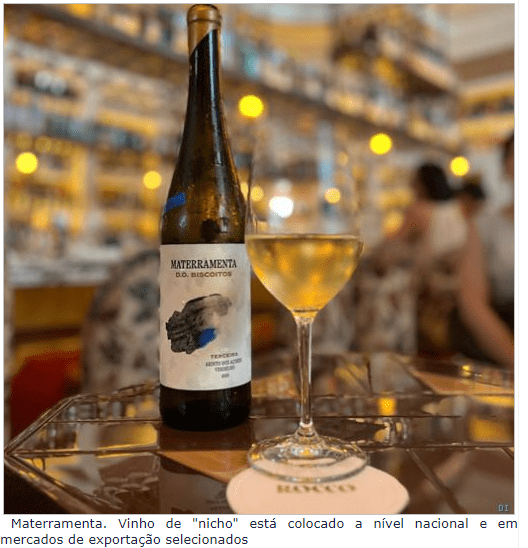
Luís Vasco Cunha, the businessman responsible for Materramenta certified wines, will this year increase the price per kilo paid to the producer from 3.5 to 4 euros “at the very least,” making these grapes from Biscoitos among the most expensive in the country.
He assured DI newspaper yesterday that he intends to expand production, but it is an investment in quality and a question of social responsibility.
“The work done in Biscoitos has nothing to do with what is done in the rest of the country. There’s no mechanization, it’s all manual. I think it makes sense, in a responsible attitude. We’re going to increase the price, as well as continuing to provide technical support services,” he said.
According to Luís Vasco Cunha, another objective is to “contribute to increasing the income of the community in which we operate.”
“Many people who work part-time are involved in this activity. It’s that extra income that makes a difference in households, that allows for those additional things we all need, like vacations and other expenses, and that contributes to more money circulating in the local economy,” he said.
He considered that Biscoitos wines will always remain the “niche of the niche.” In this capacity, Materramenta has already traveled to countries like Spain and Singapore and wants to reach Japan.
“From 2023 to 2022, our production almost tripled, counting our own grapes and those we acquired. This year, between what we’ve already bottled and what we’re going to bottle, we’re talking about 3,400 bottles,” he said.

In three to four years, the horizon is to reach 10,000 bottles.
Quality remains the main thing, however. “To produce more, we depend on external factors. It’s mainly about producing better and realizing that the quality of the wine depends on the quality of the grapes,” he stressed.
The businessman recalled that the Biscoitos demarcated area is the smallest in the Azores and argued that “the only chance we have is to make better things and, above all, things that give us pleasure to drink.”
The “most important work” is done in the vineyard, and the second is done in the cellar.
“We have a renowned winemaker working with us. At the moment, we haven’t sold all the wine because we don’t want to. We’ve already been approached by a national distributor and we’ve signed a distribution contract on the mainland, but for a much smaller quantity than they wanted, because we don’t want to neglect the markets, especially in Terceira and São Miguel, and some exports to niche markets,” he stressed.
Export markets, he said, are very demanding and “don’t tolerate a lack of quality.”

in Diário Insular-José Lourenço-director
Translated to English as a community outreach program from the Portuguese Beyond Borders Institute (PBBI) and the Modern and Classical Languages and Cultures Department (MCLL) as part of Bruma Publication and ADMA (Azores-Diaspora Media Alliance) at California State University, Fresno, PBBI thanks Luso Financial for sponsoring NOVIDADES.


 Novidades - The Islands and the Diaspora