

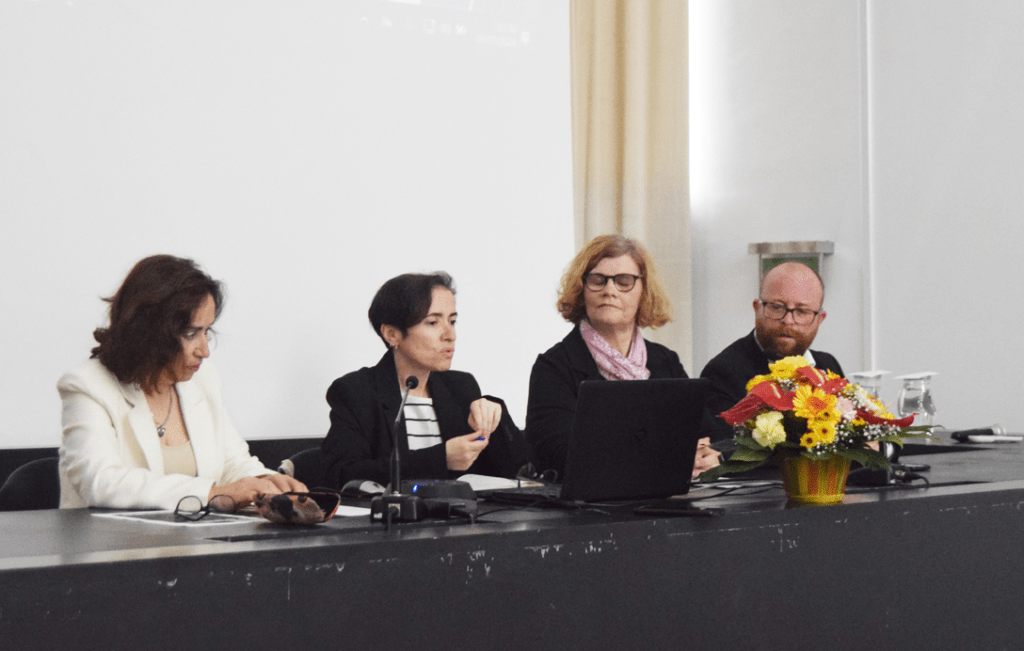
Europe Day was celebrated the day before yesterday in the North Auditorium of the Ponta Delgada campus of the University of the Azores, with an event entitled “Commemorations of Europe Day: the Azores, Europe and the Transatlantic Relationship”.
The opening session of the event was attended by Ana Paula Pires, from the Coordinating Committee of the American Corner at the University of the Azores, representing the Pro-Rector for Cooperation, Internationalization and Distance Learning, Berta Pimentel, deputy director of the Centre for Humanistic Studies (CEHu) at the University of the Azores, Laudalina Esteireiro, coordinator of the American Corner at the University of the Azores, and Paulo Vitorino Fontes, coordinator of Human Right Projects. Ana Paula Pires explains that Europe Day is “always very important and worth marking” and recalls some of the reasons behind its creation.

“If you think about the reasons behind this Europe Day, when (Robert) Schuman thought of it, it would have been to have no more war in Europe, taking into account the memory of the Second World War. Today, Europe is facing challenges, including the war resulting from Russia’s invasion of Ukraine, the impacts of the simmering conflicts in the Middle East and other non-war challenges that can lead to situations of some tension. I believe that the European elections in June could also be a test of all these new challenges that Europe is facing, starting with the issue of fake news, disinformation, technological warfare and, above all, the rise of populism. Therefore, Europe Day is always a very important date and worthy of being marked, and this year with the European elections and all the challenges and tests that democracy is undergoing, it’s another reason for this debate,” explains Ana Paula Pires, from the Coordinating Committee of the American Corner at the University of the Azores, representing the Pro-Rector for Cooperation, Internationalization and Distance Learning.

Berta Pimentel, deputy director of the Center for Humanistic Studies (CEHu) at the University of the Azores, said that the event was created to “give the floor to those who know and give a voice to those who want to learn more about European institutions, which are our young people, researchers and researchers trained in this academy, in our areas of European studies and international relations and who will participate in the round table” of the event, also explaining the commitment of the Center for Humanistic Studies to European studies: “It’s a project that aims to be a stage and be a beam for future developments and, in fact, this close connection with European studies is what justifies the fact that, since our creation, it’s a relatively young center, we’ve always had associates. “
Paulo Vitorino Fortes, coordinator of Human Rights Projects, says that this activity “is an informal moment, but it can be a moment of reflection and learning” for young people. He admits that he has a lot of hope in young people and hopes to be surprised by their greater participation in this European election.
Laudalina Esteireiro, coordinator of the American Corner at the University of the Azores, believes that “almost everything that happens in the world today is of interest to Europe and the United States too” and that is why it is “important for the American Corner to be associated with this initiative”.
In addition to the opening session, the event featured a panel discussion with former MEPs Maria do Céu Neves and Ricardo Serrão Santos, moderated by Carlos Eduardo Pacheco Amaral, Regional Director for European Affairs and External Cooperation, entitled “What challenges for the future of the European Union?” and a round table discussion entitled “Why is it important to vote?”
In Correio dos A;cores-Natalino Viveiros, director
Translated to English as a community outreach program from the Portuguese Beyond Borders Institute (PBBI) and the Modern and Classical Languages and Cultures Department (MCLL) as part of Bruma Publication and ADMA (Azores-Diaspora Media Alliance) at California State University, Fresno–PBBI thanks the sponsorship of the Luso-American Development Foundation from Lisbon, Portugal (FLAD)
 Novidades - The Islands and the Diaspora