

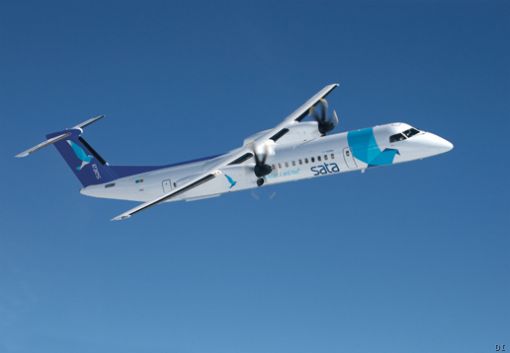
The study “Territorial Cohesion through Inter-island Transport, an In-depth Analysis of the Autonomous Region of the Azores” argues that there are still too many inter-island travelers in the archipelago who are unable to leave and return to their island on the same day.
“It is essential that air and sea operations between islands are concentrated mainly in the first and last hours of the day, expanding the times available for passengers to travel to and from destinations on the same day,” argues the study, carried out by Rui Alexandre Castanho (Faculty of Applied Sciences, WSB University, Poland), José Ángel-Hernández Luis (University of Las Palmas) and Pedro Pimentel and Gualter Couto (University of the Azores).
The researchers stress that “inter-island air and sea accessibility in the Azores has improved significantly, especially since the implementation of the 2015 Public Air Service Obligations (PSOs), which replaced the 2009 regulations” but that “the application of this regulation has not yet been accompanied by timely intervention to promote the cohesion of the archipelago.”
“Many travelers are forced to spend the night away from home, which creates accessibility problems. Our calculations show that, for a worker living on the islands, this overnight stay represents more than 100% of the total cost of the return airfare and cab. Consequently, fundamental accessibility problems, typically analyzed in classic literature and considered in this study, persist without adequate resolution,” they stress.
The study points out that “improving sea and air operating schedules would bring notable benefits for inter-island travelers, as it would avoid high expenses due to an extra stay on the visited island.”
“We mainly analyzed air schedules, since it was possible to make the round trip on the same day on only two sea routes, although these were also considered,” points out the paper published in May.
For the authors, “the absence of inter-island timetables that make it easier to return to the island of residence on the same day undermines the fundamental principle of the door-to-door policy,” and “this policy, encouraged by the European Union through its Transport White Papers, loses its prominence and fails to promote the territorial cohesion of the Azores without addressing this critical aspect.”
They highlight the “fundamental role of maritime and air transport in promoting the socio-economic development of the archipelago, improving the mobility of residents and attracting tourism.”
The authors conclude that “on more than 70% of operational routes, adequate travel times to the destination are significantly compromised.
in Diário Insular-José Lourenço, director
Translated to English as a community outreach program from the Portuguese Beyond Borders Institute (PBBI) and the Modern and Classical Languages and Literatures Department (MCLL) as part of Bruma Publication and ADMA (Azores-Diaspora Media Alliance) at California State University, Fresno, PBBI thanks Luso Financial for sponsoring NOVIDADES.


 Novidades - The Islands and the Diaspora