

With many Americans and Canadians of Azorean ancestry, especially those tied to the island of Terceira, going to the Azores for these celebrations that begin on June 21st, NOVIDADES by BRUMA PUBLICATIONS will publish a series of articles about these festivities, known as the largest non-religious festival in the Azores – although the festa does have a religious component. This first article is from Diário Insular, the well-known and respected daily (except Sunday’s) newspaper from Terceira island. We believe that the strong bond that unites Azoreans of all generations with their ancestor’s homeland can be intensified if it is filled with historical information and not anecdotal bits and pieces that, unfortunately, are still seen and heard throughout the Azorean Diaspora. We hope that articles such as this one from the DI newspapers and others to follow will be helpful to those visiting the island during this event and the entire diaspora in North America. These stories and our NOVIDADES coverage of the Sanjoaninas in English are also made possible thanks to a gift to PBBI-Fresno State by the Tulare-Angra Sister City Foundation. We (PBBI-Fresno State) also thank the Municipality of Angra do Heroismo for partnering with California State University, Fresno, on various projects, including a yearly student exchange program, Bruma Publications ( a forthcoming book on Folktales from Terceira and São Jorge) and many other projects that enrich the islands and the diaspora, from the Atlantic to the Pacific.

Like the Carnation Revolution of 1974, the Sanjoaninas, as we know them today, are celebrating their 50th anniversary this year.
Three days before the festivities start in the city of Angra do Heroísmo, the Diário Insular newspaper traveled back to its origins to tell the story of the new model for the São João celebrations, created in the year that democracy triumphed in the country.
The Festas Sanjoaninas, formerly known as the “City Festivities—or City Festas”(a word festa that in California is deeply associated with the Azorean community), are held every year at the end of June and are known as the most prominent “profane festivals in the Azores,” says writer Isabel Coelho da Silva.
However, the celebrations weren’t always along the same lines, and it wasn’t until 1974 that the festivities we know today were created.
CITY FESTIVALS
The City Festivities were launched in 1924 but interrupted in 1938. They returned to the streets 20 years later.
Between 1937 and 1957, only the traditional bullfight on St. John’s Day was held, although Maria Manuel Velasquez Ribeiro, in the book A Cidade em Festa, says that in some years, it was “a complete failure.”
In 1960, 22 years after the last edition, the festivities returned with an “ostentatious” program and significant public interest. What’s more, they presented a formal proposal that was very close to the current model of festivals.
“The most obvious intention of the promoters of this period was to give the festivals the role of a tourist attraction. Although this was a purpose that had already animated other generations and committees, the main thing now was to spread the pleasant image of the island, its achievements in terms of history, heritage and landscape, as well as demonstrating its economic potential, of course,” wrote Maria Manuel Velasquez Ribeiro.
There were no festivities in 1961, and the program was much reduced in 1964, 1965, 1967, and 1969.
With the Festas da Cidade’s reappearance, some sporting events again appeared, such as the Gincana Automóvel, later called the Rali. Visits to local sites and industry continued to be promoted as “a way of making the island known to visitors and tourists”, reads the book “A Cidade em Festa”.
However, the highlight was the cultural component and its diversity, which emerged with the association of partners such as the Historical Institute of Terceira Island, the Musical Academy of Terceira Island, the Angra Radio Club, and the National Union of Office Employees and Sales Clerks of the Angra do Heroísmo District. These partnerships promoted their events, the most significant example being the first Azorean song festival.

The Floral Games (Jogos Florais) returned in 1959 and lasted until 1972, “when the festival’s prominence had passed.” In the first year of this new cycle (1958), the Floral Games were not on the program, having been replaced by a session in the Salão Nobre of the Town Hall, where the queen presided over the presentation of a poem “Festas Velhas… Festas Novas”‘. The poem by Maria Francisca de Bettencourt featured “two characters representing the past and the present, the first describing the past festivities as local historiography had already established them, while the second presented the new program, showing that the novelties ended up being a continuation of tradition in new guises,” explains the writer.
The procession, route, and “double performance” have undergone various changes over the years.
“While the route has been fixed as a result of experimenting with various models, the same had happened with its structure, which has benefited from the contributions of many local artists, both in its conception and in its construction and decoration, an aspect in which Hildebrando Borges stands out, in 1966, when he abandoned the version of autonomous cars representing different entities, replacing it with a procession with a narrative character. “the taroleiros and charameleiros who opened the procession preceded three cars in which the Chief of Protocol and the orderlies followed, then accompanied by four swan-like cars carrying eight ladies – the eight islands of the archipelago – who came to greet Angra, Terceira and the Queen, alone in the last car,” said Maria Manuel Velasquez Ribeiro.
In 1963 and 1968, in addition to the Queen’s procession, there was also a procession of floats, which, in practice, was staged by the rural parishes and the press and called the ‘Parade of our People’s Work’.
TRANSITION TO SANJOANINAS
The second half of the 1970s was marked by the renewal of the festivities’ organizational model and a significant change in objectives and initiatives.
The establishment of the new democratic political regime was not indifferent to the changes made, but financial difficulties meant they could not be held annually. The solution was to share the festivities with Praia da Vitória in a partnership that began in 1978.
The Sanjoaninas are part of the celebrations of the “popular saints” and have St. John as their patron. From June 23rd to 24th, the “Night of St. John” is celebrated, also known as the “Night of the Machas”.
The São João festivities in the city of Angra last between eight and ten days and include cultural, sporting, bullfighting, and religious activities. They include events that have existed for several decades, namely the Queen’s procession, ethnographic and themed parades, famous marches, St. John’s bonfires, bullfights, festivities alluding to the Holy Spirit, games, and sports.
The tradition of the marches began in Praia da Vitória shortly after the earthquake of 1980, when the Sanjoaninas were held every other year between the city of Angra and the “then young” city of Praia da Vitória.
In 1974, a few months after April 25, a “new model of festivities was presented that sought to encompass various thematic areas”, explains Isabel Coelho da Silva in her book “Luís Bretão: Um Terceirense de Causas”.
At a time of uncertainty and celebration, a committee led by Luís Bretão and Pedro Leal revived the Sanjoaninas, the former Festas da Cidade, with the launch of a festival model that still exists today.
In 1974, the festivities ran from June 22 to 30 and featured an opening procession with Maria Manuela Flores Brasil as queen.
The program was unique in including events all over the island, from S. Carlos to Praia da Vitória and S. Sebastião. Meanwhile, the Holy Body was present in the World Heritage city, where the night of St. John, still without marches, and a night of Popular Saints took place.
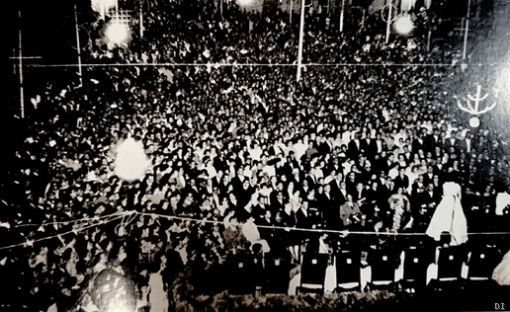
“The program was exclusively made up of the ‘silver of the house,’ seeking to value ‘our culture’,” said Luís Bretão, quoted in the book “Luís Bretão: Um Terceirense de Causas.”
In the year of the Carnation Revolution, the commission was made up of the following members: incoordination, Luis Bretão, and Pedro Alberto Leal; in information and propaganda, Francisco Fialho and José Daniel Macide; in administration, Jorge Henrique Medeiros and José Guilherme Bendito; in commerce and industry, José Manuel Moniz and João Carlos Paim; in shows and decoration, Manuel Coelho de Sousa and Álamo de Oliveira; in sports, João Botelho Pereira and Luís Manuel Louro; in bullfighting, José Duarte Couto, Luís Alberto Ourique and David Leonardo; and in accommodation and transportation, Floriberto Pereira and Amílcar Maciel da Costa.
After the “success” of 1974, the members of the commission agreed to organize the Sanjoaninas again every 10 years, something that was accomplished in 1984 but failed in 1994 “due to disagreements with the then president of the CMAH–City hall-the Mayor,” explained Luís Bretão.
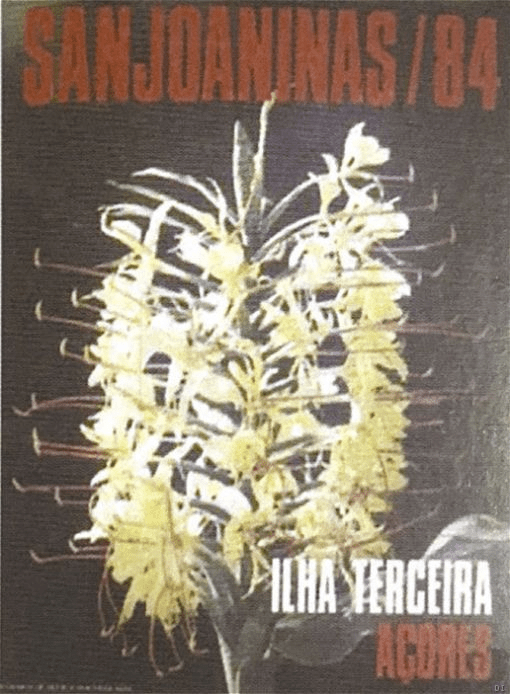
In 1984, the festivities began with an opening procession on June 20th, in which no queen existed. This was followed by the introduction of the Terceira Island Theater Festival, a regional folklore festival, and an array of local singers.
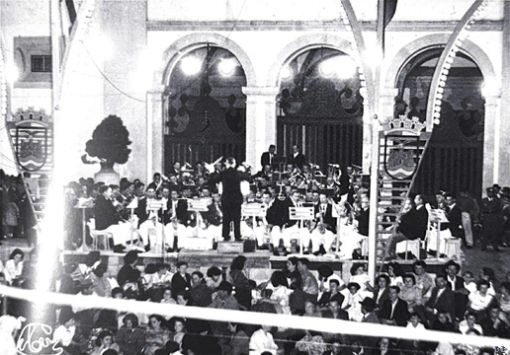
A presentation of the island’s philharmonic bands was also organized, in which around 600 musicians played the official march, and the new bullring was inaugurated.
The ’84 committee was also the driving force behind the children’s program, which is still running today. That same year saw the first bullfighting festival for children.
in Diário Insular, José Lourenço-director
Translated to English as a community outreach program from the Portuguese Beyond Borders Institute (PBBI) and the Modern and Classical Languages and Literatures Department (MCLL) as part of Bruma Publication and ADMA (Azores-Diaspora Media Alliance) at California State University, Fresno, PBBI thanks Luso Financial for sponsoring NOVIDADES.

 Novidades - The Islands and the Diaspora