

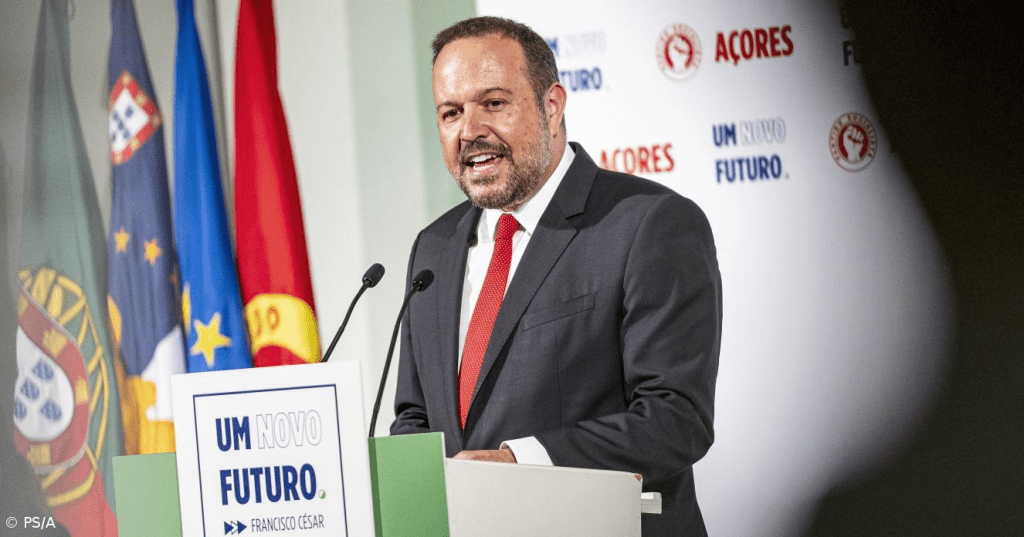
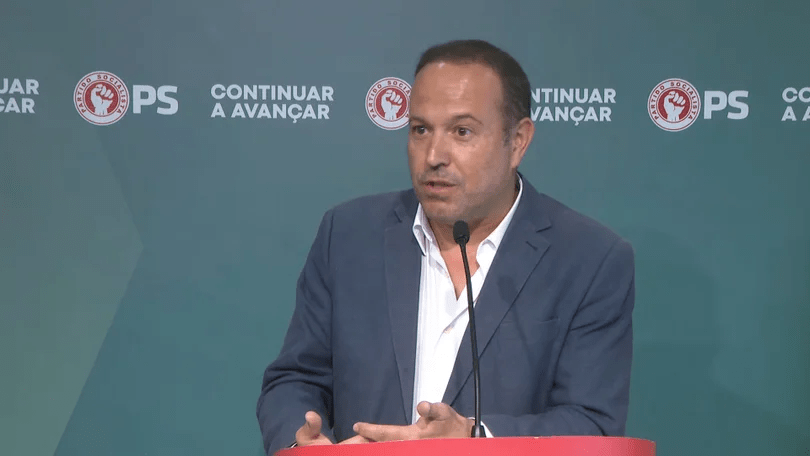
For those who like to accompany what transpires in the Azores and some of the challenges the archipelago faces daily, read this extensive and informative interview by Francisco César, the only candidate to lead the PS-Azores.
What motivates you to run for the leadership of the PS-Azores at this particular moment?
I’ve been a PS militant since I was a teenager. My parents took me to a political congress in Troia when I was less than a month old. I grew up physically and intellectually in contact with politics and following the successes and failures of the PS, its good times and bad. I never shied away from difficulties or stood on tiptoes in anticipation of or after victories. I’m from a time that now sometimes seems to have returned when you or your family were insulted for being from the PS or were afraid of being from the PS. I wasn’t scared; I’m not afraid of any election outcome, for I live well in a democracy, even when it has resulted in the most challenging situation for the PS, such as the one we’ve been in since the last elections.
Politics is full of people who, according to their convenience, pretend not to see or hear and who turn their backs at certain times when, with even more reason, they should face the problems head-on. They suspend their civic commitment, saving themselves for easy times. I am running to reunite, renew, and lead the PS and to help the PS regain energy and hope in strengthening its influence and winning again for a New Future for the Azores because the present does not bode well for our islands.
There are signs that the PS-Azores needs to reorganize itself, possibly at all levels. How far are you prepared to go regarding organization, operating dynamics, and the renewal of political cadres?
We’re not going back to where we started, but we’ll have to look at the path we’ve been on and change what we think went wrong or wasn’t in line with the ambition and results that a party like ours wanted or should have wanted. We need to review development policy priorities, just as we need people from other political, professional, and intellectual cultures to collaborate or even help in the direction and political definition of the PS. Many people, even from older PS leaderships, agree with me and feel that we should go down this road. But I would like everyone to feel comfortable in the PS on this new path, even if they no longer have a role that they used to have.
The PS must not lose its origins, ideological parchments, and status as an autonomous party. However, always doing the same thing and having the same opinion when realities change and when each of our islands has problems and demands that are not necessarily the same is not an intelligent attitude, nor does it serve the sustainable development of the Azores. Harmonious development, as I understand it today, doesn’t mean identical policies but rather different policies for the same desired goals of progress for all our parts.
I want independents in general and people who are qualified and necessary to have access to, collaborate with, and contribute to the PS’s definition. I want the PS to reflect this renewal as much as possible in the next local elections, which are an important moment. I know that this won’t happen overnight, but I’m not running for the PS leadership in order to exhaust what I intend to do at the first setback.
You’ve already said that you don’t deny the PS-Azores’ past policies but are focused on the future and even willing to make a break. What specific policies are you considering, and what breaks might be necessary?
No, I don’t deny the policies of the past, much less those of the PS governments. I very much value the pioneering efforts of the early days of the PSD and the PS.
Some people newspaper columnists who belong to the PSD think that the world began in 1975, was erased when the PS won, and was resurrected when they returned to power. And I don’t like these ways of misrepresenting history: the PS governments did a lot of transformation, modernization, and work in the Azores and brought justice and security to so many Azoreans from Corvo to Santa Maria. I think the worst government we’ve had is the one we have now, but we’ve also had good leaders with the PSD in other governments. The Azores have changed a lot and for the better in the 50 years of democracy and 49 years of autonomy that we are celebrating now.
But I’m sure that a lot needs to change, and this is already set out in large part in the Motion I’m presenting. However, it’s not a government program, I’ve announced that these new policies should be reflected on and refined at the Forum for a New Future for the Azores that we’ll be holding on the main areas of intervention and on the various islands. We must not be afraid of these debates and of contradicting each other, even if the duly substantiated conclusion is to do the opposite of what we thought we would do.
As I have said, we need a new, more open economic model that produces wealth and qualified employment, not simply companies, employees, and consumers who, however many they may be, produce without retaining much value in the region, workers who earn a minimum, and a market that is also minimal.
We have to generate more value in the agriculture, fisheries, and tourism sectors, but, supported by those who know, we have to associate the most essential aspects of a new future for our economy with the new economies, the sea economy, digital, technology, decarbonization, and the energy transition. We have undervalued and even ignored these dimensions, which we sometimes talk about but almost always do little about. We have tried to satisfy only the established and traditional economic routines. It is only because of the fact, which does not entirely depend on us, that tourist flows to regions like ours have increased significantly since the turn of the century that we have been able to keep up.
We still have a slow and disorganized public administration, which doesn’t encourage investment but does constrain it. We still have diminished response capacities and processes stalled by huge bureaucratic obstacles. We need to cut this right down, and the Forum should also reflect on this.
A small region like ours can only grow with what it does very well and with what guarantees more sustainability, not just what it’s used to doing or because it’s impossible to stop doing something. This is how I want to get the PS thinking and mobilizing contributions and guidelines quickly and well.
Taking the example of the PSD-Azores, which, after two decades in power, went into a spiral of defeats from 1996 onwards, only regaining power in 2020 and even then in the coalition, do you fear that the PS-Azores, marked by 24 years in regional power, may not be able to return to power in the region so soon?
I’ve already answered that. My most pressing issue is for the PS to renew itself, to look around in a more attentive, intelligent, and valuable way that stands up for our citizens and to be a better political party. The sooner we achieve this, the sooner we will strengthen the confidence of the Azoreans. The PS is not going on vacation, either as an opposition or as an alternative; on the contrary, we will work overtime to convince the Azoreans. I want a party that wins because that’s how we’ll help the Azores.
You’ve clarified that education is a fundamental strategic objective for the policies you advocate for the Azores. What model of education do you advocate? What role do you give to vocational education? What strategies do you have to motivate children and young people and enable families to have an affordable and accessible education, from preschool to university levels?
Education is the top priority for the PS, and it must be a valid regional goal, probably with national aid. The results for dropout rates in Education and Training programs, despite the 14.1 percentage points drop in 10 years, are still totally incompatible with any sustainable development policy. Currently, the Azores has 21.7% of high school dropouts, the mainland has 8%, Madeira has 9.3%, and the European Union target is 9%. We must act now so as not to miss the competitive train of growth and the fight against poverty. The aim is for the Azores to lead the country’s main qualification indicators for its young population within a generation.
Individual action will not be enough. We need to create an actual project for society, embodied in a partnership between the government, the educational community, local authorities, IPSSs, companies, and the cultural and recreational associative movement, which will enable the creation of a full-time, universal, and free school, from birth to higher education.
This idea to be implemented, in general, allows for individual monitoring of each child from the outset, eliminating any economic barriers to education (food, transport, fees, etc.) from school to higher education, providing, in an organized and reinforced way, universal access to accompanied study, sports practice, art education, leisure activities, digital resources, and community learning initiatives. We need to develop a strategy for vocational education that is part of this policy but, at the same time, is clearly targeted and specialized according to the needs of the internal and external markets to boost the economic activity and income of those who have graduated.
I’m very proud of this project, which can and must be improved in the Forum I want to implement. At the moment, some national and regional experts in the field of education are involved. In the future, I intend to extend it to include experts from other related fields, namely poverty and the economy.
The training of Azorean executives (at home and abroad) has proved to be a problem since many don’t return to the islands, and others choose emigration (permanent or seasonal) because they can’t find work here or work with dignity (which is a different thing). So, we are investing in the prosperity of other countries or regions. What is your vision for an economy that tends to solve this problem?
Labor and residential mobility are already almost universal. In the Azores, we also have people from other origins with greater or lesser qualifications.
We will only gain from this if we train people outside the region in professional areas with quality jobs and compatible pay. The worst thing is for people to leave for training and not be able to return to the profession in which they specialize. Then they won’t stay here. The problem, as you can see, is not solved by scholarships or tuition fee support, while good policies in cases and areas of need are not decisive later on. It’s like giving a small birth grant. It’s good, but it doesn’t solve the demographic deficit. All this proves that Education and Economics, or Economics and Education, must go hand in hand.
You have spoken of great strategic understandings with the PSD-Azores, an example being your proposal for a dialog that could save SATA. How far are you willing to go in understanding these? Which sectors should be treated as autonomous (state) issues, and should consensus be generated between the significant forces?
SATA is going through a crisis that could cause it to collapse for good. We must be aware of this. Unlike TAP, the restructuring has not had promising results or has not been carried out. Restructuring is not just about capitalizing. For us, SATA is a fundamental instrument for our development and communication between us and the outside world. If it continues like this, it’s the end. I’ve heard that the government has taken a positive view of my availability, and we will then work if the government doesn’t think it’s right in everything it feels and wants to decide to save the company.
I’m not going to lead the PS to help the PSD or serve as a crutch for a government that, four years in, has nothing more to offer than what it can already do at the expense of the PRR and little else. But I won’t be ashamed; on the contrary, I’ll be proud if I can help the Azores progress and have a new future by preventing that future from being compromised now.
Other issues that need to be amended will have to be agreed upon between the PS and PSD, either because they require a qualified majority or because if there is no agreement in the region, it will be difficult for them to be agreed upon in the Republic. We’ll see, but the signal we’ll give on SATA will be a start.
In Diário Insular, José Lourenço-director
Translated to English as a community outreach program from the Portuguese Beyond Borders Institute (PBBI) and the Modern and Classical Languages and Literatures Department (MCLL) as part of Bruma Publication and ADMA (Azores-Diaspora Media Alliance) at California State University, Fresno.
 Novidades - The Islands and the Diaspora