


The following is an in-depth interview by the Diário Insular newspaper that details some of the ongoing issues in the Santa Barbara volcano on Terceira island. We encourage those interested in reading about this most recent seismic activity in the Azores.

JOÃO FONTIELA. SEISMOLOGIST AT THE EARTH SCIENCES INSTITUTE OF THE UNIVERSITY OF ÉVORA, PORTUGAL.
We know that you’ve been following the ongoing earthquake-volcanic crisis on the island of Terceira for scientific reasons. What are the main characteristics of the phenomenon, and how do you assess the current situation (given the available knowledge)?
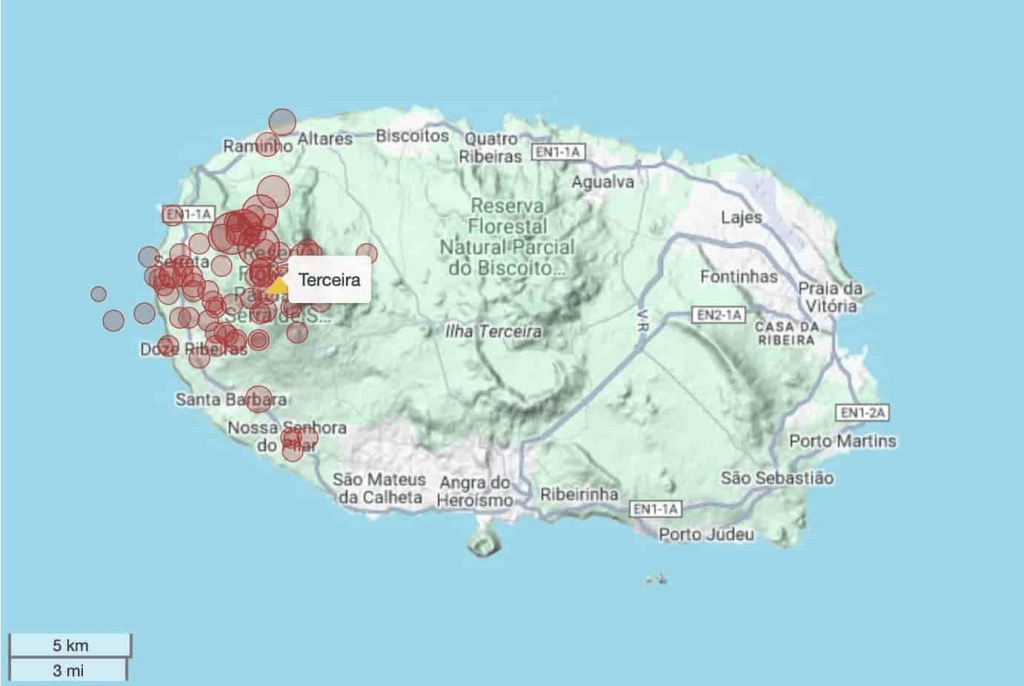
The seismic crisis at the Santa Bárbara volcano does not differ substantially from other crises. The only differentiating aspect is that, to date, there have been three earthquakes with a magnitude greater than 4.0 (4.1, 4.3, and 4.5 local magnitudes). Otherwise, the pattern of seismicity is similar to other volcanic systems in the Azores. The seismicity is primarily superficial. In 2019-2020 I had a temporary seismic network on Terceira Island and even then the seismicity was shallow. During that period, we detected some volcanic earthquakes.
Undoubtedly, the Santa Bárbara volcano is in an active phase. We have no instrumental records of other seismic crises in this volcanic or neighboring system. The last eruption in Terceira was underwater to the west of Serreta, in 1998-2000, and at the time, the seismic networks didn’t have the quantity that seismic stations have today, so there isn’t enough information to compare the seismicity pattern of the Serreta eruption with the seismic activity in Santa Bárbara. In addition, historical information on the 1761 subaerial eruptions in Terceira, Mistérios Negros, and Pico de Fogo is very sparse, revealing only the most significant events before and during the eruption.

Considering the current situation and historical knowledge of similar occurrences, how is the phenomenon most likely to evolve? What still needs to be known for predictions to begin to have a more significant degree of certainty?
Although it’s possible to predict that an eruption could occur in a few days, it’s impossible to predict the day, time, location or explosiveness, so it’s of little use to Civil Protection to activate the emergency system. I like to use Iceland as an example when predicting eruptions because volcanoes and volcanic systems are monitored using a holistic approach with different techniques (seismology, crustal deformation, gases, remote sensing, fiber optic cables). For example, on November 11, 2023, Civil Protection evacuated the town of Grindavik because an eruption was imminent. The eruption occurred on December 18th, more than 30 days after the evacuation. Is it any wonder that the forecast failed? It didn’t. Volcanic systems are very complex and, therefore, difficult to predict. This is to say that before an eruption, there are precursors that indicate that an eruption may occur soon, while in earthquakes, there are no reliable precursors that suggest that there will be an earthquake.
In the last 25 years, there have been a few crises in the Azores due to magmatic intrusion (magma rising towards the surface), which have not resulted in an eruption. Why? That’s the question we want to understand, so we installed a temporary seismic network to collect as much information as possible for the study.
Are there any similarities between the recent crisis in São Jorge, which evolved to a V4 alert and decreased to V1 without any significant incidents, and the ongoing crisis on the island of Terceira? Can what happened in São Jorge be replicated to some extent in Terceira? Is this, to some extent, an Azorean pattern?
As far as that question is concerned, I can only say that those who issue the alerts have information that allows them to decide on the alert level appropriate to the situation.

In this crisis, the occurrence of earthquakes is not concentrated only in the Santa Bárbara area (where it is, however, very significant) but is spreading throughout the Central Group. Today (2024.07.01), for example, the area most affected by substantial earthquakes seems to be the D. João de Castro Bank, between Terceira and São Miguel. What do you think of this apparent dispersion?
Terceira Island and the Dom João de Castro Bank are part of the Terceira Rift. However, Dom João de Castro is an active volcano, just look at the degassing and the hot springs that exist, and as such it has its own behavior. That’s not to say that there’s no induction of a stress field from one system to another nearby system. I don’t think that’s the case because, in 2019 and 2020, periods of more intense seismic activity on the D João de Castro Bank were not reflected in the seismic activity on Terceira Island and vice versa.
The occurrence of earthquakes during this crisis is concentrated in the Santa Bárbara area (where it is, however, very significant) and extends throughout the Central Group. Today (2024.07.01), for example, the area most affected by substantial earthquakes seems to be the D. João de Castro Bank, between Terceira and São Miguel. What do you think of this apparent dispersion?
Terceira Island and the Dom João de Castro Bank are part of the Terceira Rift. However, Dom João de Castro is an active volcano, just look at the degassing and the hot springs that exist, and as such it has its own behavior. This is not to say that there is no induction of a stress field from one system to another nearby system. I don’t think that’s the case because, in 2019 and 2020, periods of more intense seismic activity on the D João de Castro Bank were not reflected in the seismic activity on Terceira Island and vice versa.
Given the current crisis in Terceira, what should be communicated to the people, what measures should be prepared, and how should the relationship between the inhabitants, the authorities, and scientific bodies be handled? George Orwell wrote that “Ignorance is strength!” Is that the best way forward?
Many people ask me this question, and my answer is straightforward. People should follow the information provided by the Regional Civil Protection and Fire Service of the Azores and by the municipal civil protection service of the Angra do Heroísmo city council. Here, I commend the Regional Civil Protection Service and the Angra do Heroísmo City Council for designing and distributing an information leaflet for the population on what measures to take in the event of an earthquake or eruption. This type of communication must be strengthened and involve the inhabitants, the authorities, and the scientific community. We mustn’t forget that the scientific community is the one that produces knowledge and, therefore, has a responsibility to transfer that knowledge. When this is the case, we achieve full cooperation. In this respect, I’d like to give the example of the Cycle of Conferences to commemorate the 1964 earthquake crisis in São Jorge, organized by the Angra do Heroísmo city council. It was an opportunity for the inhabitants to listen to the scientific community and, at the same time, present their doubts and fears. The other question is whether this information, using these vehicles, reaches the younger generation? I don’t think so because the younger generations mainly consume graphic and animated information. You only have to look at the type of social networks they use, essentially Instagram and TikTok, so there is a need to produce digital content for the younger generations and beyond. Video is undoubtedly a clear and effective form of communication.
Although our islands are subject to seismic and volcanic phenomena, we don’t historically have a civil protection culture like, for example, Japan or Iceland, which suffer from the same problem and where exercises with the people are commonplace. It seems that situations like the recent one in São Jorge or the current one in Terceira end up being normalized. Can you find any reason for this?
I think the answer is that because of the low frequency with which events occur, people quickly forget to invest in a culture of civil protection. Your examples are good because earthquakes, eruptions, and tsunamis occur frequently in those two countries, and people know what to do because these phenomena arise so often. In other words, exercises are fundamental, but they only become effective when we experience the phenomenon frequently. That’s why there is no normalization in the Azores; people don’t experience these natural phenomena often. When I lived in Terceira, I noticed that people knew the need to build and rebuild, integrating elements to reinforce seismic action. But when I asked them what they should do during an earthquake, they said, “Run out the door.” This means that the consequences of the 1980 earthquake have been engraved in Terceira’s collective memory, except for the self-protection measures to be taken during an earthquake, for example.
In diário Insular, José Lourenço-director
Translated to English as a community outreach program from the Portuguese Beyond Borders Institute (PBBI) and the Modern and Classical Languages and Literatures Department (MCLL) as part of Bruma Publication and ADMA (Azores-Diaspora Media Alliance) at California State University, Fresno, PBBI thanks Luso Financial for sponsoring NOVIDADES.

 Novidades - The Islands and the Diaspora