


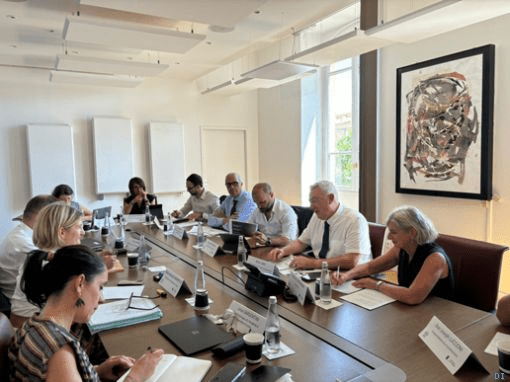
The Vice-President of the Regional Government of the Azores, Artur Lima, defended today, in the Assembly of Corsica, the need for a “mature and dynamic Autonomy” to face the social and economic challenges of the Azorean islands, also emphasizing the importance of the “solidarity of the State” which must “honor its commitments.”
“It’s still up to the self-government bodies of the autonomous regions to make efforts to deal with insularity, isolation and geographical distance from the country, and thus move forward with concrete solutions to improve access to health, reverse the course of social and education indicators, facilitate air mobility for residents, strengthen social protection, prevent emigration and depopulation and boost private economic activity,” he said.
He continued: “Only a mature and dynamic Autonomy, with the solidarity of the State, will be able to present solutions to the challenges and constraints that insist on affecting our economic and social development.”
Artur Lima spoke yesterday at Corsica’s Committee on Legislative and Regulatory Powers and Statutory Developments, where he addressed the challenges of regional autonomy in the Azores and the development of the region’s Political-Administrative Statute.
According to Artur Lima, although the Azores are “directly responsible for their development”, the state will “always have to honor its commitments, fulfilling its sovereign functions and the maxim of national solidarity” in areas such as air mobility, social security or submarine cables.
“Autonomy cannot be translated into a lack of responsibility on the part of the state,” he stressed.
Listing challenges such as the fight against poverty and social exclusion, shared management of the sea, making full use of the archipelago’s geostrategic potential, or recovering the competitiveness of sectors such as agriculture or fisheries, Artur Lima stressed that these issues “must continue to receive political attention.”
On the other hand, Artur Lima warned of the “lack of electoral participation by Azoreans,” arguing that “autonomous democracy should be equipped with voting mechanisms for emigrants and Azoreans on the move” and ensuring the implementation of “educational instruments to raise awareness of the importance of regional autonomy.”
Particular emphasis was placed on strengthening the Azorean voice in the country’s and Europe’s decision-making forums, with the Vice-President of the Government advocating the creation of its own constituency for the European Parliament and the constitutional enshrinement of the possibility for the Presidents of Regional Governments to attend meetings of the Council of Ministers when issues concerning the Autonomous Regions are discussed.
In his speech, the Vice-President of the Government also highlighted the historical importance of Autonomy and its link to the distinct identity of the Azorean people, a subject developed by Vitorino Nemésio, who coined the term “Azoreanity”.
Artur Lima, as mentioned in a note published on the Government Portal, highlighted the political evolution of the Autonomous Region of the Azores from establishing the democratic regime in Portugal to the enshrinement of the respective Statute.
Concerning the Political-Administrative Statute, he mentioned that it has undergone several revisions over the years, culminating in the last one in 2009. This one defined the fundamental objectives of Autonomy, such as the balanced development of all the islands or the consolidation of European integration.
In Correio dos Açores-Natalino Viveiros, director (photos from Correio dos Açores and Diáirio Insular)
Translated to English as a community outreach program from the Portuguese Beyond Borders Institute (PBBI) and the Modern and Classical Languages and Literatures Department (MCLL) as part of Bruma Publication and ADMA (Azores-Diaspora Media Alliance) at California State University, Fresno, PBBI thanks Luso Financial for sponsoring NOVIDADES.

 Novidades - The Islands and the Diaspora