

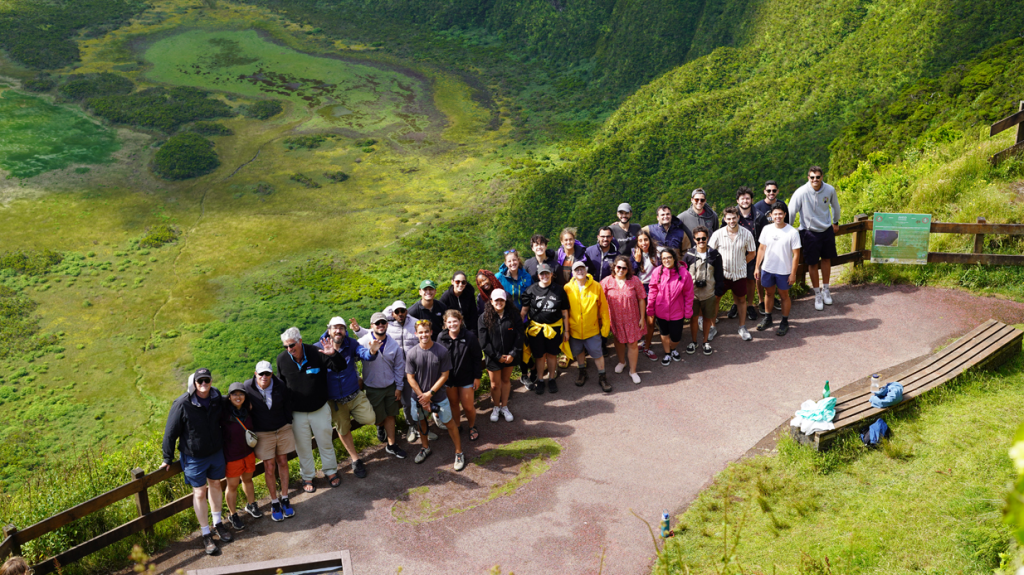
The island of Faial hosted the fourth edition of the Marine Robotics Summer School, a joint initiative of OKEANOS – the Marine Sciences Research Institute of the University of the Azores, LSTS – the Underwater Systems and Technology Laboratory of FEUP, MIT – Massachusetts Institute of Technology and the MIT Portugal Program (MPP), with the AIR Center, CoLab +ATLANTIC, the Gaspar Frutuoso Foundation and the Azores Sea School (EMA) as partners. This year, it was supported by the Regional Government of the Azores.
Over the last two weeks, twenty-six students of various nationalities have been able to share knowledge not only in marine robotics but also in marine ecology and oceanography, more specifically, in applications for ocean observation, archaeology, and ecosystem mapping.
The course has a theoretical-practical component, which allows the students to apply everything they learned in a real-life context.
The workshops presented the fundamentals of marine science and the use of robotics in ocean research and monitoring. The demonstrations and fieldwork showcased the latest technology in autonomous systems, sensors, and remote operations, allowing the students to collect data such as temperature, salinity, and pressure. The proximity to the sea gave the students direct contact with the oceanographic phenomena of the Azores, making it easier for them to analyze and collect data.
Gui Menezes, professor and director of Okeanos, says, “We are in the ideal space and have excellent conditions not only to host this type of course but also to welcome people from all over the world so that we can advance knowledge, science, and marine engineering.”
Douglas Hart, professor of mechanical engineering at MIT and co-director of the MIT Portugal program, also points out that “bringing together students with such different professional backgrounds in the same room made it possible for everyone to talk, realizing that even though they are in different areas and learning such different subjects, they all have in common the fact that they are very curious people and, above all, very interested in the ocean.”
Emma Pèrez, a student at the University of the Basque Country, says that “the most fascinating thing about these two weeks was being able to be on board the research ship Arquipélago because it allowed us to be in direct contact with the reality of working at sea,” adding that “it’s essential for biologists to collaborate with professionals from complementary areas, such as engineering.”
In addition to the theoretical and practical activities inherent to the course, the students also had the opportunity to participate in various programs that allowed them to learn about the roots and marine and terrestrial biodiversity of Faial Island, such as sailing trips on whaling boats and visits to the Capelinhos Volcano.
This year’s edition, as in the last two years, took place on the island of Faial and was attended by several world-renowned professors and professionals from the USA (MIT) and Europe. According to the OKEANOS press release, the possibility of hosting this Summer School again in future editions is being considered.
in Correio dos Açores-Natalino Viveiros, director
Translated to English as a community outreach program from the Portuguese Beyond Borders Institute (PBBI) and the Modern and Classical Languages and Literatures Department (MCLL) as part of Bruma Publication and ADMA (Azores-Diaspora Media Alliance) at California State University, Fresno, PBBI thanks Luso Financial for sponsoring NOVIDADES.

 Novidades - The Islands and the Diaspora