


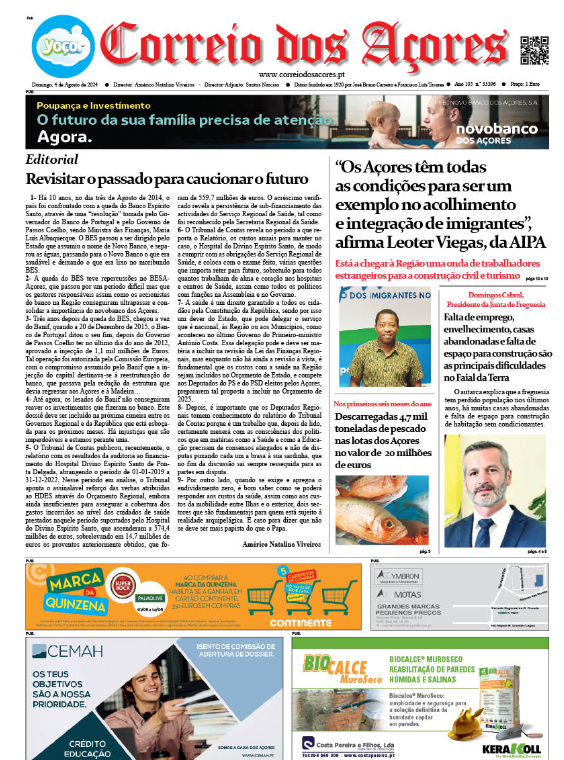
1- Ten years ago, on August 3, 2014, the country was confronted with the collapse of Banco Espírito Santo, through a “resolution” taken by the Governor of the Bank of Portugal and the Passos Coelho government, with Maria Luís Albuquerque as Finance Minister. BES was now run by the state, which took on the name of Novo Banco and separated the waters, transferring what was healthy to Novo Banco and leaving what was garbage in the moribund BES.
2- The fall of BES had repercussions for BESA-Azores, which went through a difficult period but the managers in charge as well as the bank’s shareholders in the region managed to overcome and consolidate the importance of the new bank in the Azores.
3- Three years after the fall of BES, Banif’s turn came, when on December 20, 2015, the Bank of Portugal dictated its demise, after Passos Coelho’s government had approved the injection of 1.1 billion euros on the last day of 2012. This operation was authorized by the European Commission, with the commitment given by Banif that the capital injection was intended for the restructuring of the bank, which involved reducing the structure that was to return to the Azores and Madeira…
4- So far, Banif’s victims have not been able to recover their investments in the bank. This dossier should be included in the next summit between the regional and national governments, which is planned for the coming months. Some injustices are unforgivable and this is one of them.
5- The Court of Auditors recently published a report with the results of its audit into the financing of the Divino Espírito Santo Hospital in Ponta Delgada, covering the period from 01-01-2019 to 31-12-2022. In this period under analysis, the Court points out the notable increase in the funds allocated to HDES through the Regional Budget, although still insufficient to ensure coverage of the costs incurred in terms of health care provided in that period supported by the Hospital do Divino Espírito Santo, which amounted to 574.4 million euros, 14.7 million euros more than the proceeds previously obtained, which were 559.7 million euros. The increase reveals the persistent under-financing of the Regional Health Service’s activities, as acknowledged by the Regional Health Secretariat.
6- The Court of Auditors reveals, in the period covered by the report, the annual costs of maintaining the Divino Espírito Santo Hospital, to meet the obligations of the Regional Health Service, and its examination raises several questions that should be kept in mind for the future, especially for all those who work heart and soul in hospitals and health centers, as well as all politicians in the Assembly and the Government.
7- Health is a right guaranteed to all citizens by the Constitution of the Republic and is therefore a duty of the State, which can delegate the service, which is national, to the Regions or Municipalities, as happened in the last government of Prime Minister António Costa. This delegation can and should be included in the revision of the Regional Finance Law, but while there is still no revision in sight, it is essential that health costs in the Region are included in the State Budget, and it is up to the PS and PSD Members of Parliament elected by the Azores to prepare such a proposal for inclusion in the 2025 Budget.
8- Next, the Regional Members must take note of the Court of Auditors’ report because it is a piece of work that, once read, will certainly stir the consciences of the politicians who, in matters such as Health and Education, need broad consensus and not disputes, each pulling on his own sardine, which at the end of the discussion always leaves the parties in dispute withered.
9- On the other hand, when zero indebtedness is demanded and proclaimed, it is good to know how we can respond to health costs, as well as the costs of mobility between islands and abroad, two sectors that are fundamental for those who are subject to the archipelagic reality. It’s fair to say that you shouldn’t be more papist than the Pope.
Américo Natalino Viveiros, director of the newspaper Correio dos Açores
An editorial in the Correio dos Açores newspaper – translated by Diniz Borges
NOVIDADES will feature occasional opinion pieces from various leading thinkers and writers from the Azores to give the diaspora and those interested in the current Azores a sense of the major opinions on some of the archipelago’s issues.
 Novidades - The Islands and the Diaspora