

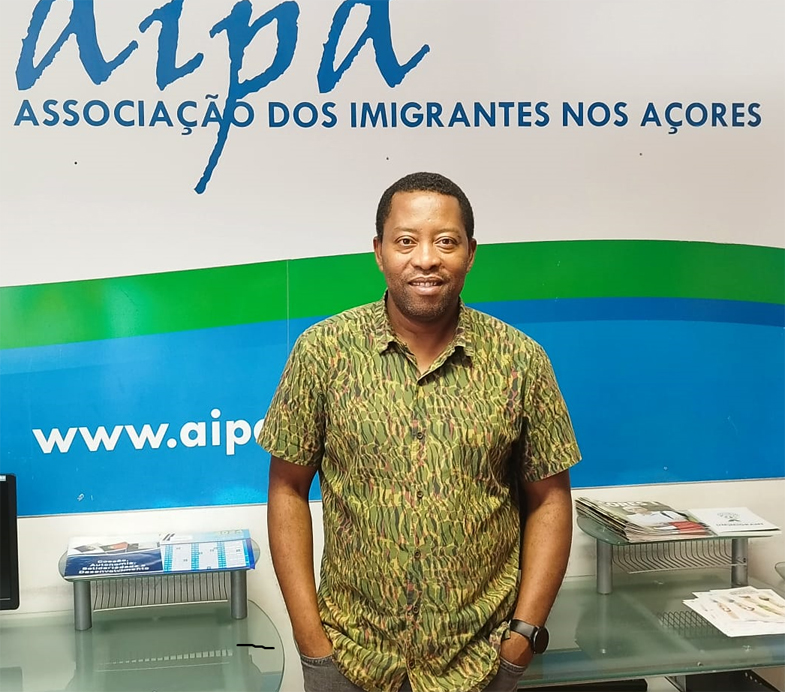
The lack of qualified workers in the Azores has led companies, especially in the tourism and construction sectors, to hire more and more foreign workers. Leoter Viegas, President of the Association of Immigrants in the Azores (AIPA), warns that although the Azores have all the conditions to become “an example” in welcoming and integrating immigrants, they still face many constraints in accessing regional services due to a lack of understanding of the immigration phenomenon and ignorance of the Aliens Act. In addition, he warns of the importance of creating preventive policies and adequate conditions for the growing wave of immigrants, as the region runs the risk of reaching the situations of housing overcrowding that have occurred on the mainland.
Correio dos Açores – What is your assessment of AIPA’s work this year? What were the main challenges and achievements?
Leoter Viegas (President of the Board of the Association of Immigrants in the Azores – AIPA) Our assessment of our work as a structure representing immigrants in the Azores is highly positive, first and foremost because we are fulfilling our mission of contributing to the process of reception and integration. First and foremost, this mission has to do with providing support and referral services to immigrant citizens, which we do through our offices on the islands of São Miguel, Terceira, and Pico. Last year we introduced mobile services on the other islands, a very successful initiative. I can tell you that in 2023, for example, our offices carried out 5,337 consultations and in the first seven months of this year alone we had 4,836, which represents 90% of last year’s total and 59% more than in the same period in 2023.
We have also carried out various activities to promote interculturality, for example organizing gastronomic events related to the immigrants’ countries of origin. In addition, this year we have also held sessions to clarify and raise public awareness of migration issues. Our aim is to draw society’s attention to the importance of welcoming and integrating immigrants properly; to draw the attention of young people in schools, for example, to the need to value cultural diversity, and also to draw the attention of our region’s political and business authorities to the need to design public policies for welcoming and integrating immigrants.
How many immigrants arrived between January and July this year?
There are still no official public statistics on the actual numbers of immigrants living in Portugal and the Azores. The available data relates to 2022 and indicates that we have around 5,200 foreign citizens in the region, but this figure is completely out of date. In the last year, we have seen a very considerable influx of immigrant citizens coming to live in the Azores and I would say that we will far exceed the figures for 2022.

What are the nationalities of the immigrants who have arrived in the region?
Naturally, and I’m also referring to the 2022 figures, we have people coming to our region from 97 different countries. The majority are Brazilian citizens, who represent 20% of the immigrant population living in the Azores. Then there are also Germans, Chinese, French, Spanish and Cape Verdeans. From the second half of 2023 to the present day, we have recorded a new fact, which has to do with the entry of immigrants from Asian countries, particularly citizens of Nepal, who already represent a considerable number. We have also seen, for example, a significant number of citizens coming from Colombia. So we can say that the dynamic of the foreign population living in the Azores is changing.
The region has experienced a significant shortage of skilled labor in various sectors. How has this situation influenced the arrival of immigrants in the Azores? Can we talk about a wave of immigration?
If we look at the immigration statistics from 2000 to 2022, we see that there has been an almost 100% increase in the foreign population living in the Azores. Obviously, in the last year and a half the increase has been accelerating, a fact that is essentially explained by economic issues. Immigrants come to the Azores and will continue to do so as long as there is demand for labor and jobs. So let there be no doubt about it: as long as there is demand, immigrants will continue to come. And what we have to do is create the necessary conditions so that people can be welcomed and well-integrated into our region, especially in terms of housing and access to healthcare. In addition, it is important for Azorean society to better understand the phenomenon of migration.
Some companies have chosen to recruit foreign workers directly, as is the case in the construction sector. What other sectors have followed this practice and with what results?
In addition to the construction sector, there are companies linked to tourism, such as restaurants and hotels, which have actually felt the need to recruit foreign labor, because there are no people available locally to fill these vacancies, so they choose to recruit people in their countries of origin. We would point out to these entities that it is not enough to go and get people to work in the region; you have to follow the legal channels to hire these workers.
Immigrants enter Portugal on work visas or job-seeker visas and employers need to understand that, once they arrive in the Azores, these people must obtain a residence permit. To obtain this permit, they need an employment contract, a tax number, and a social security registration. In addition, employers must comply with all the rules laid down in the labor code and immigration law.
On the other hand, you also have to realize that it’s not enough to go and get immigrants to fill vacancies and see them only as a workforce. Many companies make the mistake of seeing immigrants as cheap labor, but immigrants are not just labor, they are people who have goals, dreams, and prospects for the future. In most cases, they have families who stay in their countries of origin and they dream of reuniting them one day. Therefore, we must look at the issue of immigration from the perspective of integration and not as ‘cheap and easy labor’. There is still a lot of work to be done in this field, but I believe we will be on the right track when we change the way we look at this phenomenon.
Is the demand for foreign workers in tourism a seasonal phenomenon?
As you know, tourism in the Azores is very seasonal. In this sense, if a company takes on a foreign worker and gives them a contract for three, four, or six months, and then fires them, we will have a problem, because these people need to prove that they are integrated into the labor market to obtain or renew their residence permit. Once again, we call on companies to see immigrants not just as a workforce, but as people who need to keep their jobs.

What is your assessment of the working and living conditions being offered to immigrants in the Azores?
In our region, and this is an issue that cuts across the whole of society, we have a serious housing problem. On the mainland, for example, we have seen very precarious situations, with reports of people sharing overcrowded rooms. We hope that this reality does not reach our region, because, with the massive influx of immigrants without adequate housing, the risk of facing the same problems is real.
The political authorities – including the regional government, town halls, parish councils, and even companies – must take this issue into account and focus on prevention. Because if we end up with cases of overcrowding of housing by the immigrant population, we will face a serious social problem.
Another point we must take into account is access to health care. Currently, the phenomenon of immigration in Portugal is not easy to manage, nor is it easy to understand. Over the years, the Aliens Act in Portugal has been subject to a lot of instability, and often people and the regional authorities themselves don’t know how to deal with it. When we talk about ‘expression of interest’, for example, people don’t know what it is. When we talk about the decree-law that extended the validity of immigrants’ documents, people don’t know what it is. As a result, immigrants often go to an institution and there are difficulties in accessing services due to a mere lack of understanding.
On this issue, I can give the concrete example of the ‘CPLP Residence Permit’, a document created in 2023 for citizens of the CPLP (Community of Portuguese Language Countries), which is valid for one year – in other words, it was issued in March 2023 and expired in March this year. However, the previous government was unable to create a mechanism for renewing this document. To deal with this problem, the current government has created a decree-law that says that even though these documents have expired, they are still valid and should be accepted as such. But what happens in practice is that an immigrant goes to the tax office or health service and often faces problems because the officials are not aware of this change and refuse to accept the document. And even if they present the decree-law saying that it is valid, the problem persists. Just last week, this situation happened to an immigrant citizen at a driving school in the region, and, had it not been for AIPA’s intervention, he would not have been able to enroll. There is a lack of understanding on the part of many public services about the phenomenon of immigration and, in particular, about the Aliens Act, and this is precisely what we are calling attention to.
How has AIPA acted to support immigrants arriving in the region?
The support and referral of immigrant citizens is fundamental and perhaps the most important activity we carry out. At our offices in Ponta Delgada, Angra do Heroísmo and Madalena do Pico, we offer services from Monday to Friday, from 9 a.m. to 5 p.m., where immigrants receive all the information they need to solve their problems in Portugal and the Azores. This includes the regularization process, access to healthcare, registering for social security, opening a bank account, obtaining a tax number, applying for Portuguese nationality, and enrolling their children in school, among other issues. On the islands where there are no offices, we provide mobile services, with technicians who travel to all the islands every month.
Another very important issue in the process of immigrant integration is understanding the Portuguese language. To this end, we organize courses and classes. With the support of the Azorean government, we have already held the 14th edition of Portuguese courses on Terceira island, which confer a certificate. In Ponta Delgada, we teach Portuguese language and Azorean culture. This is crucial because by understanding the language of the host country, immigrants are in a better position to work, study, and ultimately contribute to wealth creation in the Azores.
In addition, we produce various information and awareness-raising materials, not only for immigrants but also for the host society, so that they have a more positive view of immigration and encourage the appreciation of cultural diversity.
What are AIPA’s expectations for the coming year in terms of immigration policies and support for immigrants?
First of all, the region is growing and needs to invest in public works and other sectors. If local labor is not available, immigration is expected to continue to increase. Concerning immigration policies, it’s important to note that Portugal currently has more than 400,000 pending cases. The current government has created a structure to resolve these cases and we expect them to be concluded within a year.
It is essential to have immigration policies that don’t leave people in the limbo of illegality, as we have seen. Until the beginning of June this year, there was a mechanism called ‘expression of interest’ that allowed people arriving in Portugal to express their interest in obtaining a residence permit. To do this, they needed to be integrated into the job market, and have a tax number and a social security number. In this way, they could obtain a residence permit while in Portugal. However, the current government has abolished this process, which has resulted in thousands of people who were already in Portugal and were unable to express their interest in time being left without the possibility of doing so.
In our offices, we have received many people who were unable to submit their ‘expression of interest’ in time. The Portuguese government must find a solution so that those who are already in Portugal can obtain a residence permit. Otherwise, we are creating situations of illegality and, furthermore, we are allowing these people to become easy targets for labor exploitation, mafia groups, and human trafficking.

Are there any specific aspects of immigration and immigrant integration in the Azores that you would like to highlight?
In the Azores, we have all the conditions to be an example in the process of welcoming and integrating immigrants, but this will only be possible through partnerships between political power, civil society, and employers. In other words, we need a joint effort between the government of the Azores, local councils, parish councils, and immigrant associations. Often, employers don’t have the necessary information on how to follow the legal channels for welcoming and integrating immigrants, making this issue a priority right now. Therefore, I believe that by having all these players in tune and working in partnership, we can create a good example of welcoming and integrating immigrants in the Azores. But there is still a long way to go. We are talking about a region where more than one and a half million Azoreans live outside the Azores. We are a region with a great deal of experience of emigration and we need to start learning more about immigration.
Daniela Canha, journalist for the newspaper Correio dos Açores
Translated to English as a community outreach program from the Portuguese Beyond Borders Institute (PBBI) and the Modern and Classical Languages and Literatures Department (MCLL) as part of Bruma Publication and ADMA (Azores-Diaspora Media Alliance) at California State University, Fresno, PBBI thanks Luso Financial for sponsoring NOVIDADES.

 Novidades - The Islands and the Diaspora