

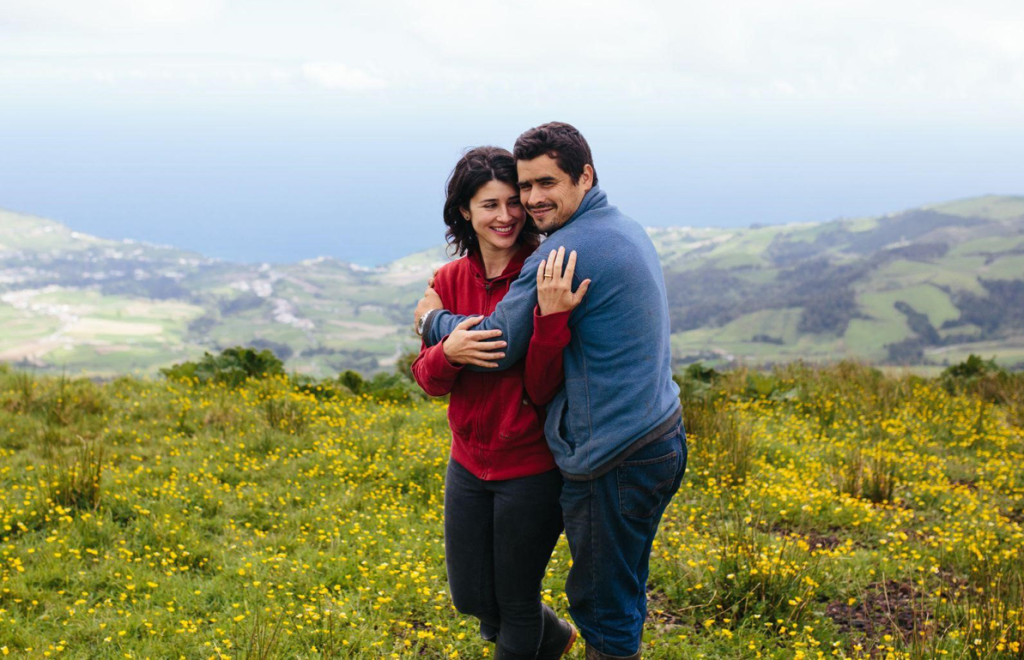
Gena Pinheiro, from California, and João Mendonça, from São Miguel, met 25 years ago on the island of Terceira: she was visiting her father’s homeland and he was finishing his military service. After 11 years of a fast-paced life in California, the couple decided to return to the Azores in 2011, still without a definite plan. In the meantime, the opportunity arose for João to continue the family farm, which initially operated as a conventional dairy. Gradually, combining João’s passion for farming with Gena’s commitment to sustainability and a holistic approach to health gave rise to Âmago Wellness Farm, a farm that adopts regenerative farming practices. In addition, they offer tours where you can experience the life of a dairy farmer, promote volunteer tourism, and hold holistic health and intimacy coaching sessions, in an approach that, according to Gena, is an “alternative to mass tourism, protecting our natural resources and the local way of life, as well as giving visitors a real sense of belonging”.
Correio dos Açores – João was born and raised in São Miguel and Gena has Azorean parents but was born in California. How did you meet?
Gena Pinheiro (founder of Âmago Wellness Farm) – We met in Terceira during the Sanjoaninas. At the time, I was visiting my father, as I often did during the summer vacations, and João was completing part of his compulsory military service. João likes to say that he saw me three times in one day and that it was a sign that we were destined to meet. When he first saw me, I was walking down Rua da Sé on my way to Jardim Duque da Terceira. Then he saw me on the way back. Both times, I remember noticing a lively group of young people on the other side of the street; it was his group. Later that evening, I was sitting on a wall with my father in Cerrado do Bailão, and it was then that João saw me for the third time. Not wanting to be disrespectful, he didn’t approach me directly but passed us several times until I couldn’t help but notice him. After a playful wink, our gazes met and, when I went to get a drink for me and my father, João took the opportunity to introduce himself. That was 24 years ago and, since then, our journey together has been filled with many twists and turns that have led us precisely to our destination.
What was your life like before you moved to the Azores?
When I met João, he was in the middle of his compulsory military service and his family was preparing to emigrate to Massachusetts. They moved six months after we met, and I went to the East Coast to spend our first Christmas together and meet his family. João’s plan was to help them settle in for a year and then join me in California, so we traveled from coast to coast whenever possible to be together. Before I met João, my goal was to finish my degree at the University of California, Berkeley, work in Environmental Management in South America, and, at some point, live and do similar work in the Azores, the place where I felt a deep connection to my ancestral roots and where I was happiest. Instead, I studied for a semester in Chile, and then returned to start a life with João in California, where I worked in environmental departments of government agencies and, together, we started an ecological landscaping company. After 11 years of a fast-paced, material-oriented life, we didn’t feel fulfilled and decided to sell everything to create a life worth living in the Azores. Little did I know that this life would include farming.
What motivated you to return to your roots and settle in São Miguel?
Our decision to move to the Azores in 2011 was a quick one. In just six months, we sold everything and got on a plane. Without knowing what our job would be in a life that would certainly be worth living, we began by helping my father realize his retirement dream: running a bed & breakfast in Terceira. At the same time, we started doing introspection exercises. I started making separate lists for João and me, explaining our passions and ideas for jobs that revolved around those passions. But suddenly João received a phone call from his father that changed our lives forever. He was ready to retire and asked if João wanted to buy the family farm.
João came up to me and told me that milk production was the job that moved him. I looked at him with a city girl look and said: “João, but it’s not on the list.” But it didn’t matter; his clarity was undeniable, he was born for this job. So I came with him to São Miguel, still not knowing how to combine his love of milk production with my list of passions.
How did the opportunity to set up Âmago Wellness Farm come about? How has the project evolved over time and what are your future plans?
Âmago Wellness Farm didn’t exactly emerge from a single moment of inspiration but is the result of 12 years of evolution. As we have remained true to our core values, our path has gradually revealed itself. One of the main reasons we left our Californian lifestyle was to achieve holistic health – mind, body, and spirit – especially after my physical health problems worsened and João’s mental well-being collapsed. Inspired by my list of passions, I took a certificate in holistic health coaching, and together we completed courses in holistic land management. When we took over the farm, it operated as a conventional dairy. However, for me to get involved, it needed to reflect on my values of sustainability and producing nutritious food. Only then could I dedicate myself wholeheartedly to this project. So we became the first dairy farm in São Miguel, and probably in the Azores, to adopt a regenerative agriculture model focused on making our ecosystem healthier with each passing year.
We later introduced regenerative tourism, offering visits to the farm, and volunteer tourism, which combines travel with community service. These activities connect visitors to the life of an Azorean dairy farmer, show them how food gets to their plate, and encourage them to give more than they get back to our community. So, just as regenerative agriculture seeks to improve the environment over time, regenerative tourism also aims to strengthen the local community over the years. This is our response to the extractive nature of mass tourism.
We are currently restoring our almost 90-year-old stone arribana, which will serve as a center for holistic health programs focused on physical, mental, emotional, social, and spiritual well-being. The arribana will also host experiences centered on Azorean traditions and ancestral foods and will have accommodation available for guests interested in a more immersive experience. Once this part is completed, our farm will be the complete integration of the three pillars on which we built it: regenerative agriculture, regenerative tourism, and regenerative well-being.
What is the concept behind Âmago?
The beauty of the word “core” lies in the way it encapsulates the purpose of our farm – to connect people to the deepest and most essential part of themselves, which is their core. In California, we felt distant from this central part of ourselves, but when we started taking the time to reconnect with our core, life began to unfold in a more magical but also more challenging way, leading us to create our wellness farm. We help others find or deepen their connection with their core, guiding them through experiences that forge connections with what they eat, with the earth, with our community, and with their own bodies. Our core, or essence, originates in the heart and soul. This heart- and soul-centered connection is vital, as it has the power to heal our relationship with the earth, our loved ones, our bodies, our communities, and the world around us.
What does a normal day in your life look like?
It varies depending on the day. Although farming is a seven-day-a-week job full of unexpected challenges, we make a conscious effort to structure our week holistically. We focus on five key areas: time for our relationship, fun, household chores, personal centering, i.e. internal alignment through dedication to stability and connection with the self, and business activities. One day, I could be guiding a client through a body connection session, and the next day, I could be helping João get a geisha out of the stream. In the same way, João could be milking cows, teaching a guest how to milk, or spreading a blanket under the trees, so that we can reconnect and remember that if we’re not right together, everything else falls apart.
What kind of services and treatments do you offer at your farm?
We have some very interesting new experiences related to real food, the mind-body connection, and ancient wisdom that will be launched as soon as our arribana is finished. So stay tuned! For now, our main offerings include farm visits, volunteer tourism and holistic health & intimacy coaching. The visits allow people to experience farm life first-hand, from grazing to milkin, and then enjoy a picnic of raw milk and artisan cheese. Volunteer tourism involves impactful community service projects, such as coastal clean-ups or assisting a member of the local community who is facing a particular challenge. Coaching sessions, whether face-to-face or online, help people deepen their connection with their bodies and bring that sense of connection into their relationships and everyday lives.
What has the feedback from clients been like?
The feedback we receive gives us the strength to continue with our vision, despite the obstacles. Clients often describe their experiences on our Quinta as ‘transformative’, ‘the highlight of our trip to the Azores’, or ‘what travel should be’. Others are amazed at the healing and transformation they have achieved through coaching. That’s why we do what we do. Our work reminds people that the obsession with status and material wealth is often a distraction from the real magic of life – authentic connections and deep relationships with ourselves, our loved ones, and the world around us.
What impact do initiatives like this have on the local economy and tourism?
Our approach prioritizes the quality of visits over the quantity of visitors, offering profound benefits. It helps preserve the unique character of the Azores, maintaining local traditions, culture, and ways of life. It creates jobs in rural communities, encouraging young people to stay close to their families. It also promotes meaningful connections between cultures and a deeper understanding of different ways of living. Models such as regenerative tourism, creative tourism, and community-based tourism offer an alternative to mass tourism, protecting our natural resources and local way of life, as well as giving visitors a real sense of belonging
Is all your daily work based on sustainability? In what way?
We believe that everything – whether it’s a company, our health, or a farm – must be considered as a whole to be truly sustainable. A company focused solely on profit cannot be sustainable because it sacrifices people and the planet. Similarly, a company that prioritizes the environment but ignores financial stability is not viable in the long term. This is why we practice the triple bottom line, carefully considering the impact of our actions on the community, the environment, and our financial stability. We implement this same holistic approach to health, which for us is more than just food and exercise. It includes sunshine, meaningful relationships, quality water, rest, a sense of purpose, and much more. By understanding sustainability through this holistic perspective, we adopt regenerative practices in all three components of our wellness farm, to improve the conditions of our land, our community, and our customers every year.
What else would you like to highlight?
I want to express deep gratitude to my late grandparents, who showed me what it means to move through the world as a heart- and soul-centered person. Growing up in a big American city, I often lost myself in the drive for hyper-individualism and material success. But my grandparents instilled in me fundamental values such as honesty, family, empathy, loyalty, and responsibility. These values continually guide me back to my core, to my essence, where I can reconnect with my grandparents and find the answers that allow me to live my deepest purpose: to share it with the world through Âmago Wellness Farm.
Daniela Canha is a journalist for Correio dos Açores-Natalino Vivieiros, director
Translated to English as a community outreach program from the Portuguese Beyond Borders Institute (PBBI) and the Modern and Classical Languages and Literatures Department (MCLL) as part of Bruma Publication and ADMA (Azores-Diaspora Media Alliance) at California State University, Fresno, PBBI thanks Luso Financial for sponsoring NOVIDADES.

 Novidades - The Islands and the Diaspora