

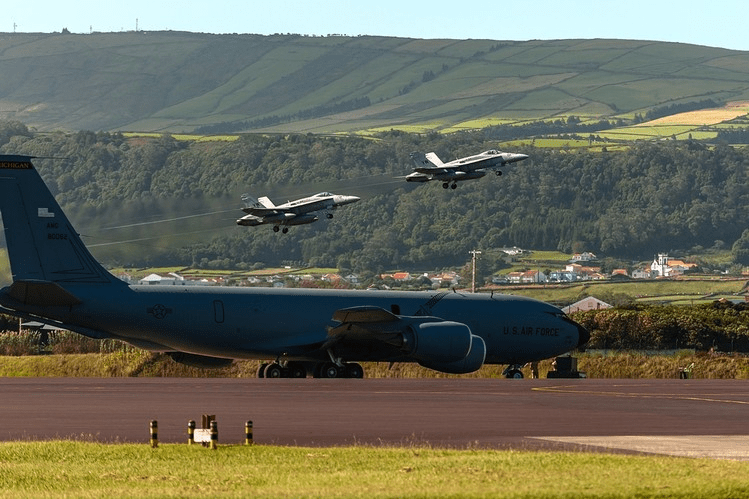
The air bases that the United States maintains outside its territory could be the target of attacks, admits an opinion article published on the “Military Times” website. Radley Bowman, senior director of the Center for Military and Political Power at the Foundation for Defense of Democracies, and Lydia LaFavor, a researcher at the same center, recall the report of the Commission on National Defense Strategy, released on July 30. This document, they point out, “echoes long-standing concerns of the USAF leadership that adversaries will aggressively attack air bases abroad to prevent them from being used to launch and recover aircraft”.According to the article, there are “growing issues in the Pacific, Europe, and the Middle East” that must be addressed and the strategy may also involve “pop-up” bases that keep adversaries in doubt.“In the Pacific, Pentagon assessments indicate that the Chinese People’s Liberation Army (PLA) possesses ballistic and cruise missiles to strike regional air bases, ports, and land-based infrastructure in Japan and the Philippines, as well as US bases as far away as Guam. In a major contingency in the Taiwan Strait, the USAF must be able to sink ships and destroy adversary aircraft. It will be difficult to sustain this effort if American pilots have nowhere to land,” says the article.

In Europe, meanwhile, it is pointed out that “Russian forces continue to use long-range fire, hypersonic missiles, and unmanned aerial systems to target Ukrainian air operations on the ground”.The article was written after, on the 10th of this month, the US Air Force concluded exercise Bamboo Eagle 24-3, with more than 3,000 military personnel and 150 aircraft to operate in the western United States and the eastern Pacific. Agile Combat Employment (ACE) and a RedFlag exercise were employed. “This exercise, and similar future efforts, are critical to strengthening the US Air Force’s (USAF) ability to operate in contested environments at all echelons, which is essential to deterring and defeating aggression in the Pacific, Europe, and the Middle East,” said the researchers, who argue that a change of concept is needed.
The article argues that, “at a time of growing threats in multiple regions, ACE operations or exercises can be used as a signal to adversaries to strengthen deterrence” and that “such operations cast doubt in the minds of military planners as to whether they can effectively target US combat forces”.
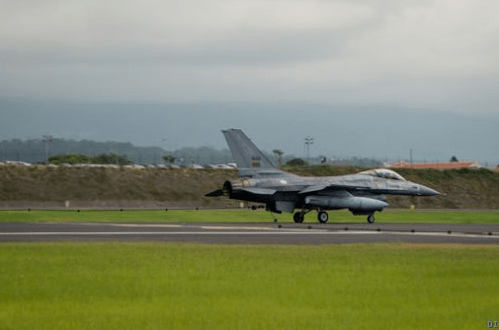
It is argued that “the State Department should redouble its efforts to obtain host nation approval for Department of Defense access to a greater number of airfields and operating sites while exploring opportunities to work with allied nations to develop civilian plans and infrastructure that can be quickly converted to operational use”.In the authors’ view, “this could include maintaining straight roads or highways, reserving indefinite storage facilities, and even clearing land to meet landing or launch zone criteria.”
“Finally, Congress should press the Army and Marine Corps to redouble investments and maximize acquisitions of man-portable air defense solutions,” the researchers maintain.“Adversary capabilities are increasing and serious new conflicts may be on the horizon. There is no time to lose to ensure that the USAF can sustain progress in conducting disaggregated combat operations,” stresses the article in Military Times.
in Diário Insular – José Lourenço – director
Translated to English as a community outreach program from the Portuguese Beyond Borders Institute (PBBI) and the Modern and Classical Languages and Literatures Department (MCLL) as part of Bruma Publication and ADMA (Azores-Diaspora Media Alliance) at California State University, Fresno, PBBI thanks Luso Financial for sponsoring NOVIDADES.

 Novidades - The Islands and the Diaspora