

Correio dos Açores – Could the literacy pilot project, which is being tried out in some schools on the mainland, be implemented in secondary schools in the Azores in the coming years?
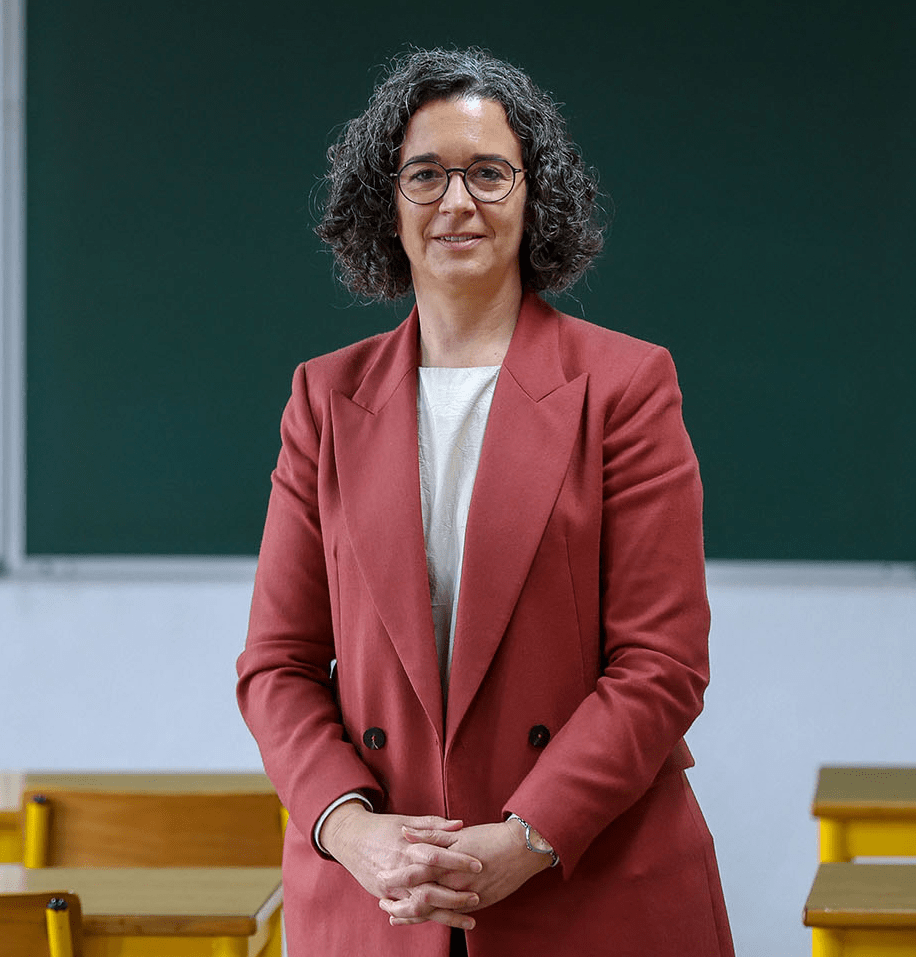
Sofia Ribeiro (Regional Secretary for Education, Culture and Sport) – This pilot project was launched by the Ministry of Education, with a limited number of schools in mainland Portugal taking part. So far, as far as we know, no secondary school in the Azores has been invited to take part in this pilot project, but that doesn’t mean it can’t happen if our schools want it to.
The competence for managing secondary school curricula is national and we are here to provide the necessary guidance. If our schools so wish and if they want to develop innovative curricular projects at the secondary school level, we are here to support and guide them – but always with very close ties to the Ministry of Education.
As far as the management of basic education is concerned, this is already a curricular component that is directly managed by the Autonomous Regions, even in the regional basic education curricula. We want to revise the diploma in the very short term and we have already started working on it. We believe that it should be accompanied by various consultations with society, and we have also consulted our schools beforehand. We intend to bring this revision to public scrutiny so that – we hope – it can then have curricular expression.
In the common issues with the Ministry of Education, and concerning financial literacy, economic literacy, and democratic participation processes, we are also adding dynamics concerning health education and environmental education, but this is a differentiated process since it concerns basic education and has components specific to the Azores. Therefore, we want to see these issues introduced into basic education, and we are going to propose them and present them to the wider public before we can introduce any normative changes, which, in this case, is a change that falls within the ultimate and final competence of the Legislative Assembly of the Autonomous Region of the Azores, as it is a regional legislative decree.
These are changes ranging from preschool to the end of the ninth year of schooling, where we have our own immediate powers to make curricular changes.
What subjects do you want to add?
The subjects we intend to implement are part of our government program and are presented in the preliminary draft of the Azores Education Strategy 2020, which is being finalized after receiving contributions from the public consultation. I can also tell you that the public consultation was favorable to this approach to health education and environmental education. It is always important to stress this: we are still at a very early stage of this project.
It is our intention to introduce the debate on the importance of introducing subjects, and above all areas that are compulsory work in terms of the component and the actual teaching in our schools from the first cycle of basic education, of literacy, concerning health, the environment, the economic field, and democratic participation. This will obviously be introduced gradually and is in line with the age groups and the different structure of the student’s thinking.
In addition, the government’s program also includes the introduction of a second foreign language in the second cycle of basic education as a compulsory and optional course. In other words, schools are obliged to present the proposal of a second foreign language to the pupils and parents who attend them, and it will be adopted if they so wish.
We also want to introduce subjects in digital literacy, whether in the field of technology or cyber security.

Is there a compulsory subject for choosing a second foreign language in the second cycle, or will each school decide which one students can choose?
Once a curriculum base has been created, schools always have curricular flexibility, which we want to continue to exist in the regional dynamic, allowing schools to analyze what their teaching plans should be and make their choices.
I would also like to point out that, regardless of this, the possibility for schools to develop pedagogical innovation projects in basic education has been established for several years. Therefore, we are available to welcome and appreciate any pedagogical innovation project that schools want to present to us. In fact, this has even been an issue raised by some private education institutions, and we have been given this initial opinion that there is a regulatory framework, in other words, we are willing to collaborate with all educational institutions that want to carry out a process of pedagogical innovation, which obviously then has to be followed up and monitored in terms of its evaluation, within the scope of their pedagogical structures and also by the pedagogical team of the Regional Directorate of Education.
With the possibility of adding subjects to basic education, will the school timetable increase?
In the region, we don’t intend to change the overall workload. We’re going to work with times that are related to curricular flexibility and may create other dynamics, but that’s not our intention a priori.
In addition to the time needed for formal learning, our children and young people also need to be able to value informal and non-formal learning mechanisms. Therefore, they must always have time to play and also time to develop other selective activities.

You mention that the government intends to introduce digital literacy into primary education. Will this be an improvement in Information and Communication Technologies (ICT)?
Undoubtedly, it will be in a more structured way and from the first cycle of basic education. When we talk about technologies, they don’t necessarily all have to be digital
In the Azores, we have been developing computational thinking in our schools, which is an absolutely innovative area in primary school, with autonomous expression and weekly work time in every class. Three years ago, we started with year zero, with the preparation of materials and teacher training for the start. In the meantime, we made the first year only for the first year of primary school two years ago, and last year we extended it to the second year as well. This year, for the first time, this area will also be included in the third year of primary school. Therefore, our intention is to continue this project and computational thinking program until the end of the second cycle of basic education. And we want it to be integrated into an area of digital education and computational thinking. In other words, this area will have its own space that will develop reasoning and digital literacy skills. This doesn’t mean that students will always be hooked on digital technologies – and that doesn’t happen at all, especially in the early years of school. It will have the component of digital education as a whole, which will then be complemented in the area of citizenship in terms of cybersecurity.
From the third cycle onwards, our intention is to evolve digital education and computational thinking into coding workshops, and then we’ll have specialized courses with a more practical approach to programming training itself.
Now, every day, without thinking about what we’re doing, in the countless tasks we have, we make choices. For example, what we’re going to do first and who we’re going to do it with. Systematizing these choices is part of building algorithms. So we can learn to systematize these choices and reflect on them. This would be extremely important for solving problems and, in the future, for constructing the algorithms behind the programming language we choose. There are various program languages, but the most important thing is to know how to choose the process behind the program. In other words, in addition to writing the program, you have to know what the program is going to do and you have to make those choices.
The first stage is structuring in terms of reasoning, which is often done behind the game, in learning with a strong playful component from the first year of school. In the following years, the level of complexity increases until sixth grade, and then in seventh grade, the students can begin to learn programming languages.
I can also say that, at the moment, we already have very positive feedback about computational thinking in our schools.

Do all schools have the resources to include this subject in their curriculum?
Yes, computational thinking is done with the resources of each of the schools on an ongoing training basis. We have a core team that accompanies the teachers who are administering computational thinking at this time, and who are also preparing the materials, both for this year and for the following years. So there’s a strong component of working in partnership between teams of teachers to develop it.
Moreover, the technical specifics of its implementation are not very complex, i.e. with the right guidance it’s easy since we’re talking about complex digital skills at this early stage, which allows us to have a very wide range of teachers with the skills to teach it and with the support provided by the central team.
Our aim is to make and continue to make changes to the curriculum, with changes that are gradual and without any kind of rupture. This, for me, is extremely important in a curriculum change. For example, the Ministry of Education is introducing the pedagogical experience of the literacy project with a small number of schools to monitor it and see if it is feasible and interesting to extend to other schools in a curriculum change. This is precisely what we’ve been doing: introducing projects and dynamics that are pilot projects and that are gradual so that they can then have a substantiated change at the level of a normative revision and of the basic education curriculum.
What about the subject History, Geography, and Culture of the Azores?
This subject will be integrated in conjunction with Citizenship from the first cycle of basic education. Our intention is to be able to create, or generate this public discussion – it’s extremely important to do so – a specific space for the History, Geography, and Culture of the Azores from the first cycle, which also integrates the social areas in conjunction with Citizenship. In this way, students are gradually introduced to these dynamics with a transversal expression.

Some schools have a subject linked to the performing arts, such as theater. Does the government intend to include this subject in all schools?
This concerns the area of expressions themselves, in which there may be a component that schools create as an alternative to Technological Education (TE).
Last year, we introduced a change to the regulations governing the administrative and pedagogical management of students, in which it was contemplated that the teaching of theater would also be included in the curriculum of artistic education in the region. So the door is open for us to have theater as a teaching area in the arts component in the region. We have schools that have these choices of theater in these complements of artistic and technological education.
Filipe Torresis a journalist for Correio dos Açores- Natalino Viveiros, director
Translated to English as a community outreach program from the Portuguese Beyond Borders Institute (PBBI) and the Modern and Classical Languages and Literatures Department (MCLL) as part of Bruma Publication and ADMA (Azores-Diaspora Media Alliance) at California State University, Fresno, PBBI thanks Luso Financial for sponsoring NOVIDADES.

 Novidades - The Islands and the Diaspora