


José Eduardo Pereira has 105 dairy cows for 57 hectares (approximately 260 acres) of land in Maia, and a further 85 rearing cows in land that he has in Furnas. He also says that being a dairy farmer “is more profitable” and does not intend to switch to meat production. “With the accounts I do for milk, I can’t get the same income for meat. The money only comes in at the end of the year and I prefer to get paid every month,” although he points out that the price of milk paid for production ‘is very low’ when compared to all the increases in different products. However, he doesn’t spend money on feed because his cows only eat grass and corn, two elements sown on his land.
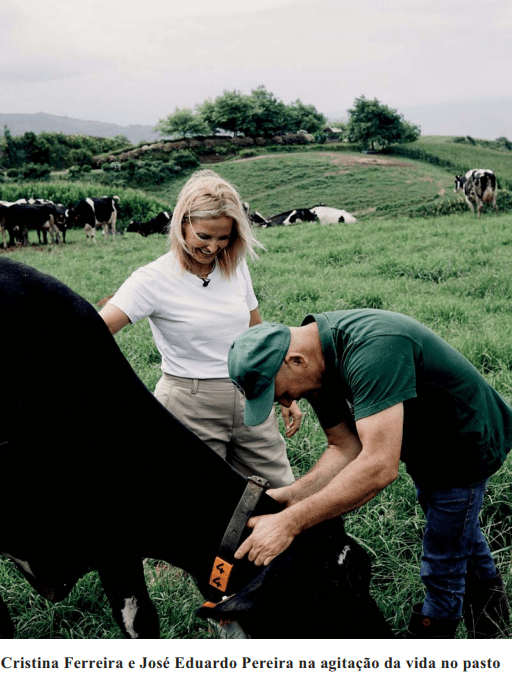
A few hundred meters from the entrance to the road that leads to Furnas, still in the parish of Maia, in a pasture as far as the eye can see, TVI presenter and shareholder Cristina Ferreira and José Eduardo Pereira, a dairy farmer from Micael, last Thursday, were the protagonists of a series of works to produce television content about the daily routines of life on the pasture, the treatment that the animals receive from the producer – and their carers – which is also part of the program “Happy Cows” by Terra Nostra, part of the Bel Group. This is a program that “was born to do good for our animals, for our producers, for the economy, for the ecosystem and for all of us”, as Yvan Mendes, Terra Nostra’s Head of Marketing, says.
The preparation of a concert in the pasture is also underway, with a unique campaign based on the choice of the favorite style of music of the Happy Cows of the Azores, which has already been tested. The concert will be promoted by a national artist, whose name has not yet been revealed, but Yvan Mendes says that “it will be a calm song, just the way the cows like it”.
Always with work to do, José Eduardo Pereira monitors everything that goes on in the pasture and is already thinking about the new step his farm will take from October when, alongside the “Happy Cows” program, it will optionally join the BEL Regenerative Agriculture Project and will have the support of agronomists and veterinarians. “I believe that the added value that will be gained from the point of view of animal health and the environment will be good for everyone, for the planet, which comes first, and then for people and animals.”
José Eduardo Pereira has 105 dairy cows on 57 hectares of land in Maia, which is equivalent to 500 bushels (alqueires) of land, and a further 85 rearing cows that are distributed over the 160 bushels (alqueires) of pasture he has in Furnas.
He also says that being a dairy farmer “is more profitable” and does not intend to switch to meat production. “With the accounts I do for milk, I can’t get the same income for meat. The money only comes in at the end of the year and I prefer to get paid every month,” although he points out that the price of milk paid for production ‘is very low’. In fact, as he says, “If you look at the price of milk, it’s the same as it was 10 years ago and the price of diesel is double. So is labor. For each worker I have I pay 1,300 euros, so I also pay twice as much as I did 10 years ago. However, he admits that the producer “has an income, but he has to forget that he’s the boss. You have to work to get your paycheck. I have to get up every 5am and work 10 hours. I only take vacations on days when my wife or daughters need me.”
The producer also doesn’t forget that being involved in the “Happy Cows” program and Regenerative Agriculture is also a way of dignifying the work of those who look after the animals and the land.
Now 57, he recalls that his work in livestock farming began when he was 12, when he left school, “although my mother wanted us all to study. There are twelve of us brothers, six of whom are involved with cows and six of whom have degrees in various areas. I followed in my father’s footsteps. As I didn’t want to study, my father punished me by putting me to work on the cows. A year later, my mother asked if I wanted to go back to school and I always said no. I felt good, as I still do today. I felt good and I still do today, I like being in this life. I don’t know what it’s like to come home tired. I work an average of 10 hours a day and I still enjoy it. I only take one day off, Sunday, and it rotates with my two workers, to be with my family, or in some situation where my daughters need it.” Although he didn’t continue his studies,
José Eduardo admits that he has always encouraged his daughters to continue their studies and today they both have degrees.
Cristina Ferreira delighted with the island and the gastronomy
Cristina Ferreira expressed her delight at the attention that has been paid to animal welfare the attention that has been paid to the planet and the warnings that have been made about preserving the environment. “I feel happy here, I really like São Miguel, which I’ve visited three times, always for work, but essentially I’m happy to be able to see this way of working with grazing and how attention is being paid to the planet. We must all be alert to this. I grew up in the countryside, with my uncles and cousins around me and in this type of agriculture, where artificial things rarely come into play, and I’m happy to know that there is this growing concern, both among older producers and younger ones. And knowing that the younger ones are trying to follow in their parent’s footsteps – and they are the ones who often bring innovation – that also makes me happy, because it protects us and the environment, and of course, I also must show it on television.”
Sustainability is also associated with tourism and the need to preserve the environment around us. And Cristina Ferreira is delighted with what she discovers every time she is on the island, such as Praia dos Moinhos, which she visited.
Her eloquence is so great that she blurts out: “I hope that no Portuguese person dies without knowing this island”, because, as she emphasizes, “whoever comes here finds a magic, a glow, that is very special and different. The island needs to receive more people who come to see it with their hearts”.
Of the three times he has been to São Miguel, always on business, he notes that there is more tourism, but “slowly, as it should be. It doesn’t take many people to know how to welcome you, it’s just knowing that those who come here are welcomed with open arms, and that’s what happens”.
She is pleased to note that in terms of gastronomy, “the food is getting better and better”. The presenter knows the island of Terceira, where she has been once, but is very keen and curious to visit the islands of Pico and Flores, but stresses once again that “São Miguel is a very complete island, from culture, landscapes and gastronomy”, admitting that she won’t leave the island this weekend “without taking a dip in the Azorean waters and with high sea temperatures for the season. I want to have that feeling,” she said.
Nélia Câmara is a journalist for the Correio dos Açores-Nartlaino Viveiros, director
Translated to English as a community outreach program from the Portuguese Beyond Borders Institute (PBBI) and the Modern and Classical Languages and Literatures Department (MCLL) as part of Bruma Publication and ADMA (Azores-Diaspora Media Alliance) at California State University, Fresno, PBBI thanks Luso Financial for sponsoring NOVIDADES.


 Novidades - The Islands and the Diaspora