

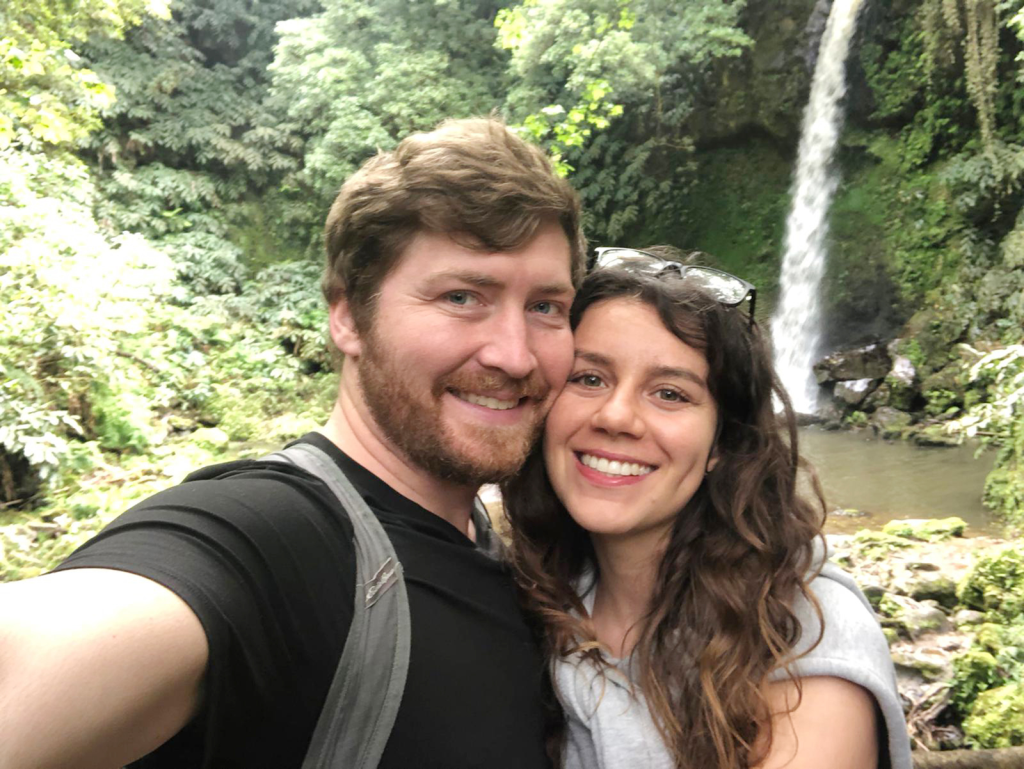
Correio dos Açores – Anna is from Poland, and Charles is from the United States. How did you meet, and what brought you to the Azores?
Anna Mrozek (psychologist/co-founder of Azores Dwell) – We met about 10 years ago when I worked in a hostel and Charles was visiting Poland. In the meantime, I did my Erasmus internship in Porto, where I lived for about a year and a half. Charles visited me several times, and we traveled around Portugal a lot, but during all this time, my teachers in Gondomar always told me about the Azores and said I would love to go there. In 2018, we came to São Miguel for the first time.
Charles Driscoll (musician/co-founder of Azores Dwell – Our first visit was during the winter and lasted no more than three or four days. At least for me, and from what I’d seen in other parts of the world so far, the idea of an island was that it was always linked to resorts, nightclubs, and all sorts of touristy things, which is good but lacks authenticity. However, when I visited the Azores, it was a great surprise to realize that, despite having such an island vibe, it was mainly a rural, agricultural place. In other words, farms and cows were everywhere, an environment familiar to me because I grew up in the countryside. What’s more, on that first trip, I also got the idea that most of the island wasn’t created for visitors but for those who live here, especially in 2018.
We realized that those three or four days weren’t enough, and less than a year later, we were back in the Azores for another short winter trip. At this point, we decided we had to go back for longer, and I don’t mean a two-week trip. We still didn’t know the purpose, but we were convinced we had to spend some time in the Azores.
When did the idea of creating Dwell Azores in Fenais da Luz come about?
Anna—When we arrived in the Azores in 2019, we started thinking about what we could do here because we didn’t just come for the beach and the trails. I worked in a hostel and had a dream of opening my own place because I love meeting people from different countries and the community atmosphere that you feel in most hostels—that’s exactly what I wanted to recreate somewhere in the world.
Charles – I also had my own reasons. I did some home renovations and was involved in real estate in the United States, but around 2017, I decided to spend more time in Europe, where I also wanted to start some kind of project. Besides, by then, we had traveled a lot and met in a hostel, so it’s safe to say that we’re fans of this kind of environment where you meet different people and make friends who were complete strangers the day before.
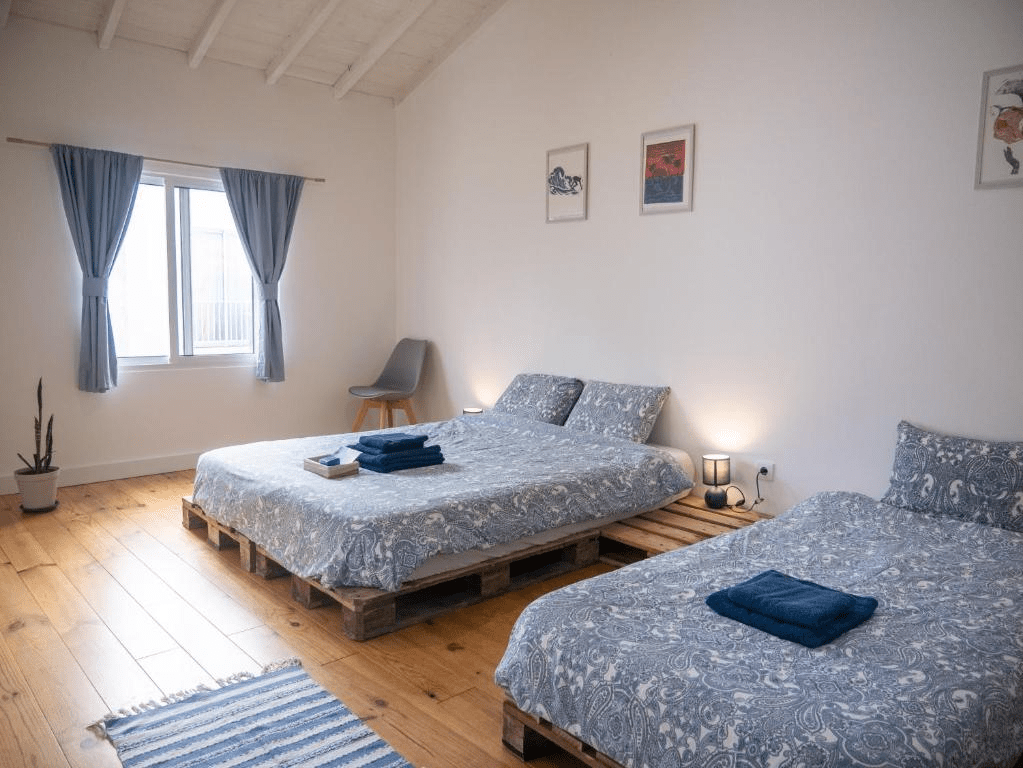
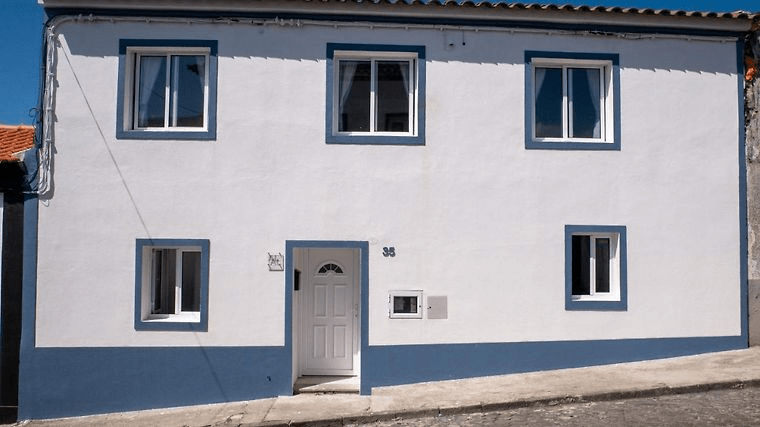
Anna – At the time, we were both working remotely and wanted to create a space where digital nomads could combine the social interaction typical of a hostel environment with work. That’s when we started thinking, ‘OK, we can create something like this in the Azores’: a kind of ‘Airbnb’ with a community atmosphere and desks and chairs for professionals. And that’s how the idea for Dwell began to emerge. We bought the house in October 2019 and opened in the summer of 2020.
Why the name ‘Dwell Azores’?
Charles – The name is a little play on words with the English term ‘dwell’, which can have two meanings. One of them is “to live somewhere”, or ‘to dwell somewhere’, which means to live there. So, instead of simply calling a house a house, in legal terms, we can call it a dwelling located on Rua de Baixo, for example. But ‘dwell’ also has a second meaning: ‘to dwell on something’ means to spend some time thinking about something. For example, when we have a big decision to make, we might say “I’ve been dwelling on this”, which means taking time to reflect or consider something. So we wanted to create a place where people could find a kind of mental escape, a place to live, but also a place to spend some time reflecting.
You arrived in the Azores on a one-way ticket in June 2019, and in October of the same year, you bought a dilapidated house in Fenais da Luz. What was the renovation process like, and what were the biggest difficulties?
Anna—The house was in a very bad state, and we started renovating it on our own, which took us about nine to ten months. We were also in the middle of renovations when the pandemic hit, but we remained determined and kept working. We finally opened in the summer of 2020.
Charles – We did most of the work ourselves, but we hired some Azoreans to help us lift some beams for the roof or work with cement, for example. We faced difficulties on several fronts, but for me, one of the hardest things was working with different materials. In the United States, houses are built of wood, not cement and stone, and adapting to other materials and dealing with the humidity issue was a big challenge.
Anna – Probably the biggest challenge for us was the climate. We knew, of course, that the environment here is particular, but the truth is that we really underestimated the humidity issue.
Charles—Doing the renovations during COVID-19 also complicated things, as we had many delays with the materials. On top of that, there was also a culture shock because we both came from different countries with different policies and working hours. And trying to fit all this in with our deadline expectations was very difficult.
Dwell Azores started in August 2020. What was it like opening a tourist accommodation during the pandemic?
Anna – By the end of the renovations, we had spent all our money, which was scary. We started thinking, ‘What have we done with our lives? We’re renovating a tourist project at a time when no one can travel’. It was a big shock, but the truth is that we had already invested so much that we couldn’t stop. We finished renovating the house and prayed for the best. Finally, August 2020 arrived, and the truth is that we were fortunate.
Charles—That summer, there was a slight easing of restrictions and a little more freedom compared to the previous months, which were the scariest of the lockdown. And because of that August, people started feeling more accessible and confident about traveling, so Dwell Azores was almost complete when we opened.
Of course, this is where all the irony of the pandemic in general and our project in particular lies… The pandemic has accelerated the remote working movement; even people who used to work in offices have become remote workers. So we had a lot of guests coming from London, Germany, Paris, all over Europe, especially from countries with stricter lockdown rules, where people couldn’t, for example, leave their apartment except to go to the supermarket a kilometer from their door.
Anna – In the Azores, people could be outdoors, and as we have a co-working space with several desks, our guests were able to maintain their routines; they worked during the day, in the evening, they went swimming or for a walk, and in the evening we cooked together. One of the most caricatured cases we had at the time was that of a couple who had only come for two weeks but started continually postponing their return to their country of origin and, in the end, ended up staying for three months! Every week, they saw the news from their countries and thought: ‘Why am I going to be confined to my apartment again if I can have a pretty decent life here?’ We were delighted to have guests here for more extended stays because that was Dwell’s initial idea: to take advantage of the Azores, work remotely, and build a good community.
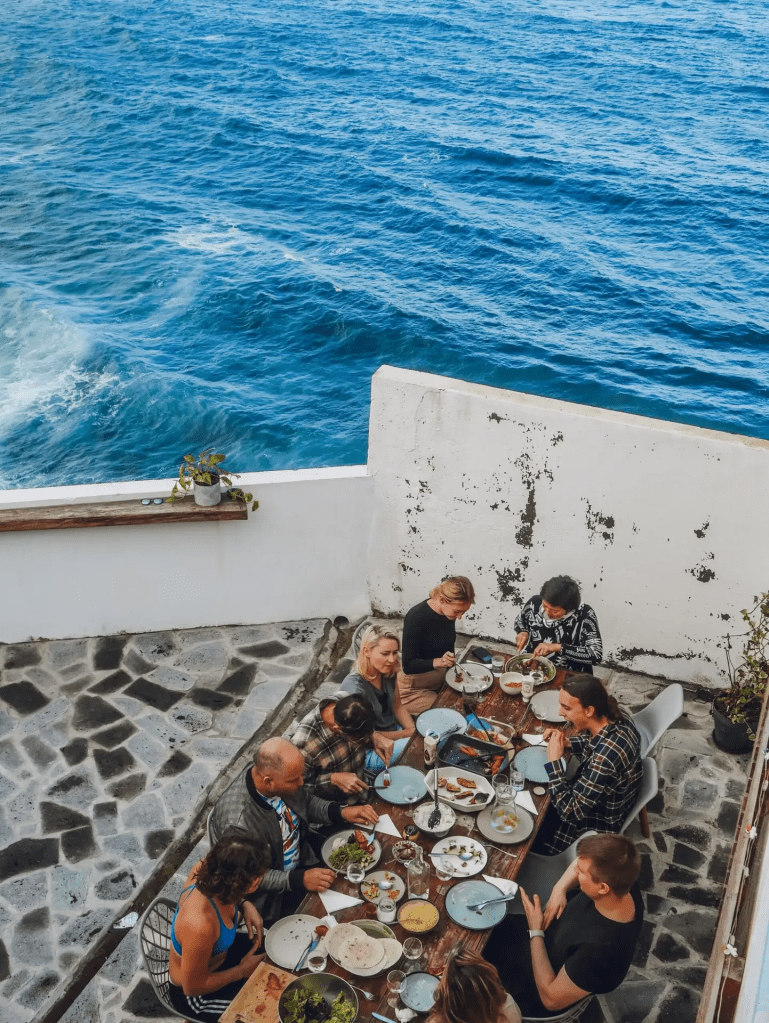
Charles – Over the years, we’ve welcomed people from all over the world, many of them digital nomads, and it can be a relatively isolated and, I’d say, lonely life. In the past, many people’s social interactions took place in the workplace. But nowadays, some people work exclusively remotely, without ever having met their colleagues in person, and don’t see anyone daily. So our aim was to create a place where people aren’t just welcomed as guests or clients but as friends or acquaintances; we’re welcoming them into our home. We’re trying to implement this idea, not just as a slogan on the website but in practice. If someone arrives and we’re all having dinner, for example, we say straight away: ‘Come, sit down. We have enough food; eat with us, and let me pour you a glass of wine. It’s a very informal and relaxed atmosphere.
What’s a typical day like for a digital nomad at Dwell Azores?
Anna—Normally, people work in Central European time, and the days start one or two hours earlier than usual, around six or seven in the morning.
Charles – People have coffee and often go to the coast to see the sea, have breakfast, and maybe say hello to the other nomads. Especially when talking about remote work, having other people around you who aren’t just on vacation is essential. In other words, seeing other people getting up early to work keeps everyone motivated. Those who have a more flexible schedule go for a run or walk in the morning.
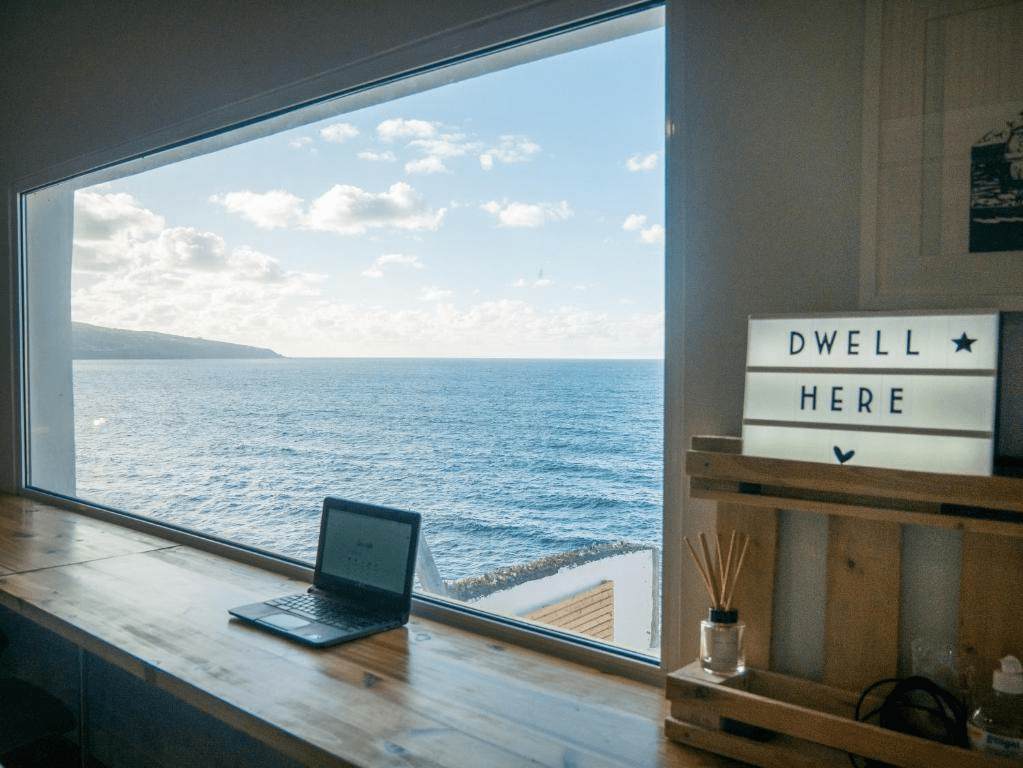
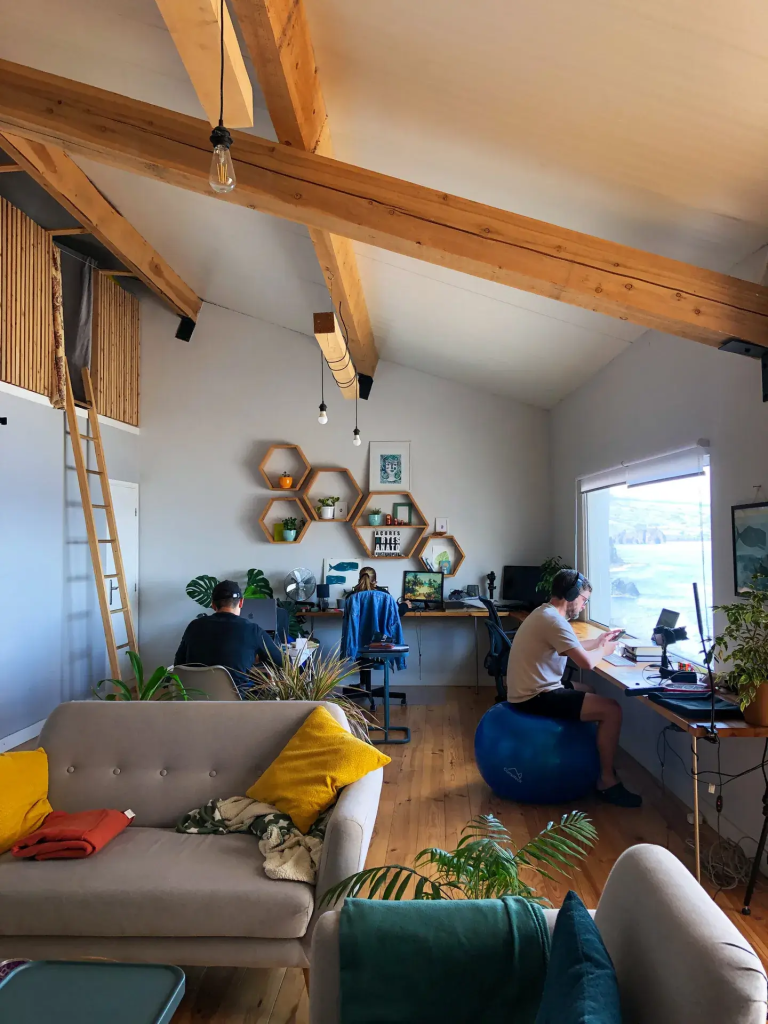
Anna – Our location is excellent, as we’re right next to the coastal trail. If you leave the house and walk out of the center, you’re alone with nature – the sea on one side and the fields on the other. It’s a beautiful place. After the morning routines, we go upstairs to the co-working space, a designated room overlooking the sea, where everyone has their own desk. Some people have meetings first thing in the morning and go to the call booths for more privacy; others stay at their desks, and some even like to work more relaxed on a puff on the terrace. Guests form friendships and often take coffee breaks together, cook together, and frequently share extra food with each other if someone has extra food.
Charles—At lunchtime, there are lots of conversations going on, such as: ‘How about we go hiking?’, ‘Do you want to go to the thermal baths on Thursday?’, and ‘Tomorrow I was thinking of coasteering or canyoning.’ People start planning activities in these moments of pause, just as they do in a conventional work environment. They are at work but also at home, interacting as if they were part of the family and, at the same time, as work colleagues.
To organize the activities that take place at Dwell, we try to understand our guests’ passions and talents. For example, recently, we discovered that a guest liked to paint watercolors. We asked her if she would be willing to share this with the others in a painting class, and she was very enthusiastic. This is just one example of how these events come about organically.
Anna – Every day, we swim, usually in the Poços de São Vicente, and take the Dwell guests with us. The same goes for walks and other daily activities, as there is always something going on in this house, which is very vibrant and dynamic.
Charles, we also try to integrate guests into the local community and often take them to the center of Fenais da Luz, to the snack bar, or to the mini-market.
Anna—When we were renovating the house, we went to the snack bar almost every day, covered in cement and dust, and the people of Fenais da Luz have known us since then. It’s fun for us to take a group of foreigners to our local bar because it’s a very different experience for them—it’s where they get to see what it’s really like to live in an Azorean parish.
How does the interaction between digital nomads and the local community work?
Anna—If you’re in a small parish for a few weeks or months, the locals start to recognize you because they realize that you’re not just a tourist but someone who’s really there. In our case, the locals already say, ‘Oh, you’re Anna and Charles’ guests from Dwell.’
Charles—We take our guests to Quinta da Jardinete, Luís’ bar, or José Eduardo’s bar. It’s great to see that they even go back on their own and take other guests. Most importantly, they start interacting with the Azoreans in the bar, who ask them where they’re from and what they’re doing in the Azores, and good conversations ensue.
Anna – The places are very welcoming and have always been very good to us. We have nothing negative to say! And, of course, we’re there whenever there are festivals in the parish, like the Nossa Senhora da Luz festival. We know everyone and feel that we really are part of the community.
Charles – The fact that many foreigners are buying houses in the region is creating tensions due to rising house prices, among other issues. But what disappoints and frustrates us is that many foreigners live entirely apart from and ‘above’ the locals. It has always been essential for us to try to live among the community, not above it. Coming here as a foreigner and living entirely apart from the locals doesn’t make sense. In fact, I think having that attitude when you arrive in a new place is disrespectful, as many foreigners buy a house but don’t interact with life there.
Anna – We’ve heard people say, ‘ I don’t know how you live near the sea in Fenais da Luz. It’s all problems, all bad people. And we’re baffled because we live by the sea and the people are lovely – we’re very proud of where we live and love it here.
In your opinion, what causes foreign residents to distance themselves from Azoreans? Is it difficult to interact with the locals?
Charles – I wouldn’t say that the locals are difficult to get to know or relate to, but to a certain extent, this island is quite traditional, and, in this sense, the locals can be a bit reserved. I mean, people aren’t necessarily going to go out and approach foreigners. Still, suppose we’re willing to participate in local activities, go to the local bar for a beer, or to the Festas da Nossa Senhora da Luz, for example. In that case, there’s mutual respect and room to build relationships.
In this respect, the fact that we did all the renovation work really helped us connect with people. Besides, we were driving a 1998 Opel Corsa, the worst car in the parish. We weren’t trying to live above anyone; we did the physical work ourselves, and the locals saw that. For nine months, we arrived at the café every day covered in dust and cement, and I think that’s when people realized that we weren’t just foreigners with money trying to exploit Portuguese people to do the hard work. We were working hard to improve the neighborhood; we bought a dilapidated house that had been empty for years, renovated it, and made it nice. Now we have people who come here, spend money in the café and bar, and contribute to the community.
Anna—Last week, we spoke to Bruno, the President of Fenais da Luz, who told us, ‘You’ve brought life to Rua de Baixo’—and that was wonderful to hear. He’s very happy to have us here and supports our project. The truth is that we would like to do even more for the community, but, as you know, this is a struggle in Portugal because no matter how much you want to, bureaucracy makes it difficult to make things happen.
What were the most memorable moments of this project?
Charles – One of the most memorable moments was the first Christmas we spent here. José Eduardo’s bar usually organizes a Christmas dinner yearly for the bar’s family and friends, including everyone from the center of Fenais da Luz (laughs). Although we had only been here for two months and were still strangers, we were told we were invited and would be very welcome. And it was an incredible dinner, with lots of people, all the children from the parish, lots of joy and food! As I’m a musician, they told José Eduardo that I could play the guitar, and he immediately said: ‘Charles, get the guitar!’ So I went home, picked up the guitar, and suddenly, the whole bar sang along. It was an incredible experience.
After so many years of traveling and living in different places, I can say that the Portuguese, and the Azoreans in particular, are probably some of the most welcoming people I’ve ever met, but in a genuine way. I’m American, and I know we’re friendly, too, but it’s in a bit of a fake way (laughs). As soon as we arrived, many people were smiling and saying ‘good morning,’ and I’d reply with a ‘hello’; these memories have really marked me.
Anna -We also have many good memories of the wonderful people who stayed at Dwell. Still, I would also say that the most memorable moment was that Christmas in José Eduardo’s café. It was an extraordinary moment.
Do you believe that the Azores have the potential to become a top destination for digital nomads? What advantages and disadvantages do they find in the region?
Charles – The Azores undoubtedly have the potential to be a top destination for digital nomads, but there is a difference between having potential and realizing it.
A good comparison example is Madeira, in particular, the Nomad Village in Ponta do Sol. Like the Azores, Madeira has great potential in beauty, nature, and connectivity with the rest of the world. Still, the big difference is that over the last five years, the government in Madeira has been very proactive in supporting and organizing initiatives to make the digital nomad community work well. This included collaboration with Gonçalo Hall, who led the effort to create an ecosystem conducive to nomadism. They created co-working spaces, established partnerships with hotels and accommodations in the area, and organized events.
There are some similar initiatives in the Azores, but unfortunately, from what I see, the government seems to pretend it knows what it’s doing but lacks the skills or knowledge to execute.
Anna – Nobody expects you to know everything, but it wouldn’t bother you to ask for help. As happened in Madeira, the Azorean government should also talk to someone with more knowledge in this area. The region has potential, but they need someone to lead this development.
Charles – In Ribeira Grande, for example, they opened a coworking space that wasn’t visible on Google Maps for a while. They created a website for digital nomads in the Azores, specifically for São Miguel, Ribeira Grande, and the surrounding areas; they compiled a list of all the co-working spaces, but the list didn’t include our space or the other two natural co-working spaces that exist on the island. It did, however, include a surf school and a library, which shows that they clearly don’t understand the needs of a digital nomad. In other words, if a digital severe nomad trusts that website and turns up at a surf school bar, they’ll have to cancel all their meetings because they can’t afford to work.
Anna—We are willing to help, but the government has never attempted to contact us. However, Nonagon (São Miguel Science and Technology Park) approached us and came to visit us to learn about our project; it was a good meeting. Now, the initiatives mostly come from the private sector.
Charles – In the best of cases, the government sometimes gets in the way or does things the wrong way around. In other words, at least in this area, they are neither leading nor helping. But they should at least decide whether or not they want to attract digital nomads here. And it’s OK if they don’t; the Azores don’t have to take the same approach as Madeira.
Digital nomads travel all year round and have more extended stays. In your opinion, is betting on this type of traveler a way of dealing with the issue of seasonality in tourism?
Anna—Absolutely. Summer in Dwell is always packed with tourists and digital nomads, but from September onwards, we pretty much only have people coming for work, and we’re already booked up for this month and next.
Charles—There’s a clear opportunity, but the government doesn’t seem interested or doesn’t know how to take advantage of it. Attracting more summer tourists only exacerbates the problems, such as rising prices and saturated services. Tourism that comes all year round is much more sustainable, and digital nomads travel every year and stay longer.
Anna—What’s more, by staying longer, nomads understand the Azores better, get to know the locals, and see what life is like here. In contrast, short-term tourists only visit the sights and have contact with the locals only in the restaurants.
Charles—The government needs to regulate tourism more effectively. It should probably start charging a tourist tax that would help solve the housing crisis or at least eliminate the big problems of bureaucracy for construction. Often, real estate developers don’t want to work here because it takes about two years just to get started. So, we need to simplify the process so that housing is built for the locals; the focus can’t just be on housing for tourism.
And at the moment, from what I understand in the 2030 program, most of the money for tourism projects is going to four- and five-star hotels. In other words, what they want to build, where they’re investing the money, is only in luxury accommodation, which I don’t think is the best approach for the future. I don’t control the government coffers, but investing even more in luxury tourism is just a way of increasing the sector’s seasonality, draining resources and taking away quality of life from the locals.
Anna – What’s more, the summer tourism money coming into the Azores isn’t benefiting the local population enough. Most of that money stays with the big hotel operators, and it is they who are getting rich. However, the workers continue receiving the same low wages, and the government isn’t investing in social programs. There should be more regulation and investment in long-stay tourism, which would benefit both the island’s natural resources and the standard of living of the locals who arrive at a restaurant in August and have nowhere to sit, who go anywhere and everything is packed.
Daniela Canha is a journalist for the newspaper Correio dos Açores-Natalino Vivieiros, director.
Translated to English as a community outreach program from the Portuguese Beyond Borders Institute (PBBI) and the Modern and Classical Languages and Literatures Department (MCLL) as part of Bruma Publication and ADMA (Azores-Diaspora Media Alliance) at California State University, Fresno, PBBI thanks Luso Financial for sponsoring NOVIDADES.

 Novidades - The Islands and the Diaspora