


The issue raised by CHEGA (a right-wing political party in the Azores) in the Regional Legislative Assembly regarding Social Insertion Income (RSI), despite the way it was approached, reopened one of the most sensitive topics in Azorean society. This matter has been going on for a long time without enough being done, either on the part of Social Security or, above all, on the part of Education, where the core of the problem lies.
In fact, Chega approached the issue in the worst way, presenting a Draft Resolution proposing that the children of parents in the RSI program who are unemployed should be at a disadvantage when it comes to access to Childcare compared to those whose parents work. The bill was eventually approved by CHEGA, PSD, CDS, and PPM, with IL abstaining and PS, BE, and PAN voting against it.
In practice, many children are being denied the opportunity to start their education on equal terms, multiplying the situations at the root of this problem.
Father Júlio Rocha – with one of his magnificent texts – put his finger on the wound and ended up shaking many consciences and shattering party structures. However, regardless of who voted for or against, this is one of those issues for which everyone is to blame.
It is strange, however, that the PSD, now in government and already responsible for government in previous times, where the issue of poverty had already arisen, voted for the diploma in these terms.
Despite the proposal’s incongruity, it resonated with many people, especially couples who have difficulty finding places in nurseries and sometimes have to register their children before they are born.
But that’s not the way forward.
The government tries to put out the fire.
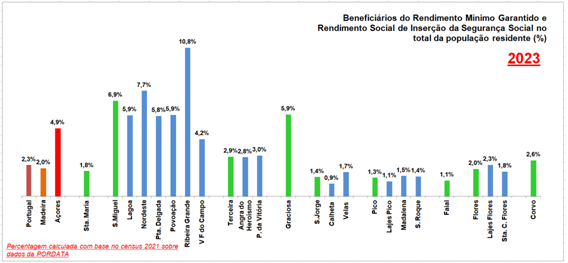
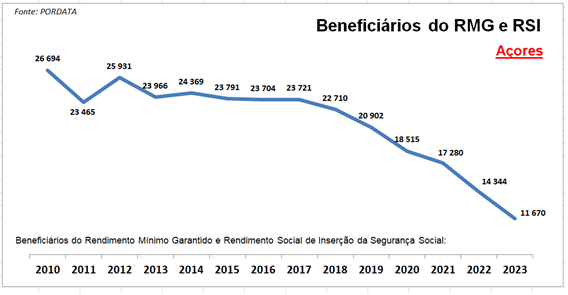
Speaking to the press, Mónica Seidi (Regional Secretary for Health) stressed that there has been a significant reduction in the number of RSI beneficiaries. The figures do not coincide with those presented in the graphs in this article because the statistics released by the government refer only to working-age citizens. In contrast, the statistics presented here refer to all beneficiaries, the data available on the Pordata statistical platform.
However, they also confirm that there has been a significant decrease in the total number of RSI beneficiaries.
More places in Childcare Centers
The government also promptly announced that “an additional 444 places will be provided in the crèche system to cover the start of the 2023/2024 school year, on the islands of São Miguel, Terceira, Faial, Pico and Santa Maria”.
It’s a commendable measure, even though circumstances pushed it through, and apparently, it doesn’t correspond to a political project, but it’s still appreciated. It remains to be seen whether they will be enough.
Numbers remain the highest in the country.
But if we look at the bigger picture, without the noise of partisan debates, we see that a lot needs to be done in this area. The tables show that even with the recent decreases, the Azores still have high numbers, especially on the island of S. Miguel.
Ironically, the island with the greatest resources and dynamic economy has the highest poverty levels. In fact, this problem goes back a long way, always excused by the situation inherited from the times before autonomy. Still, the truth is that independence is several decades old, and not enough attention has been paid to this phenomenon that weakens us, especially when compared to the country as a whole and the Autonomous Region of Madeira.
The introduction of the RSI, formerly the Guaranteed Minimum Income, was a far-reaching social measure that had the merit of lifting many people out of poverty and resolving many hunger situations. It didn’t solve all the problems, but it did ease consciences.
CHEGA doesn’t deserve much praise for bringing it into the limelight in such a harsh manner, but they did get one of the most sensitive issues of the Azorean public cause into the public arena.
There hasn’t always been courage. But it’s time to break with the government’s pattern of opting for works that win votes and direct investments towards projects that bring wealth and social balance.
Rafael Cota, independent journalist
The two graphs, in Portuguese, indicate the number of folks receiving social assistance in the Azores.
Translated to English as a community outreach program from the Portuguese Beyond Borders Institute (PBBI) and the Modern and Classical Languages and Literatures Department (MCLL) as part of Bruma Publication and ADMA (Azores-Diaspora Media Alliance) at California State University, Fresno, PBBI thanks Luso Financial for sponsoring NOVIDADES.

 Novidades - The Islands and the Diaspora