

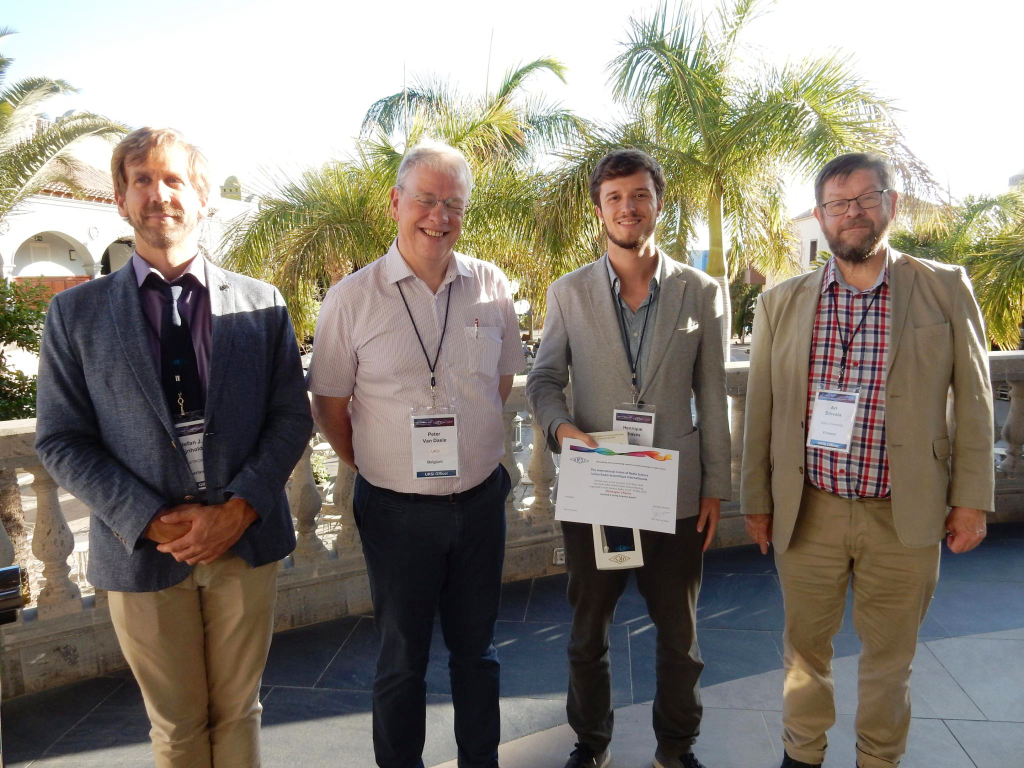
“I believe that my research could be useful for technological innovation in the region, especially in the aerospace area, and for the creation or establishment of companies in the future,” says the young Azorean researcher from Santa Maria Island.
Correio dos Açores – From the island of Santa Maria to the city of Aveiro. How did you become interested in electronic and telecommunications engineering, and what is your academic career to date?
Henrique Chaves (Researcher): Ever since I was little, I’ve been interested in extracurricular activities and curious at home about the workings of technology and the innovations we could expect in the future.
My secondary school teachers were fundamental in developing this interest, encouraging me to explore new inventions, applications, and technologies. The opportunity to participate in the Summer Academy at the University of Aveiro, provided by the municipality of Vila do Porto, was decisive in directing me toward telecommunications.
I completed my Integrated Master’s Degree in Electronic Engineering and Telecommunications at the University of Aveiro in 2022. Since 2021, I have been part of the Radio Systems Group at the Telecommunications Institute, the same higher education establishment. I’m in the 2nd year of my PhD in Electrical Engineering, which I started in September 2023 at the University of Aveiro.
What are your areas of interest within the context of research?
My main research interests are in Wireless Power Transmission (WPT) using radio waves and low-speed, low-power satellite communications. These areas are crucial to the development of efficient telecommunications solutions.
What work have you been doing recently, and what are your future goals?
I have been studying, evaluating, and integrating real-time energy monitoring and control systems to increase the efficiency of existing solutions. My work also involves integrating renewable energy sources powered by batteries, which are essential to meeting the needs of satellites in Earth’s and the Moon’s orbit.
In the future, I would like to apply this knowledge to satellites, contributing to more sustainable and efficient missions.
In May of this year, you took part in the 4th URSI – Atlantic Radio Science Conference, which took place in Gran Canaria (Spain), receiving the Young Scientist award for your work “Development of Adaptable Feedback Channel for Wireless Power Systems.” Can you describe this experience and explain your award-winning work?
It was an honor to receive the Young Scientist Award at URSI. The conference was an excellent opportunity to meet renowned researchers and learn more about advances in my field. I’m very grateful to everyone involved in this recognition, especially the International Union of Radiosciences (URSI) and the URSI Portuguese Committee, for the dynamic opportunities they provided.
This achievement would not have been possible without the support and guidance of my supervisor, Professor Nuno Borges Carvalho, and the invaluable contributions of the University of Aveiro and the Telecommunications Institute.
The paper I presented was in Commission A – Electromagnetic Metrology, focusing on developing an adaptive feedback communication module for different Wireless Power Transmission (WPT) systems. In WPT systems, it is crucial to obtain information about the energy collected, locate the device, and provide this data to the transmitter. My work and that of the group I’m part of aims to demonstrate a complete system in which the adaptive Feedback Channel module I presented fulfills all these objectives, allowing for more efficient and precise energy transfer management.
Your course also includes a lot of CanSat competitions. What is the level of your participation?
I took part in the CanSat competition for the first time in 2015, during high school. It was my first practical experience in the technology field, giving me an essential basis for the course I would follow. A year after completing my master’s degree, Professor Juan Nolasco (a former teacher at the Santa Maria school who has encouraged several teams to participate) challenged us to form a team of engineers from Santa Maria to participate in a European university CanSat competition. The support of the University of Aveiro and the Telecommunications Institute was fundamental to this project. We brought together students from the necessary areas of the project: mechanics, electronics, software, and management. With the Bei-Sat prototype, which was very flexible and met the objectives efficiently, we presented an organized team and an innovative structure.
This year, 2024, we were selected to take part in the world finals organized by the WCRC consortium, and I was given the challenge by the Telecommunications Institute and my supervisor, Prof. Nuno Borges de Carvalho, to coordinate the organization of the event together with my PhD colleagues. I helped the students reapply their knowledge to the prototypes and exchange innovative ideas with teams from different countries: Portugal, India, Serbia, and Romania. The event was organized at the military base of São Jacinto, Aveiro – Infantry Regiment No. 10, to whom we are incredibly grateful for their availability. We also had the support of a drone company – AEROPROTECHNIK, and an internet service via StarLink provided by IT. I could hold a successful event where I gained much experience dealing with new challenges. I would also like to thank the other partners who made the event possible.
Do you intend to return to the Azores? In what way could your research have an impact on our region?
Returning to the Azores has always been a childhood dream and is part of my professional goal. The experience I’ve gained, both on and off the island, has shaped my future vision. I believe that my research could be helpful in terms of technological innovation in the region, especially in the aerospace area, and for the creation or establishment of companies in the future. In addition, I also hope to contribute to the training of new students who gain some interest in these areas or who can understand their professional desires.
José Henrique Andrade is a journalist for the Correio dos Açores newspaper-Natalino Viveiros, director.
Translated to English as a community outreach program from the Portuguese Beyond Borders Institute (PBBI) and the Modern and Classical Languages and Literatures Department (MCLL) as part of Bruma Publication and ADMA (Azores-Diaspora Media Alliance) at California State University, Fresno, PBBI thanks Luso Financial for sponsoring NOVIDADES.

 Novidades - The Islands and the Diaspora