

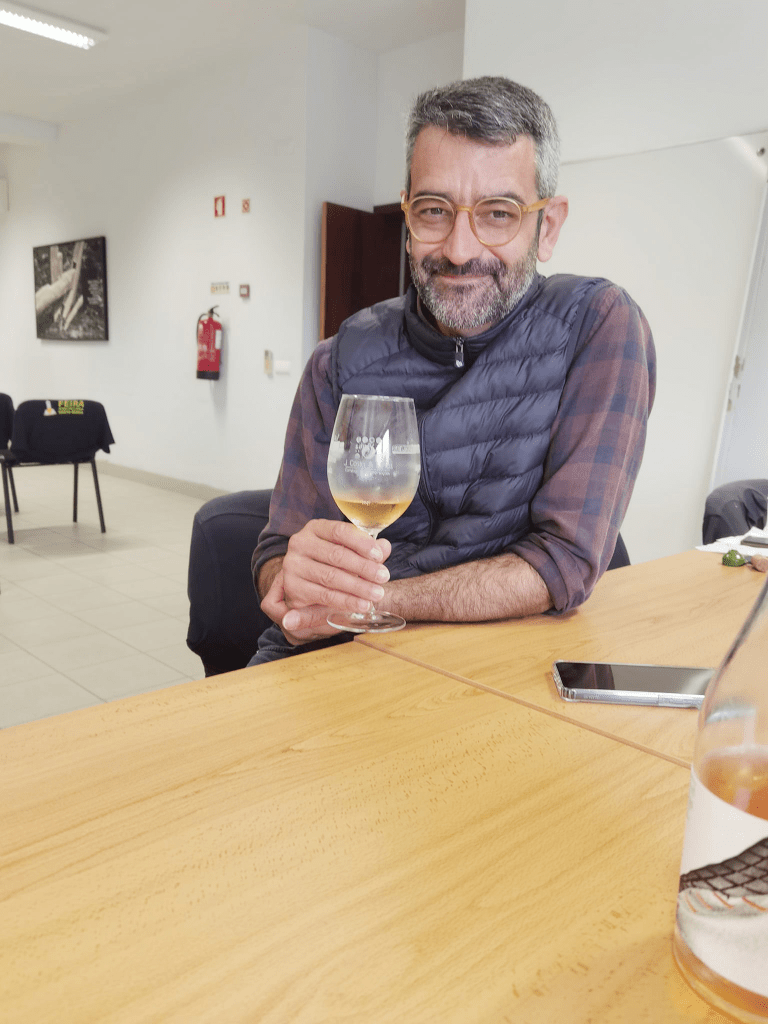
Correio dos Açores – Can you tell us a little about the history of viticulture on the island of Santa Maria?
Rui Andrade (winegrower and researcher) – Winegrowing on the island of Santa Maria began with the island’s settlement in the 15th century. At that time, wine consumption was already well-established in Portuguese culture and was an essential product for the island’s lifestyle. But, above all, it was an added value when it came to fulfilling the island’s mission as a supply platform for the ships that passed through.
Wine was thus used for local supplies, for sale, and even as a bargaining chip for other products that were in short supply on the island. The importance of this activity can be seen precisely from the area where vines were planted, which, a century and a half after the settlement, we know was the same as it is today, i.e., the entire slope of the island, except the west coast.
There are even cave-type wine presses all over the island, unique in the Azores. These demonstrate precisely the antiquity and importance of this sector on the island and archipelago. When we talk about viticulture in Santa Maria, we talk about vineyards planted on terraces on the hillside, sometimes with a slope of more than 45º, giving the landscape a unique beauty. As the more fertile and flatter land was reserved for wheat, the hillsides were set aside for vineyards. A peculiar type of viticulture carried out in extreme conditions, which the World Organization of Vine and Wine has defined as Heroic Viticulture.
Wine growing continued until the middle of the 20th century, although it underwent several phases. The most recent was the “Vinho de Cheiro” phase, made from an American grape variety that replaced the pre-existing European varieties decimated by phylloxera in the 19th century.
The activity declined, especially in the last fifty years. There were several reasons for this: lack of mechanization, mass emigration to the USA and Canada, and a local economy that moved towards the tertiary sector due to the importance of its international airport.
Looking back to think about the future. Can we say that your research work and passion for the subject are essential to understanding this process of vineyard recovery?
As I have a degree in History and a particular fondness for the history of my island, as well as being a small wine grower, I have dedicated myself to discovering more about our vineyards, which are so peculiar and a vibrant heritage for Santa Maria. I haven’t published anything; I’ve just collected some documents and information that have helped me better understand all that heritage. I have a blog called “Poça das Pipas,” where I appeal to preserve Santa Maria’s wine-growing heritage. At the same time, I collaborate with the whole project to enhance Santa Maria’s wine-growing landscapes. I think we should all make our contribution, and this is mine.
Can you give an overview of the activities carried out on the island in the field of wine-growing? What is your assessment of this year’s harvest?
This year was a good year weather-wise for the vines. However, there wasn’t much quantity, especially in the red varieties. In other words, the grapes were of good quality but in short supply. Moreover, it wasn’t a good year for viticulture because pests badly affected it. And this didn’t just happen in Santa Maria; it happened all over the region. Other problems also affect us, such as the lack of manpower, but the road is traveled, and for each issue, we will find a solution until we reach a good port.
Other activities that have taken place as part of this project to enhance the value of the stalls include training for winegrowers by the Santa Maria Agricultural Development Services and the Santa Maria Agricultural Association and several conferences on viticulture, particularly heroic viticulture.
This year, the Santa Maria Agricultural Association organized a trip for winegrowers to learn about similar realities, such as Ribera Sacra in Galicia and Agromariensecoop setting up a winery, which, although temporary, is working at Incuba+, which has improved conditions for making our wines.
José Henrique Andrade is a journalist for the newspaper Correio dos Açores-Natalino Viveiros, director.
Translated to English as a community outreach program from the Portuguese Beyond Borders Institute (PBBI) and the Modern and Classical Languages and Literatures Department (MCLL) as part of Bruma Publication and ADMA (Azores-Diaspora Media Alliance) at California State University, Fresno, PBBI thanks Luso Financial for sponsoring NOVIDADES.

 Novidades - The Islands and the Diaspora