


“There are farmers who come to Terra Verde Association to express their interest in having an area of horticulture on their farm and are discouraged when they find out about the support,” says Manuel Ledo on the subject of World Organic Farming Day.
Correio dos Açores – How big is organic production in the Azores?
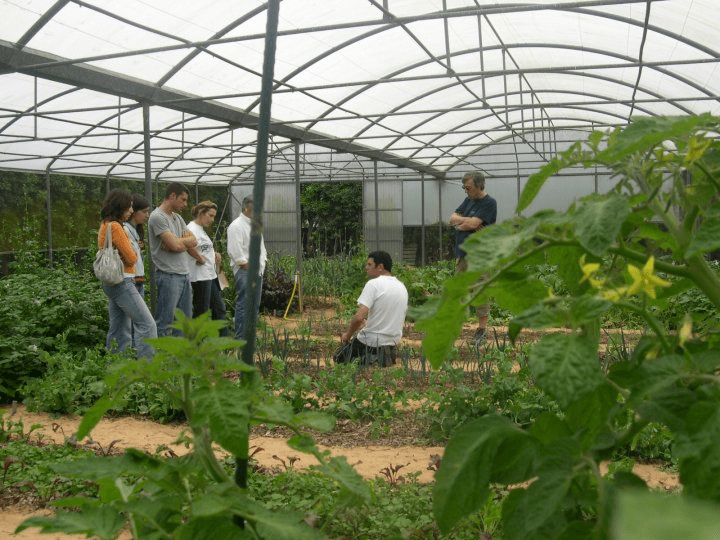
Manuel Ledo (President of Ilha Verde – Association of Agricultural Producers of the Azores) – There are many organic producers in the Azores, but in the livestock sector. In the area of fruit and vegetables, the number is minimal: in the area of vegetables, on São Miguel, we have about seven producers; on the other islands, there are two or three on Terceira; and on Faial, perhaps one or two.
It should be noted that two associations in the region are dedicated to developing organic farming. The Association of Agricultural Producers of the Azores is not exclusively dedicated to organic production; we cover all forms of production, from conventional to organic, and even some other forms adapted to the Azores.
What difficulties do you face in expanding the production of organic products?
The biggest difficulty is the cost of production because all the work done in organic farming requires much more hours. Another issue that puts some people off organic agriculture is that very few consumers adhere to this type of farming, which means that 90% of the producers who practice it sell the product as conventional.
In this sense, it can be said that if the conditions are not created for the product to reach the consumer at a much more affordable price, it will be tough for this form of agriculture to advance. Nevertheless, there has been support. This proves that some producers are interested in selling organic products. The biggest problem is that they don’t know where to sell because I repeat, the price is much higher than conventional. I can tell you that I have a son who does organic farming, but that’s not enough because between 80% and 90% of organic farming is sold as conventional, which is basically the same.
There is a tiny niche of consumers of organic agricultural products, at least as far as São Miguel is concerned.
Is the same true of the other islands?
Terceira is an example because organic farming has been practiced for many more years than in São Miguel. There is an individual, Mr. Ormonde, who belongs to the Agricultural Association of Terceira Island, who I would call an aficionado of organic production, who has already managed to carve out a niche in the ‘off-island’ market. On the mainland, I don’t think there are any imports or exports from our territory. Therefore, as an expert in organic production, he has already managed to make sure that, as we say, there is an ‘off-island’ market. As far as restaurants are concerned, there are already restaurants in Terceira that use organic products.
Are the governmental incentives encouraging?
You could say that support for those who practice organic farming has increased. The support is more geared towards livestock farming because it has the most organic production units. So there is an increase in this agriculture, and, of course, by extension, it also reaches horticulture.
For conventional horticultural agriculture, there is little support from the government. In fact, horticulture is the poorest of all agricultural sectors and needs to be looked at differently to progress. However, the government is reluctant to listen to our association’s proposals. So, based on the little they give us for conventional agriculture, we will make a 10% increase. We should receive 2,500 euros per hectare for each of the three sectors. Currently, the amounts are distributed as follows: for Horticulture, 1,150 euros per hectare; Floriculture, 1,300 euros per hectare; and Fruit Growing, 1,400 euros per hectare.

What else can be done to support organic production?
Firstly, support in marketing and, secondly, make schools and nutritionists aware of the importance of consuming organic products, as they benefit our health. I’ll give you the example of tourists: they seek out restaurants that offer organic products, as well as rent local accommodation where there is organic production, something which, by the way, has been in very significant demand. In fact, tourists are much more aware of health issues and, therefore, know that good health largely depends on what we eat. Thus, on our part (the Regional Government of the Azores), there should be more significant support so that producers can get their product to the consumer at a lower price. Let’s face it, people know how to shop.
Nevertheless, I believe that the view of organic farming is going to change because there is already a lot of talk about it. So it’s something that could happen. Salaries will have to improve, with the support of the increase of 2,500 euros, with the surcharge, and wages will have to go up. That way, the product will be sold at a more affordable price.
Anything else you’d like to add?
I have several points to make. Firstly, I think the media’s role in society is vital. As a very significant influencer, I think the media should pay more attention to livestock farming and horticulture, exposing the problems that this activity and its producers face.
We don’t have anything planned for the European Day of Organic Farming, but that doesn’t mean we don’t want to raise awareness of the problems of organic farming. Unfortunately, we don’t have the funds to put on a proper event. In fact, we’re on our way to October, and the Association doesn’t know about the application it made for this year, which started in January.
Finally, I can tell you that within the framework of the Association, we want to develop a project that has been going on for a few years and has to do with creating a concentration center for vegetables in a cold chain. In this way, we want to bring quality products to the customer, and quality has a lot to do with preservation. As part of the same project, we are also considering an auction-type sale, where producers display their products and consumers can choose. This is one of the main points for our production to be more regulated, for the products to reach consumers in better conditions and, consequently, for these products to result in higher quality food.
Unfortunately, there is no political will to move forward with these projects. Note that around 53% of the resident population of the Azores is from São Miguel; around 70% of the floating population is also from this island; in other words, all the islands have support except Corvo. Politicians don’t look at São Miguel. Most of the subsidies are given to Terceira. I’ll repeat it: this isn’t about political party affiliation but political will. In fact, the government only values cattle breeding. By this, I mean that it is essential to support this type of activity but to warn that there are cycles: we’ve already had the orange and sugar beet cycles, for example.
In addition, São Miguel has a lot of room for maneuvering to increase horticultural activity, but there must be incentives for it to progress. There have been farmers who, with the crisis of change, have come to our Association, showing interest in horticulture. You see, they have hectares of land, so if each gave up a hectare to grow vegetables, this would mean a significant increase in our production and, consequently, lower imports. However, as I said above, these producers don’t venture out because there is no support for vegetable farming.
If the government paid more attention to the Association’s proposals, we would have more producers. The Regional Secretariat for Agriculture and Food places a lot of emphasis on livestock farming but forgets about agriculture. In this sense, I think there should be a greater effort to distribute support more evenly for farming and agriculture. I am also a member of the Agricultural Federation of the Azores, as are many others, and I would like to see a better balance in the distribution of support.

Neuza Almeida is a journalist for Correio dos Açores-Natalino Viveiros, director
Translated to English as a community outreach program from the Portuguese Beyond Borders Institute (PBBI) and the Modern and Classical Languages and Literatures Department (MCLL) as part of Bruma Publication and ADMA (Azores-Diaspora Media Alliance) at California State University, Fresno, PBBI thanks Luso Financial for sponsoring NOVIDADES.

 Novidades - The Islands and the Diaspora