

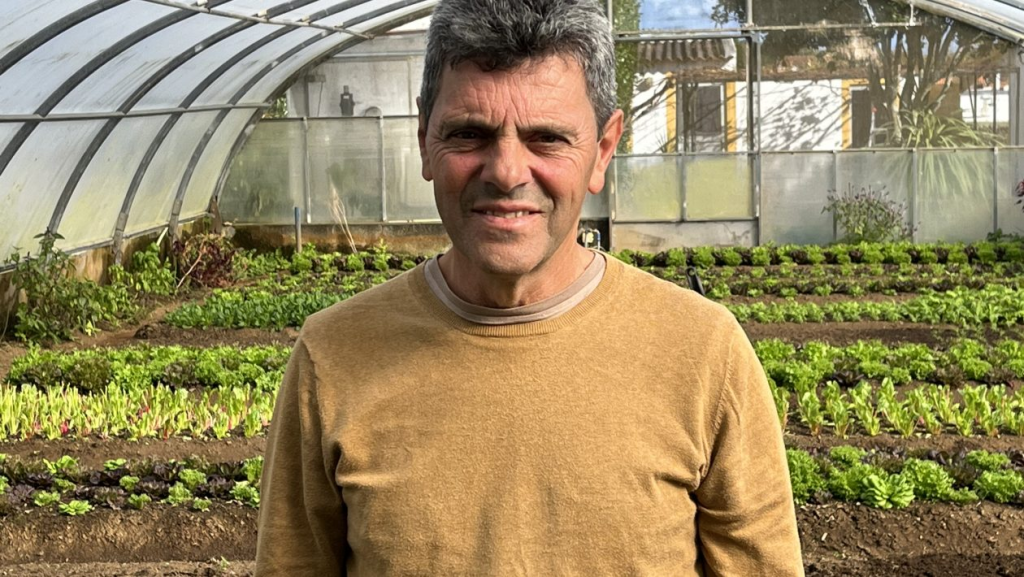
AVELINO ORMONDE, AGRICULTURAL PRODUCER TERCEIRA ISLAND
You were one of the pioneers of organic farming in the Azores 30 years ago. How have you seen this form of production evolve in the region?
30 years is a long time; I think it’s been a slow evolution. It has accelerated somewhat in recent years, but this acceleration is still much less than expected. What justifies the higher numbers in the production areas is the appearance of the milk sector, which is also converting. So the figures are starting to come in. As milk production areas are enormous compared to horticulture, they score more points. When you look at the charts, they’re more impressive because they have high growth percentages, but it has to do with the more excellent introduction of pasture, which makes the figures look better. Evolution has always been at the same slow pace.
Why is the rate of growth so slow? What needs to be done to give it more momentum?
Many things are missing. I, who have been doing this for many years, look down from 10,000 feet. Looking down, I see a lot of fear: fear of decision-makers, fear of farmers, fear everywhere, and fear of change. It’s not easy to change when you’re in a comfort zone, and you’ve been taught to be that way for decades. It’s not easy for those in power because they’re usually only there for a short time, so they only make decisions in the concise term. It’s all about medium- to long-term decisions, there’s a lot of fear of deciding, because they won’t be there, so they only decide on what has an immediate impact. When I give training, I see the fear of change. Even though they’ve seen me doing this for 30 years, they’re still full of fear because when they talk to their parents or grandparents, they convey precisely the same thought of fear of change. It’s good to stay where you are, change is always difficult, it’s always complicated, so people choose to sit on the nail, where it already hurts a bit, but it’s better to sit there than to feel the pain when you leave, and so they stay there. I see it every day, every month, every year.
Do you think we need to create specific incentives for organic production?
It’s funny that you should ask me that because it’s a question that’s always on the menu. I’m not really in favor of significant subsidies. I’m anti-subsidy for those already established, and I favor young farmers, who should be supported once but not remain subsidy-dependent. I don’t think it will always last to have your hand out for northern Europe to give money to the South to survive. We’re going to have to take on that survival ourselves. Incentives could also exist to bring about change by offering some sort of incentive. So many incentives are given to conventional people that we could give them to those who change to do less harm to the planet, their families, and other people’s children. The less they hurt, the better for everyone. There would be more balance. Then it would be worth spending that money on a good change and not on more of the same.
Do you believe that people will be forced to make this change in the future, even if they don’t want to, for environmental and economic reasons?
For example, people may not be forced by governments, but they will be moved by nature. Nature will manifest itself in such a way that they will have to change out of fear of nature so that it doesn’t exalt itself even more and doesn’t destroy even more. The more we heat up the planet, the more everyone already knows the result. Scientists talk and talk and talk, and everyone thinks they’re joking. And so we go on, because day to day it doesn’t hurt, it only hurts more in the long term. We push on with our bellies. Next thing we know, we’ve been living in change, but we haven’t noticed, and we’re leaving our children and grandchildren in a package with a pretty bow, but all contaminated and full of problems. And that’s not what they left us.
Is there a reason for this fear of change? Is it for fear of not being an economically viable form of agriculture?
We are what we want to be; we choose what we want to be and what we want to do. It’s all possible; you must be willing to do it. While you’re looking for justifications of how not to do things so that we can continue with more of the same, it’s easy to justify. Just as it’s easy to start doing. It’s a question of wanting to do it and everyone being aligned to do it. The tendency of those who govern is to do what works. If that’s the case, people vote and continue to govern. We will always be at the mercy of someone’s interests. As long as we are considered economic pawns, as human beings, it will always be like this. We have to change things more directly. Things have to change through schools. The change is dominated by women. They demand more to protect their children. Men aren’t as protective. They are the ones who are going to make the change and demand that those who produce make things cleaner for their children. You have to go out and educate people, but educate in a direct, unpretentious way and do it as a mission and not as a personal interest.
in Diário Insular, José Lourenço-director
https://www.projectomateria.pt/pt/produtores/biofontinhas_100
Translated to English as a community outreach program from the Portuguese Beyond Borders Institute (PBBI) and the Modern and Classical Languages and Literatures Department (MCLL) as part of Bruma Publication and ADMA (Azores-Diaspora Media Alliance) at California State University, Fresno, PBBI thanks Luso Financial for sponsoring NOVIDADES.

 Novidades - The Islands and the Diaspora