

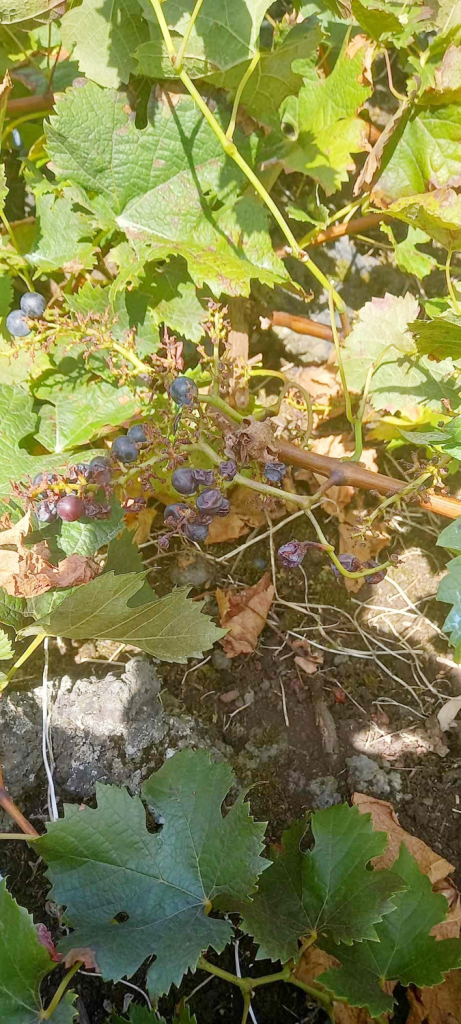
Damages are substantial for the Island of Pico.
Secretary for the Environment and Climate Change says they don’t have the basis to formulate an opinion.
Correio dos Açores – What is your assessment of this year’s grape production?
Losménio Goulart – This year has undoubtedly been the worst year ever because we’ve never had so much cultivated area in production with such low output per cultivated hectare.
We’ve had less in absolute terms, but in terms of quantity per cultivated hectare recorded by the Azores Regional Wine Commission (CVRA), it was the worst year ever.
The CVRA received around 150 tons of grapes from all over the Azores, which is clearly not enough. The Picowines Cooperative received around 120 tons. Despite the appearance of new economic agents in this area, the Cooperative maintains a ratio of 50% of the total from the Azores.
Despite being the worst year ever in terms of quantity produced per hectare, we have excellent grape quality, healthy grapes, no rot, and no major diseases. In contrast to the amount produced, there has been an increase in the value of the grapes. It’s a way for the Cooperative, the Board of Directors, to value the low production that our members are having and to minimize losses. This increase, on top of other increases in the finished product, cannot be attributed to production. It will have to be allocated to another item because the market and our distributors are unlikely to accept a third sharp rise in the price of our wines.
Unfortunately, the aid granted doesn’t cover operating costs and consecutive years of low production. As a result, many farms are running deficits and are even at risk of being abandoned. Here, I would suggest to the Regional Secretary and the Regional Directorate for the Environment that there should be tighter supervision, probably with the same funds, but given to people who take viticulture seriously, and reward them to the detriment of others who, with little work and minor handling, manage to get the same kind of support as those who do it thoughtfully and honestly.
Has there been an increase in the production area in Pico?
The production area hasn’t increased in the last three years because there hasn’t been a program to encourage this conversion. The VITIS program had almost no take-up because it was no longer possible to apply for abandoned areas, but only for places already in production, so take-up was low.
We conclude that the Secretary must have understood the situation since he had already publicly stated that the game rules had changed and that the Region and the Regional Secretariat for Agriculture and Food would be responsible for the VITIS program.
We again believe that by returning to the previous model, which is to consider old vineyards, even those that are abandoned or those that have had vines in the past, even though they don’t have them now, we will have more candidate areas.

What do you think of the statement made by the environmental associations blaming pests for the low production of this year’s harvest?
The environmental associations’ communication is based on a study. Which study are we talking about? How long ago were these studies carried out? What method was used in these studies? What were the factual conclusions drawn from this study?
The truth of the matter is there for all to see. Those who don’t want to or who don’t get up early can’t see it because if you go to a vineyard at seven in the morning, the evidence is there. There are photographic records and videos sent by various members of the winery from different parishes that show the damage done to these protected birds, which have an uncontrolled population.
It is atrociously ignorant to discuss methodologies for vineyards such as nets, scarecrows, and cannons (which only cause noise pollution). Only someone utterly unaware of Pico’s viticulture can suggest such methodologies.
The winegrowers have indeed made an effort with the Regional Secretariat to change methodologies so that the populations of invasive species and protected species can be controlled.
The environmentalists are relying on an inconclusive study carried out in 2016. Eight years have passed from 2016 to 2024, and the populations of protected species and predators have increased exponentially year after year. So, we are falling victim to pests from non-protected species and have protected species with completely uncontrolled populations.
What we’re asking for isn’t annihilation and slaughter; we’re asking for populations to be controlled, even of protected species that have become predators.
The year went badly because there was too much rain during harvest. The weather was inconsistent, with rain and sun all on the same day, so the treatments carried out on the vines couldn’t withstand these conditions. In other words, it was already bad at that time, at the end of April and the beginning of May, and then, on top of that, the few grapes that escaped had predators all over them.
The Regional Directorate for the Environment was here in Pico. They carried out a study during the harvest, but they arrived at the vineyards at 9 a.m./9.30 a.m. My vineyard was identified in the Candelária area, others in São Mateus and Santa Luzia.
You can’t count birds at 9:30 a.m., but it has to be early, by 7.30 a.m., because that’s when these species are out and about. By 9.30 a.m., they’re already in bed with full bellies.
This study needs to understand the methods used, which vineyards were identified, and the locations. Environmentalists have listed several factors in their communiqué that do not belong to serious people.

José Henrique Andrade is a journalist for the Correio dos Açores newspaper-Natalino Vivieiros, director.
Translated to English as a community outreach program from the Portuguese Beyond Borders Institute (PBBI) and the Modern and Classical Languages and Literatures Department (MCLL) as part of Bruma Publication and ADMA (Azores-Diaspora Media Alliance) at California State University, Fresno, PBBI thanks Luso Financial for sponsoring NOVIDADES.

 Novidades - The Islands and the Diaspora