


The leader of the PS/Açores, Francisco César, committed yesterday at the party’s 19th Congress that, within a generation, the region would lead the country in economic and social indicators. He said that to achieve this goal, “in addition to the necessary reform of the political and governmental system and the transparency of governmental acts,” he listed three regional goals that are “structural for the development of the Region.”
He considered that “the low levels of schooling and educational attainment are not compatible with the region we want for the future, and perpetuate a cycle of poverty that we want to break.”
That’s why, he advocated, “we want to establish a Social Pact, with everyone’s participation, to turn this persistent situation around and bring back those who once decided to leave school, or those who are in school and don’t want to leave!”
This Social Pact, according to Francisco César, “will be made up of partnerships between the Regional Government and that of the Republic, the educational community, the Municipalities, the Parishes, civil society, Private Social Solidarity Institutions, companies and the cultural and sports associative movement.”

“We want to create a Full-Time School” that ”will work – using what we know of good educational practices, with results in other countries and on the Portuguese mainland – as a child’s tutor, accompanying them in the main moments of their day, throughout their growth, encouraging new forms of literacy, including digital literacy and, in addition, the ambition and security necessary for a good school career; that excludes no one, a School open to the communities; a School open to the future so that it can itself induce a New Future for the Azores.”
He considered “the insensitivity that the Regional Government is showing towards the housing problems of displaced students from higher and professional education to be unexpected and shocking.”
In his opinion, such an attitude, “in addition to the blockages it represents for families, could set the region back decades in terms of its qualification levels and disappoint the legitimate expectations of young Azoreans to take a course outside their area of residence.”
“A room for a displaced student, with an average price of 400 euros per month, is not compatible with the income of Azorean families and is taking hundreds of young people out of higher and professional education,” he said, going on to stress that ”a regional government that doesn’t understand that this is a structural and urgent problem to solve is a government that is completely unaware of what is happening to Azorean families and what matters most to our collective future.”
He also considered that the region currently has “a severe problem” regarding housing.
“Coupled with the lack of supply of properties on the housing market, the prohibitive sale prices, associated with loan interest rates that are still very high, have made this asset, which should be a right, inaccessible not only to the poorest classes, but also to practically the entire middle class,” he said.
For Francisco César, housing, “unfortunately, has become just a business instead of, above all, a right.” The PS/Azores leader explained the statement: “Much of what little has been built in the Azores in recent years has been absorbed by external demand or by local accommodation, driving up the average price of housing and making the rental market unattractive about the cost of acquisition.”
He said that the PS governments had provided the PRR with “historic” funds to invest in housing in the Azores, “but unfortunately, for the Azoreans, the low implementation of this community program by the current Regional Government of the Azores makes us fear that much remains to be done…”.
In his opinion, the current government of the Azores “has neglected the need to strengthen and extend the public housing stock to the middle classes as well.” He considered that, for young people, the situation “is even more dramatic. It’s unacceptable that practically an entire generation, the most qualified ever, should be deprived of their emancipation, of giving stability to their lives, their jobs, of starting a family, until they’re close to 40, because they can’t afford to buy or rent a home.”
According to Francisco César, the PS “is sensitive to this reality and will, even in opposition, present alternatives and projects to overcome these blockages!”
Throughout his speech, he considered that the Azores “need to innovate, modernize, establish partnerships with the outside world to develop and add value to our agriculture, fisheries and tourism, and to add a fourth pillar to our economy, based on knowledge and entrepreneurship: the sea, digital, science applied to the economy, decarbonization and the energy transition.”
He considered that “it will only be possible to achieve a New Future for the Azores if we have a strengthened and capable PS, focused on action, cohesive, civically and politically committed! A PS in love with the Azores and with the hearts of its fellow citizens!” He stressed that the New Future that “we seek is not that of a single person or a single island, of a few people or a few islands! It is a New Future for everyone; a New Future, from Flores and Corvo to Santa Maria, passing through the mainland and our diaspora, wherever there is an Azorean.”
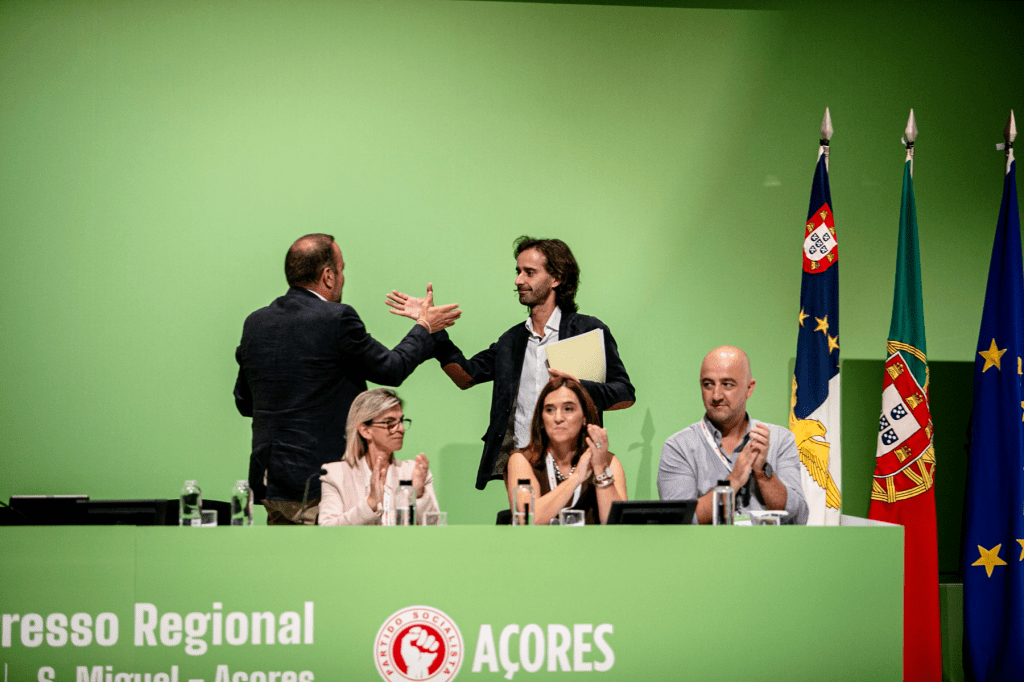
“Aware of our history, of our errors and omissions and of our victories and successes, we are the Socialist Party, the party that will increasingly be the regional party and the party of Azorean sentiment,” he stressed, before committing himself to ”a New Future for the Azorean People.”
Francisco César began his speech by clarifying that the PS “is the largest political party in the Azores!” He then defined the Azorean Socialists as “autonomists! Optimists! Universalists and cosmopolitans!”
“We believe that there can be no developed societies without social justice, freedom and equal opportunities,” he said.
“We don’t believe, as the right does, in the individualistic and reductive perspective that the well-being of some is achieved at the cost of admitting the detriment of others, as if inequalities were the engine of progress and that the benefit of some must correspond to the detriment of others. We do not accept that some Azoreans are treated as if they had more right to opportunities than others. We don’t accept some islands being forgotten so that others can benefit,” he added.
He referred to the position, “motivated by Chega and supported by the Regional Government” of “removing” children between the ages of 3 months and 3 years from nursery schools in order to place other children because of the lack of places in these establishments, instead of mobilizing all the resources to provide the necessary responses to ALL our children and their families. This means that there really are differences between what this government is doing and what the Socialist Party would do if it were the government,” he stressed.
He pointed the finger at the “divisive sentiment, fostered by the actions” of the current government, “of one island against another, with an exacerbated and unhealthy parochialism.” Then he stressed that “we are not on that side, which is holding us back and dividing to rule.”
He stressed that the Azores “have the second highest rate of Early Leavers from Education and Training in Europe (21.7%)” and referred to the rate of young people who “don’t study or work, which is around 15% and a President of the Regional Government who says of these young people that they are ‘a bad example of citizenship’, instead of acting relentlessly on the reasons and causes of these phenomena.”
“We are different and, I am convinced, different for the better!” he stressed.
He considered that “it’s time for the government to govern and it’s time for it not to apologize to other times and other governments!”

In his speech, Francisco César pointed out that the current coalition government has increased its debt to the banks by 260 million euros in the last 18 months, around half a million euros a day, even though tax revenue in 2023 has increased by around 120 million euros compared to 2020.”
“They pay nothing to anyone, with 100% investment budget cuts: to sports clubs, companies, individual entrepreneurs, IPSSs, displaced patients, health providers, cultural agents, and citizens. In the meantime, they have vainly lowered tax revenues, brutally increased spending on government offices, and appointments of so-called “technical experts,” he stressed.
He focused on the “mismanagement of health,” which, for the Secretary of Finance, was due to “the lack of financial control of the Government of the Republic and the European Union.” At the same time, the Secretary of Health amended that “the Government of the Republic cannot be at fault, since no inventory of the costs of rebuilding our hospital has yet been calculated or sent to the Prime Minister.” What the PS does know, Francisco César stressed, is that “we won’t have a functioning hospital any time soon…”
He considered the revision of the Social Mobility Allowance “a moment of unpreparedness, disorientation and lack of coordination between the Regional Government and the Government of the Republic.”
He pointed out that “despite promises that no Azorean would have to pay more for a trip to the Portuguese mainland, this is not going to happen.” In this context, the Socialist Party “is committed to using all the legal mechanisms at its disposal, here and in the Republic, to prevent these changes from harming the mobility of Azoreans.”
Referring to the PS, he repeated at the Congress that “the worst mistake the PS/Azores could make, in this new phase of its history, is to make its future the defense of our past.” He advocated an “evolution” in socialist policies in the region “to discuss new directions for Autonomy and even, in some cases, to assume ruptures,” he concluded.
He addressed the Azoreans’ lack of credibility in politics. “I’m often told in the street that politicians must do something different. That people are tired of politicians’ jargon, of sterile and incomprehensible party bickering, of long adjectival speeches and of measures presented in bulk, at the whim of the customer, which glitter in their presentation but always disappoint in their implementation.”
He believes that “in a full and dignified Community, a citizen should have the right to be protected and helped in the face of misfortune.”
“And, in truth,” he concluded, ”the breakdown of this social contract has led to disbelief and disappointment on the part of the people with the political class and continued hopelessness about the future. And the people are right! We need to believe again. We have to make people believe again!” he said.
At the 19th PS congress, he promised to “do things differently, so that we have different results for the better. This is an obligation that must be strengthened.”
“A New Future that looks at poverty, not with charitable tics that only solve instant difficulties, but with the firmness of a sure hand to help lift those of us who need to get up off the ground and carry on!”

in Correio dos Açores-Natalino Viveiros, director
Photos from the PS-Açores Facebook Page
Translated to English as a community outreach program from the Portuguese Beyond Borders Institute (PBBI) and the Modern and Classical Languages and Literatures Department (MCLL) as part of Bruma Publication and ADMA (Azores-Diaspora Media Alliance) at California State University, Fresno, PBBI thanks Luso Financial for sponsoring NOVIDADES.
 Novidades - The Islands and the Diaspora