

The Government of the Azores announced yesterday that if the region’s tax collection system is based on the capitation model, revenue will increase by around 180 million euros in 2025.
However, if the Republic does not agree to the Azorean government’s proposal, the region will have to go into debt for 150 million euros. This money is considered essential to carry out the investments planned in the Recovery and Resilience Plan in 2025. It is estimated that this debt will cost 30 million euros.
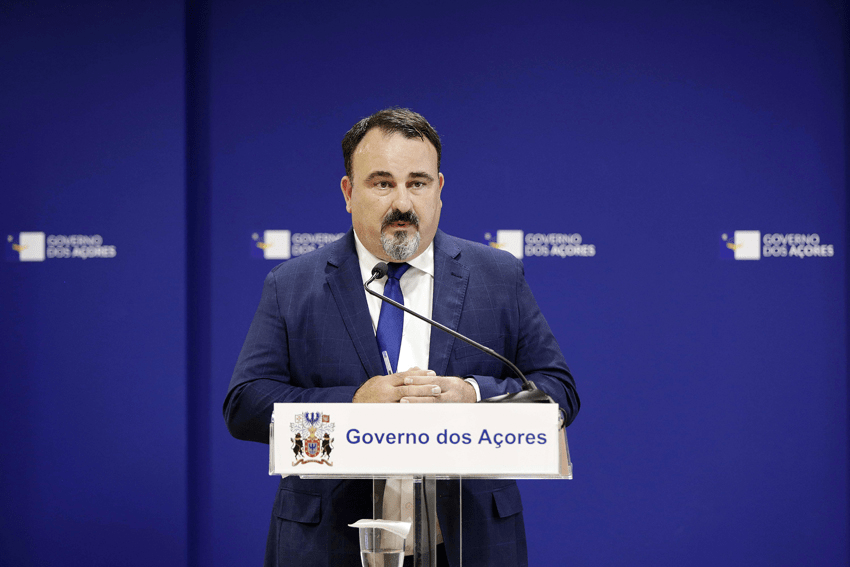
The Secretary for Parliamentary Affairs and Communities, Paulo Estêvão, announced the announcement during the presentation of the main guidelines for next year’s Plan and Budget.
The region’s budget for 2025 will be 1,913 million euros. The projected revenues in the Azores will account for 53% and correspond mainly to tax revenue. Transfers from the 2025 State Budget to the Region will amount to 346 million euros and EU funds will amount to 400 million euros.
To implement this budget, the Government of the Azores admits that “it may be possible” to change the tax revenue calculation model this year and return to the calculation model in force before the Troika and the measures implemented (before 2013). This means going back to higher taxes.
From the year of the Troika, overall VAT revenue (tax system) was distributed according to the percentage of the national population. This change meant a new calculation factor was added to the regional transfers, ” not just the capitation but also considering the differential between the Autonomous Region of the Azores and the Republic.
In other words, whenever the Azores lowers its taxes, the Republic “imputes this responsibility to us, takes this amount from us.” In other words, even though the Constitution states that the Republic “is responsible for building a model to overcome many of the constraints related to insularity,” according to the Troika model that has been in force for more than 10 years, “every time we reduce fiscal pressure so that we can foster economic growth and relieve families in the Azores, every time we do so, this means a reduction in state transfers to the Autonomous Region of the Azores,” explained Paulo Estêvão.
What the Azorean government wants “is for this model to be revised this year and if this revision is carried out in the way it was until 2013, this will mean an increase in revenue of more than 150 million euros. “And this amount is crucial and very important” for the Azores, stressed Paulo Estêvão.

If this result is not achieved, the Azorean government will have to take on 150 million euros in debt, which, according to Paulo Estêvão, “is absolutely essential if the RRP is to be implemented.”
This has not been the Azorean government’s policy. Still, in 2025, the debt “is essential” because, according to government calculations, “if we want to implement the RRP, we have to have access to a sum of around 150 million euros, which is the debt we will incur if we don’t manage to change” the tax system.
Paulo Estêvão pointed out that the government of the Azores “is optimistic and believes that we will be able to change the VAT revenue calculation model and obtain this increase in revenue that is defined by the Republic.”
An increase in revenue through taxes of around 150 million euros “not only means that the region will not be in debt by 150 million euros, but it also has a very positive factor, which is to increase our revenue. This will allow the Azores to finance its budget more significantly with its revenue, which is also crucial.
The 150 million euros, either through revenue or debt, is also necessary from another perspective. The fact is that the revenues in the 2025 budget are around 1,017 million euros less than the operating expenses, which are 1,094 million euros. If we change the formula for calculating VAT, “own revenues will exceed operating expenses,” in the words of the Azorean leader.
Paulo Estevão also made it clear that the 30% tax differential will be maintained in the region’s budget for 2025, despite the fact that the reduction in taxes at the national level also represents a drop in taxes in the Azores.
He announced that the region’s budget for 2025 foresees an increase in health funding of around 50 million euros and 20 million euros for education.
In Correio dos Açores-Natalino Viveiros,-director
Translated to English as a community outreach program from the Portuguese Beyond Borders Institute (PBBI) and the Modern and Classical Languages and Literatures Department (MCLL) as part of Bruma Publication and ADMA (Azores-Diaspora Media Alliance) at California State University, Fresno, PBBI thanks Luso Financial for sponsoring NOVIDADES.

 Novidades - The Islands and the Diaspora