

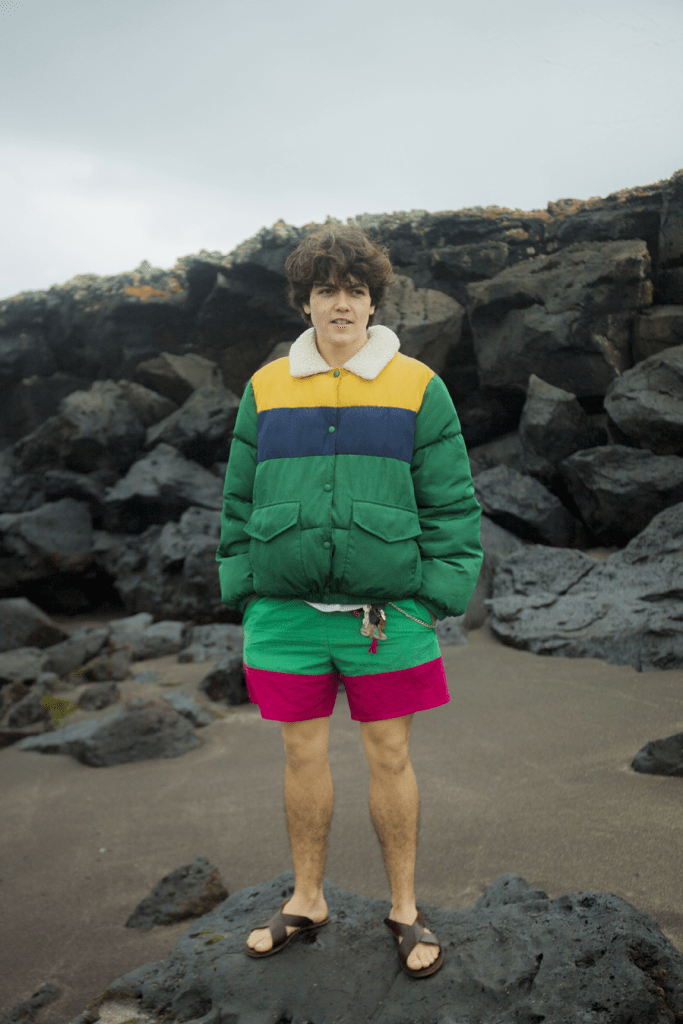
From a community studio to gatherings and workshops, this project is funded by Youth for Autonomous Regions, a European Union support program for young people. According to Cristovão Maçarico, this “is a way of combating certain social issues such as dropping out of school, drug use or lack of interest in culture. To show that music can be a creative and healthy alternative for young people in São Miguel”.
Correio dos Açores – Tell me about the concept of the PLUGG Collective?
Cristovão Maçarico (founder of the Collective): The PLUGG Collective started as a personal studio, which I then began renting out and storing all my equipment in. In the meantime, it became something more significant.
I thought about doing something for the local community because I realized that many young people wanted to make music but didn’t have the space or equipment and wanted to learn more. So, together with some friends, we started creating the PLUGG Collective, a community music studio. We ended up building a kind of community, with people beginning to show up more often.
It’s a studio now where anyone can come, and it’s more aimed at young people who can try making music without any pressure or prior musical knowledge. We’re opening the doors to anyone who wants to take part. Just send an email to coletivo.plugg@gmail.com. You can submit a proposal for a project you want to do or simply show up for the activities we’re going to start doing.
And what are these activities?
We are basically a team of young people. We found support from the European Union, called Youth for Autonomous Regions, which funds young people aged 14 to 25 with a cultural proposal aimed at the outermost regions.
So we got this funding for a project we’re calling “PLUGG Collective Challenges Season,” which will last six months. Practically, it will be a series of workshops and gatherings. We’re bringing regional, national, and international artists to share knowledge and inspire young people. It’s also a way of combating specific issues that matter to us, social problems such as school dropout, drug use, or lack of interest in culture. To show that music can be a creative and healthy alternative for Azorean and Micaelense youth.
What do you hope to bring to the Azorean cultural scene?
We’d like to do something by young people for young people because many things that happen here are not so didactic from the point of view of youth interest. We’d like to see people more involved in culture. We see people experiencing culture in Lisbon, and the people who live here want to leave—they want to go elsewhere. There’s a lack of interest in culture because there are no initiatives to get people more involved.
Maybe we can change how young people think about the island by being in this collective and being together. I even studied abroad, and since I came back, I’ve been told every day, “What are you doing here?” or “Go abroad.” There’s no incentive for young people to think, “I’m going to stay on the island and do something with it.”
What references do you have for national and international artists?
In France, there’s a house called “59 Rivoli”, which is, in a nutshell, a house for artist residencies. It was a milestone and inspired me to create something like this. However, I think that music is something that has a lot of interest in São Miguel because here on the island, we have 75 philharmonic bands, and we have the Regional Conservatory. However, it’s all through very theoretical didactic methods, which proves to be a burden for young people, who often can’t even be tangent with their interests.
What would you say is your biggest dream at the moment?
We’re at the beginning, still expanding. I’d like to do this as the main thing, not just as an extra. I’d like to turn it into an academy, a cultural association that could hold events. Because this support was the first step we took. If it hadn’t been for this support from the European Union, I don’t think the Collective would be much more than this. Most of the team are underage, so in terms of rides, time available outside the studio, extracurricular activities, and economic terms, it’s very complicated to make things happen, especially when we take the time we don’t even have to organize these events.
JHA is a journalist for the Correio dos Açores newspaper-Natalino Viveirios, director
Translated to English as a community outreach program from the Portuguese Beyond Borders Institute (PBBI) and the Modern and Classical Languages and Literatures Department (MCLL) as part of Bruma Publication and ADMA (Azores-Diaspora Media Alliance) at California State University, Fresno, PBBI thanks Luso Financial for sponsoring NOVIDADES.
 Novidades - The Islands and the Diaspora