

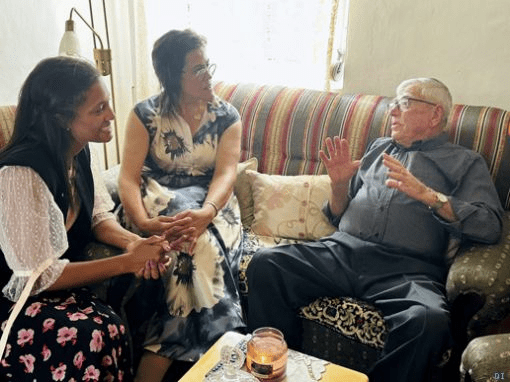
There is a “high demand” for the New Elderly program, which has entered its third phase, said regional secretary Mónica Seidi when she visited a user of the initiative on World Elderly Day (October 1). Manuel Souza Lima has been part of the “New Elderly” program since December 2023.
“The results are clear to see. He had been living alone since his widowhood and has been able to live in his own home, with the support of someone, combat loneliness and work on his cognitive skills. He is very satisfied and well integrated. It reflects well on the acceptance of society and the success of the program,” said the secretary.
“The demand for the program is high and has been rising, with over 500 applications at the moment, which not only proves the success of this work, but also guarantees its continuation, since the availability of vacancies is dynamic. It is, once again, ample proof of this Executive’s investment in people”, according to Mónica Seidi.
The secretary stressed that “this is a program that has changed the paradigm of aging” and that it is “a real success.” Seidi invokes this alleged success to “extend it to all the regional municipalities.”
“We are working with a total of 12 institutions,” said the Regional Secretary for Health and Social Security.
“The number of places available is 221 for this phase. We are very proud to have such a positive effect on people’s lives, particularly those who have worked all their lives and can now enjoy greater comfort,” she said.
The “New Elderly” program will represent an investment of more than four million euros by 2025. The application period for the third phase of enlargement ended on September 13, and the technical teams are currently assessing the more than 500 applications.
NEW REQUIREMENTS
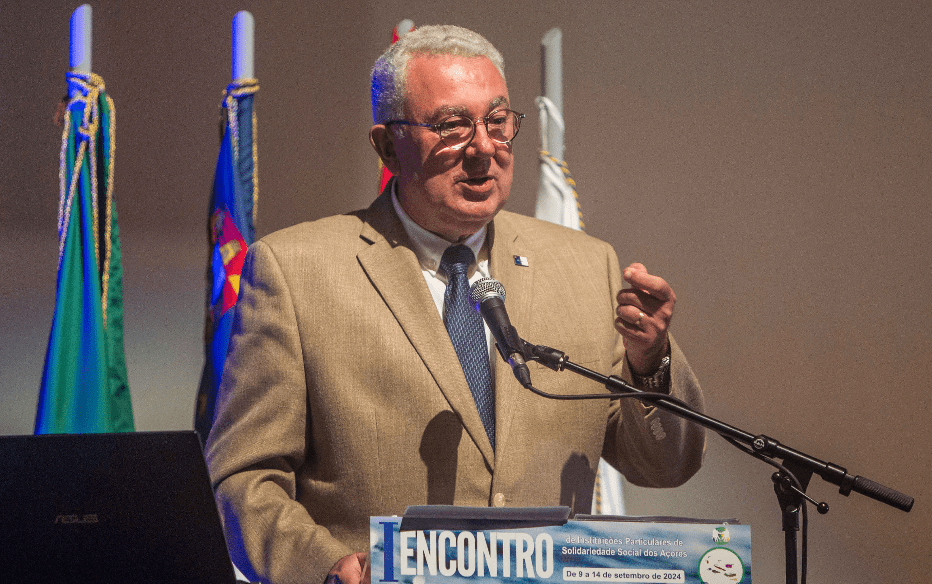
The “New Elderly” program was created in 2022 by Artur Lima, the Vice President of the Regional Government of the Azores. The experimental phase started in Ponta Delgada and Praia da Vitória.
Presenting the initiative, Lima considered that “ageing is one of the main challenges of modernity” and warned that the “Azores must be prepared, with innovative public policies, to respond to the elderly of our nine islands”.
“The elderly of today and the future require a different kind of attention and care. They live longer, are more literate, more traveled and more connected to the digital world,” he said.
The Vice-President pointed out that “Programs and projects that encourage healthy and participatory aging” and that ‘guarantee the preservation of the elderly person’s original social identity,’ keeping them, whenever possible, at home, with their family, are the responses that are necessary to the new demands.
The program has since been transferred to Secretary Mónica Seidi.
In Diário Insular-José Lourenço, director
Translated to English as a community outreach program from the Portuguese Beyond Borders Institute (PBBI) and the Modern and Classical Languages and Literatures Department (MCLL) as part of Bruma Publication and ADMA (Azores-Diaspora Media Alliance) at California State University, Fresno, PBBI thanks Luso Financial for sponsoring NOVIDADES.

 Novidades - The Islands and the Diaspora