

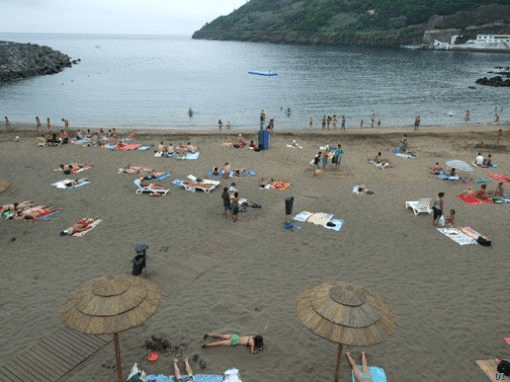
In August, the Azores recorded the highest air and sea temperatures in 83 years. Meteorologist Diamantino Henriques says that the climate is no longer the same as it was 30 years ago and predicts that temperatures will continue to rise.
“August was an extremely hot and generally dry month throughout the Azores. Of particular note were the monthly air and sea surface temperatures in the Azores region, which, like July, reached the highest values since 1941,” reads the August climatological bulletin for the Azores from the Portuguese Institute for the Sea and Atmosphere (IPMA).
According to IPMA’s analysis, there was a “predominance of good open conditions” in August, although “some episodes of intense precipitation, associated with the passage of some fronts.”
“The sea surface temperature recorded its highest daily maximum since at least 1941, reaching 27.3°C on the 25th. In fact, the sea surface temperature field in the Azores region showed positive anomalies of over 2°C in August, reaching 2.7°C, the highest for this month since 1941,” he said.
The air temperature also “exceeded several absolute maximums,” with 31.3°C recorded at the Flores Aerodrome, 30.5°C at the Pico Aerodrome, 30.5°C at the Ponta Delgada Observatory, 29.9°C at Ponta Delgada Airport and 29.6°C at the São Jorge aerodrome.
The average air temperature ranged from 23.4°C in Nordeste, São Miguel, to 25.3°C in Corvo.
The lowest minimum temperature was 17.0°C in Corvo and the highest maximum was 31.3°C in Flores.
For example, the temperature didn’t drop below 20 degrees in Santa Maria in August. “The lowest daily minimum temperature in Santa Maria was 20.1°C, which means a total of 31 days with ‘tropical nights’, i.e., with daily minimum temperatures greater than or equal to 20°C,” explains the IPMA.
METEOROLOGIST WARNS THAT THE SITUATION WILL GET WORSE

According to meteorologist Diamantino Henriques, the Azores have had “a different climate for some time now”.
“The climate is no longer what it was 30 years ago. If we compare the last 30 years with the 30 years before that, the statistics are different. We’re talking about different climates,” he said.
“Even if we have pleasant temperatures here, it doesn’t mean we have the same situation as 30 years ago. We already have very high temperatures, compared to what could be expected in another climate,” he added.
The meteorologist claims that “the tendency is for these situations to get worse”. “This is not the highest of highs. There will be others in the future,” he warned.
In addition to rising temperatures, more extreme weather events are also expected.
“What we’re predicting for the future is that there will be two types of situation and to some extent we’re already seeing this: long periods with little precipitation, the so-called droughts, and short periods with a lot of precipitation,” said the meteorologist.
In a warmer climate, explained Diamantino Henriques, “the atmosphere can contain more water vapor” and “when there are conditions for this water to precipitate, these episodes of more extreme precipitation will occur and will occur with more intensity”.
“At the end of the year, perhaps the total annual rainfall isn’t very different from one period to the next, but its distribution throughout the year is,” he said.
In Diário Insular-José Lourenço-director
Translated to English as a community outreach program from the Portuguese Beyond Borders Institute (PBBI) and the Modern and Classical Languages and Literatures Department (MCLL) as part of Bruma Publication and ADMA (Azores-Diaspora Media Alliance) at California State University, Fresno, PBBI thanks Luso Financial for sponsoring NOVIDADES.

 Novidades - The Islands and the Diaspora